How many times have you felt something deep down?
A gut feeling. A knowing. A quiet nudge that seems to arrive from nowhere.
And how quickly does the second voice follow?
Was that real? Am I imagining this? Is this my intuition, or is it anxiety? Is this spirit, or just my mind?
I've asked myself those questions more times than I could count. And the longer I develop my mediumship, the more convinced I become that the hardest part of this work isn't connecting with the spirit world.
It's learning to trust yourself.
That was the thread running through my Soul Sync conversation with Irish psychic medium Susan Diadem. Susan studied with Mavis Pittilla and Tony Stockwell, is accredited as a teacher with the Spiritualists' National Union, and still describes herself, quite happily, as "a most reluctant medium".
But I've come to think this isn't only a mediumship question. It may be one of the defining questions of how we live now.
We're living through a trust crisis, and it may start closer to home than we think
Every year, the Edelman Trust Barometer asks tens of thousands of people who and what they trust. The 2026 report surveyed nearly 34,000 people in 28 countries and found that seven in ten are unwilling or hesitant to trust someone with different values, backgrounds or sources of information. Richard Edelman called insularity "the next crisis of trust". Here in the UK, 76% of people scored as insular, above the global average.
We're turning inwards, towards our own circles, and away from one another.
But I think there's a quieter trust crisis that never makes the headlines: how little many of us trust ourselves.
Think about how often you reach for something outside yourself before you check in with how you feel. A search engine. A review. A comment thread. An AI chatbot. Somebody else's opinion on something you have every right to feel your own way about.
Technology has given me a great deal, and I'm grateful for much of it. But I do wonder what happens to our inner sense of knowing when it rarely gets the chance to speak first.
There's early research pointing in that direction. In a 2025 study of 666 people, Michael Gerlich of SBS Swiss Business School found that heavier use of AI tools went hand in hand with weaker critical thinking. "Cognitive offloading", handing our thinking over to the tool, helped explain the link, and the youngest participants leaned on AI the most and scored lowest on critical thinking. It's a correlation, so it can't tell us that AI causes anything, and it measured thinking rather than intuition. But it raises a question I keep coming back to:
If we're handing over our thinking, how often are we handing over our feeling too?
Why is it called a gut feeling?
"Gut feeling" sounds like a figure of speech. It may be closer to a description.
Your digestive system has its own network of nerve cells, the enteric nervous system. Johns Hopkins Medicine describes it as "two thin layers of more than 100 million nerve cells" lining your gut, which is why it's often called the second brain.
And the gut doesn't keep what it senses to itself. The vagus nerve, which links your brain to your heart, lungs and digestive system, carries most of its traffic upwards. According to a 2018 review in Frontiers in Psychiatry, between 80% and 90% of its fibres carry signals from the body to the brain.
In other words, your body is constantly reporting in, and your brain is doing far more listening than talking.
Scientists call this inner sensing interoception: our ability to perceive what's happening inside the body. A heartbeat. A breath. A tightening in the stomach. A warmth in the chest.
Our emotions live there too. In a 2014 study published in PNAS, researchers at Aalto University asked 701 people in Finland, Sweden and Taiwan to colour in where they felt different emotions in their bodies. Each emotion produced its own distinct map, and the maps were strikingly similar across cultures. We don't only think our feelings. We physically feel them.
There's even evidence that the body can know something before the conscious mind catches up. In a well-known 1997 experiment, Antoine Bechara, Antonio Damasio and colleagues asked people to draw cards from four decks, two of them quietly rigged to lose them money over time. Before participants could say what was going on, their skin was already showing stress responses as they reached for the risky decks, and many began avoiding those decks before they could explain why. Researchers still debate exactly how much the participants consciously knew. But it's a striking picture of what a hunch might be.
Now here's the part I think matters most if you're developing your intuition.
In 2010, a team led by psychologist Barnaby Dunn measured how accurately people could sense their own heartbeat, then gave them a task that rewards intuitive choices. The people more tuned in to their bodies were more strongly guided by those bodily signals. When the signals pointed the right way, that helped them. When the signals pointed the wrong way, it led them astray.
A gut feeling is information. It isn't a verdict.
If I could hand one sentence to anyone beginning this journey, it might be that one.
None of this research is about psychic ability or spirit communication, and it doesn't prove either. But it does confirm something mediums have been saying for a very long time: the body is always listening, and its language is worth learning.
Left brain, right brain: what's really happening when we "get out of our heads"?
If you've spent any time in development circles, you'll have heard it. Mediumship happens in the right side of the brain. Logic lives on the left, intuition on the right, and the job is to switch sides.
I've said it myself, more than once.
So I went looking at what the science actually says, and it's more interesting than the slogan.
The idea that people are "left-brained" or "right-brained" doesn't hold up. In 2013, neuroscientists at the University of Utah analysed brain scans from 1,011 people and found no evidence that individuals rely more on one hemisphere's network than the other. Some functions do lean to one side ("language tends to be on the left, attention more on the right," as lead researcher Jeff Anderson put it), but the two halves work together constantly.
Where it gets useful is the kind of attention each side tends to bring. Psychiatrist Iain McGilchrist, in The Master and His Emissary, describes the right hemisphere as offering broad, open attention that takes in the whole picture and its context. The left narrows in, picks things out, names them and sorts them into categories. We need both. But they feel very different from the inside.
And I recognise that difference in a reading straight away.
An impression arrives: a feeling, a picture, a warmth around someone's personality. Before I've even finished receiving it, part of me has grabbed it, labelled it and decided what it means. I've written before about spirit showing me a washing machine and my brain shouting "launderette!" (What Does Spirit Communication Feel Like?). That's narrow attention doing its job a fraction too early.
There's also a small but fascinating study of mediums themselves. In 2012, Julio Fernando Peres, Andrew Newberg and colleagues scanned ten Brazilian mediums while they practised psychography, a form of writing they understood to be guided by spirit. The five experienced mediums showed lower activity in areas the researchers linked to focus and conscious control, yet produced more complex writing than in their normal state. The five less experienced mediums showed the opposite: more activity in those areas. It's a tiny sample, and the researchers called for it to be repeated. But I find it a beautiful picture of development:
Experience may look less like effort, and more like getting out of the way.
So when I say "right brain" now, I don't mean a literal switch. I mean a quality of attention: receptive rather than grasping, open before it's certain.
Is it intuition, anxiety, imagination or spirit?
This is the question I'm asked most by people starting out, and one I still ask myself.
I don't believe there's a neat checklist. But over the years I've noticed some differences, and you might recognise some of them in your own experience.
Intuition tends to arrive quietly, and first. It's often calm, even when what it's telling you is difficult. It says something once, simply, and waits.
Anxiety tends to arrive loudly, and repeat. It feels urgent and contracting, and it loves the words "what if". Interestingly, research on anxiety suggests anxious minds are often more sensitive to bodily signals but less accurate in reading them. In their 2010 review, psychiatrists Martin Paulus and Murray Stein describe increased interoceptive sensitivity "associated with reduced interoceptive accuracy". The volume is turned up, and the signal becomes harder to make out. If you're a sensitive person who also lives with anxiety, that may be helpful to know: sensitivity and anxiety can share the same doorway.
Imagination can be steered. Spirit often surprises you. If I can change an image simply by deciding to, I treat it with curiosity. When something arrives with a detail I wouldn't have chosen (a quirk, an object out of place, a feeling that isn't mine), that's often where the communication is.
And imagination may be more of an ally than we think. In 2020, researchers at Durham and Northumbria universities surveyed 65 Spiritualist mediums and found they scored higher than the general public on "absorption", a trait linked to vivid mental imagery and becoming deeply immersed in an experience. The mediums' unusual experiences also tended to start early in life, to feel positive, and were often something they felt able to control. The researchers and I might interpret that differently. But to me it suggests the vivid inner world that so often makes us doubt ourselves ("it's just my imagination") may be the very canvas the spirit world uses to reach us.
And in a reading, you don't have to decide alone. It's why I ask the people who sit with me to answer only yes, no, don't know or maybe. A "no" is as useful as a "yes", because it lets me go back to the spirit person and ask for clarity.
Feedback is how intuition earns trust. There's science behind that too. Daniel Kahneman, who spent his career studying the flaws in our snap judgements, and Gary Klein, who studied the gut instincts of firefighters and nurses, came together in 2009 to ask when intuition can be trusted. Their answer: when it has been trained in an environment with real patterns to learn, through plenty of practice and honest feedback. Intuition becomes reliable through practice and correction.
Which is exactly what a good development circle gives you.
Trust isn't certainty: what Susan taught me about responsibility
One of the things I loved about Susan is that she holds trust and responsibility in the same hand.
She told me about a class with Mavis Pittilla in which the students hadn't done their homework. Mavis walked in, pointed at the room and said: "You will all die."
Then she explained. When you do, you'll meet every person you ever claimed to represent. They'll be standing in a line. And some of them may say: "I didn't say that to you."
Susan said that moment changed her view of mediumship completely. She didn't want a line of people saying "I never said that". She wanted a line of people saying, "I appreciate that you really tried."
I've thought about that image ever since.
Because I think it explains why so many of us doubt ourselves. As I said at the start of the episode, the people who doubt themselves the most are rarely the least gifted. More often, they're the ones who care most about getting it right.
That care is precious. It's what keeps this work honest. The aim is to keep it, and let it make you careful rather than afraid.
Trust, I think, isn't the same as certainty. Trusting yourself means being willing to say what you're given, honestly, and being just as willing to hear "no".
Evidence matters. So does essence.
Susan also said something every sitter and every medium could hold onto. A reading is a phone call with someone you love. And nobody picks up the phone and says, "Hi. Cancer. Blue car. Hot belly."
Evidence is how you recognise who's there, and I'll always care about it. But then comes the question that, for me, sits at the heart of mediumship: what do they want to say to you?
If you're thinking about a reading because you're missing someone, your own sense of that person matters too. Susan told me about a medium who brought through her father by making a joke of how much weight he'd lost before he passed. The detail was accurate. But it took away his dignity, and Susan wouldn't accept the message. She knew her dad.
You are part of the evidence. Your knowledge of the person you love is part of how a reading works, and your honest yes or no is how it reaches me. (If you've never had a reading, here's what happens during one.)
How to start trusting your gut again
Whether you're at the very beginning or you've been sitting for years, these are some of the practices that have helped me and the people I teach.
1. Check in before you check your phone. Next time you're about to look something up, ask for an opinion or open a chatbot, pause for one breath and ask: what do I feel about this? Then go and look, if you still want to. You're simply giving your own voice the first word.
2. Notice before you name. When an impression arrives, describe it before you interpret it. "A red door" before "it must be her house". "A tight feeling in my chest" before "this must be how he passed". The first is what you received. The second is your mind joining in.
3. Learn your body's vocabulary. Sit for two minutes and see whether you can feel your heartbeat without touching your pulse. Notice where your breath moves. Notice what happens in your stomach when you think of someone you love, and when you think of something you're dreading. The more fluent you become in your own body, the easier it becomes to tell a whisper from a wobble.
4. Keep a hunch journal. The ex-police officer in me loves this one. Write down your gut feelings about a phone call, a person or a decision, then come back later and note what actually happened. Over time you build your own body of evidence, and you learn which of your feelings tend to be right.
5. Practise where it's safe to be wrong. Intuition earns trust through feedback, and circle is one of the best places to get it. You try, you hear a "no", you go back, and you learn, surrounded by people who are learning too.
6. Let your way be your way. Susan's parting advice was the simplest of all: "Do not compare yourself to another." If you admire how someone works, aspire to it and ask for guidance, then let your own sensitivity unfold in its own language. (I explored this further with Donna King in Trust What You Feel and Trusting Your Mediumship Starts with Trusting Yourself.)
And for those already working: experience doesn't make the doubt disappear. Susan has taught and demonstrated for years and still calls herself a reluctant medium. Perhaps the doubt never fully leaves. Perhaps it simply learns its place, as something that keeps you careful rather than something that keeps you quiet.
Explore your own awareness with us
If something here has spoken to you, you're very welcome to explore it with us.
The Power of You, my online psychic development class with trance medium Donna King, runs on Sunday evenings (6–8pm UK) on Zoom. It's the class I recommend if you're new, because it begins with you: your own energy, how impressions come to you, and trusting what you receive without overthinking it.
If you're already sitting in circle or giving readings, Moving in the Intelligence of Spirit, our online mediumship development class, runs on Monday evenings (7–9pm UK), with plenty of one-to-one practice.
And every Tuesday from 6–8pm UK time, our free online mediumship development circle is open to anyone who'd like a supportive place to practise.
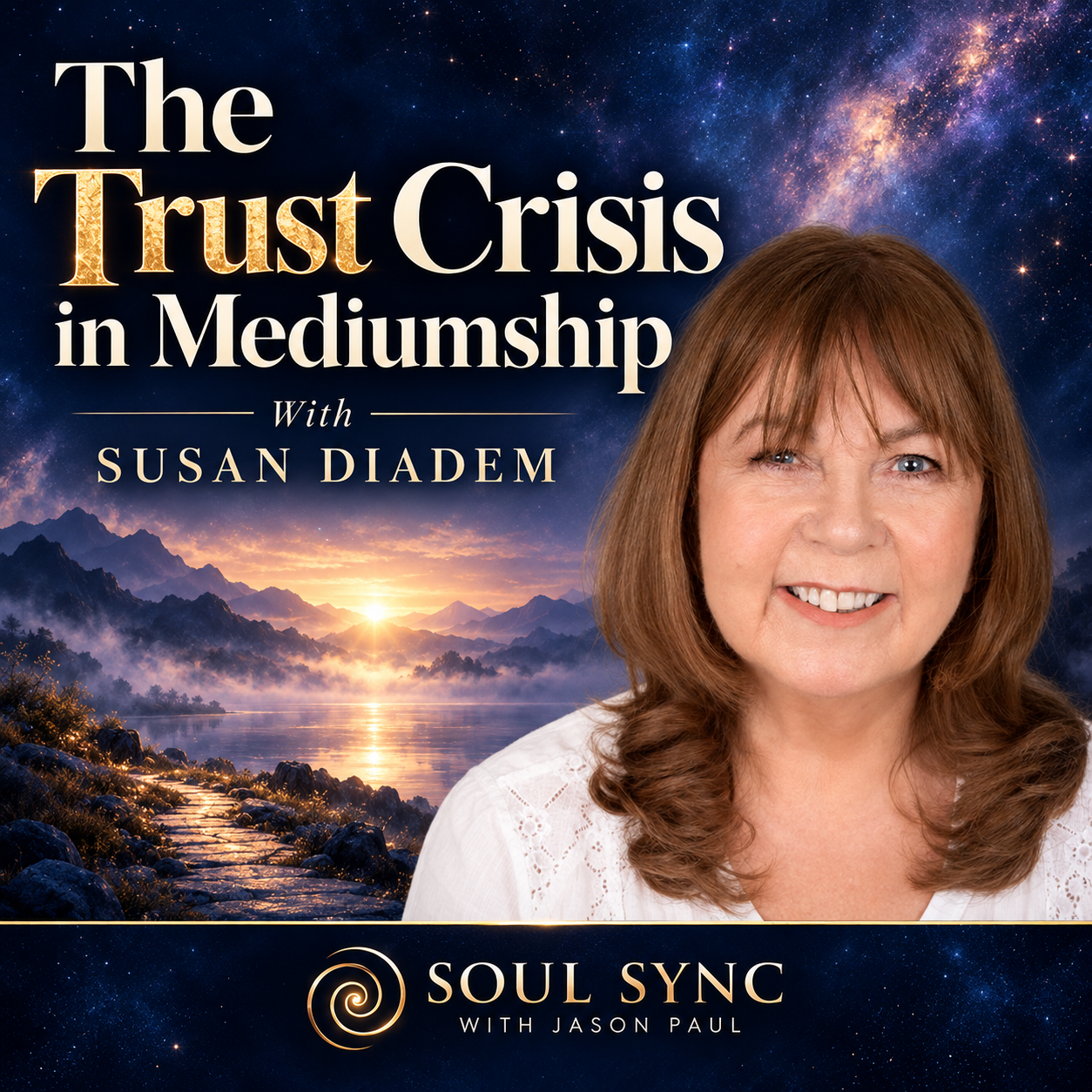
Listen to the full conversation by clicking the player at the top of the page
In this episode of Soul Sync, Susan and I talk about her journey from a shy, sensitive teenager reading playing cards to an accredited teacher of mediumship. We talk about the near-fatal illness in Tenerife where a voice told her, "But you already know"; evidence versus essence; protecting the dignity of loved ones in spirit; and why she believes structure is a good foundation that should never stop a medium growing beyond it.
Find Susan Diadem
Diadem Zodiac Soul Vibes, Susan's new YouTube channel of tarot and oracle readings for the zodiac signs
Your questions about gut feelings and intuition
Why is it called a gut feeling? Because it's often felt in the gut. Your digestive system has its own network of more than 100 million nerve cells, and most of the fibres in the vagus nerve carry signals from the body up to the brain. Many emotions and hunches are first noticed as physical sensations, such as tightness, warmth or a flutter in the stomach.
How can I tell the difference between intuition and anxiety? Intuition often arrives quietly, once, and with a sense of calm even when the message is difficult. Anxiety tends to be loud, urgent and repetitive, and often comes with "what if". Research suggests anxious people are more sensitive to bodily signals but less accurate in reading them, so slowing down and noticing before you interpret really helps.
Is mediumship done with the right side of the brain? Not literally. Both hemispheres work together, and research has found no evidence that people are "left-brained" or "right-brained". But the hemispheres do tend to bring different kinds of attention, and "right brain" is a useful shorthand for the broad, open, receptive attention that mediumship asks of us.
How do I know if it's spirit or my imagination? The spirit world often uses your imagination, memories and feelings to communicate, so the two work together. Many mediums notice that impressions from spirit arrive with details they wouldn't have chosen, while imagination can be steered at will. A sitter's simple yes, no, don't know or maybe, and regular practice in circle, are the best ways to learn the difference for yourself.
Can you learn to trust your intuition? Yes. Research by Daniel Kahneman and Gary Klein suggests intuition becomes reliable through practice with honest feedback. Keeping a hunch journal, noticing your body's signals and practising in a supportive group all help build that trust over time.
You can read the whole conversation in the transcript below, chapter by chapter.