Read the episode transcript
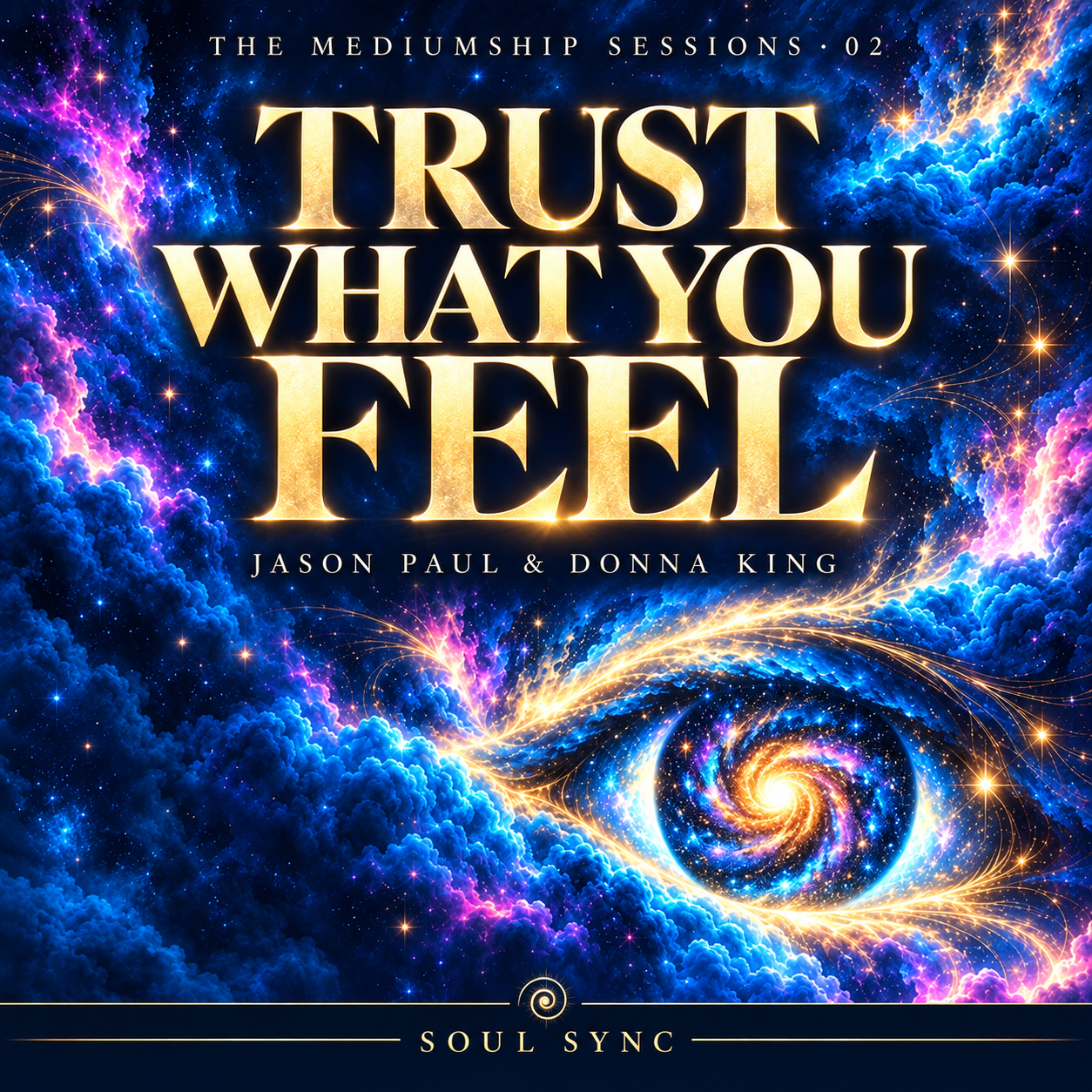
Trust What You Feel: The Foundations of Psychic Development
Jason Paul and Donna King — The Mediumship Sessions, episode two.
Edited and condensed for readability, with repetition and unclear fragments removed. This follows the conversation throughout but is not a word-for-word transcript. Times refer to the finished episode. The separately recorded introduction and outro are not included.
02:28 — Welcome back
Jason: Here we are, Donna King, back for round number two.
Donna: Hey, Jason.
Jason: Hello, hello, hello. If you're joining us here, this is a series about unlocking, developing and unfolding your psychic and mediumistic awareness. If you've joined us at lesson two, you are a keen bean. Welcome; we like that. But I would advise you to go back to lesson one, because the whole point of development, in my mind, is to start with the basics, the foundations and the pillars.
So many people jump straight into mediumship, wanting to make a connection with spirit. I can't judge them, because I was exactly the same, without even realising I was already working psychically. It's important to get these foundations in place.
Although we're on coffee-on-the-sofa number two, we're not going straight into mediumship. Last time we talked about spirit guides, angels and angelic beings. This time we're talking about the psychic. Donna, why is it important, and what does “psychic” mean?
03:49 — What do we mean by psychic?
Donna: I would describe it as your own natural intuition: the essence of your very being, your God-centred consciousness. It's your own guidance. I believe everybody is psychic. I prefer the word “intuitive”, because of the connotations society has attached to “psychic”.
Jason: The way I describe psychic work is working with a person's energy, rather than making a connection with the spirit world. “Intuitive” is a good word, because for years I said I had a very strong gut feeling. That was the label I used.
I was sensitive when I was young, and I built on that in my jobs over the years. As a police officer, that gut feeling could serve me very well in knowing where to look. In recruitment, I was reading people for years: their motivations and whether what they were saying felt sincere. I used to laugh that I had a detector for a lack of integrity or lies. You could call it bullshit, if you like.
When I first started exploring psychic development, I went to a lady's house. She was something of a spiritual all-rounder. It was a cute little house that reminded me of my nan and granddad's. We did ribbon work, tea leaves and other psychic work. By the end of the day, I was using dowsing rods to find things she had hidden around the house.
She showed me a photograph of a watch and hid it in a cupboard for me to find. I'm not sure I'd be as happy having someone rummage through all my cupboards, but she was very up for it. That was one of my doorways into this work. I remember thinking I wanted to develop these skills, completely unaware that I felt I had been using them already.
Donna: For me, the emphasis would always be to start with your own intuition. Where does it lead you? The more you work with it, the more familiar you become with it and the more you learn to trust it. From there, you can move towards reading for people and trusting what you feel, see and sense.
07:10 — Psychic awareness and mediumship
Jason: People understandably get confused about the difference. A psychic works with your energy; a medium connects with the spirit world.
If you want to develop mediumship, I believe you need to understand psychic work. In a psychic reading, you might be sitting with someone and exploring how they feel, what's happening in their life, experiences from their past or beliefs that may be holding them back.
If you haven't become familiar with that and jump straight into connecting with a spirit person, you may have an uphill battle, which probably won't help your confidence. When I think about earlier generations of development, people could sit for considerable periods before attempting to bring through information.
Every medium should be a strong psychic, but not every psychic is a medium. Said as modestly as possible, Donna King, I think I'm quite a sharp psychic, but I've honed that over many years. Some people listening may already be working with this sensitivity without realising it.
At its most basic, I think people recognise experiences such as walking into a room and getting a feeling about someone, or noticing someone looking at you before you consciously register them.
Donna: It's your own natural guidance. As a younger person, I would sometimes have a feeling that a house was going to be broken into or that someone would come off their bike. Those are negative examples, but I noticed patterns between my intuition and what followed.
It can be ordinary things too: “I bought blue, but I knew I should have bought pink.” It's that gut feeling you mentioned, the sense you work with in daily life. I see it as a natural part of being human.
Jason: I've gone through many chapters in my business life. I remember the early days of setting up my recruitment agency in Bristol, sitting in one office with a lovely view of the greenery. Looking back, it seems quite blissful, although I did get lonely. It probably did me a favour, because I couldn't leave the phone alone. I wanted to make outbound calls.
I followed my gut feeling. Then, around the time of COVID, I became much more caught up in my head and in worry. I felt I had replaced gratitude with worry. My experience of life changed, and I started making decisions very differently. It felt as though the wheels began coming off.
These days, I consider things and give them the thought they need, but I also pay attention to my gut feeling. People often ask me for advice, and I find myself saying, “Follow your heart.” In that way, I remind myself of my granddad.
12:00 — Becoming aware of what you feel
Jason: One of the first things to address is working with what you feel. Some people listening will feel very in tune with themselves. Others will be thinking, “Right now, I feel absolutely rubbish. Why would I want to follow that feeling?”
At the beginning, we need to become aware of our energy and how we feel. That itself requires introspection, doesn't it?
Donna: It does. Even with the experience I have, I can sit down to an exercise, such as placing cards face down and asking whether one is red or black, and notice myself moving into thought. It becomes a matter of bringing my attention back and learning how that energy works for me.
That has its challenges. In daily life, those of us who trust our gut might follow it quite naturally. But stress can pull us into our heads. We are living in a human world. It takes awareness to come back to: “What am I feeling? Where do I feel I should go? What am I navigating?”
Jason: Before I had a name for psychic awareness, I often felt I could read something of people: their fears, their confidence or what might be holding them back. I sometimes describe it as reading into their souls, although I realise how intrusive that can sound.
In my twenties, getting to know people could be difficult because what they said didn't always align with what I felt. I've always struggled when words and actions don't match. In recruitment, sensitivity to that could be useful, but it could also grate on me like a cheese grater.
I've made rash decisions based on a feeling, too. Not all those feelings were correct; some were fuelled by paranoia. Other feelings served me well. I can be too much of a risk-taker and roll the dice too quickly.
15:37 — Awareness, sensitivity and gentleness
Jason: The point is that development begins with awareness. Some people may be unhappy with their lives or unsure how they feel about things. You need to be gentle with yourself as you begin exploring this.
We can be so hard on ourselves in every other part of our lives. You might be coming from a busy job or an overstimulating environment. Recruitment could be overwhelming: moving from one candidate to another, then a client, then trying to close a deal, while absorbing everything happening around you.
If you are also picking up feelings about whether someone is being sincere, it can be a lot to process. As your sensitivity develops, you need to understand how you feel and how you interact with other people.
Donna: Yes. There can be a tendency to become very analytical about people, which brings the brain into it. But that depth of sensitivity you describe is a facet of the work. You spoke about the soul; I might describe that as a soul reading. People begin at different levels of sensitivity and build their understanding from there.
Jason: Any environment where you're dealing with the general public can feel like a lot when you're sensitive. You could be working in a hospital or another busy setting and finding yourself very affected by what's around you.
18:15 — Protection without unnecessary fear
Jason: That brings me to protection. For me, what I'm addressing is feeling drained or affected by other people's energy. You need awareness of that, but I don't believe you need elaborate rituals to protect yourself from negative entities.
I've heard people talk at length about everything they need protection from, and I find myself thinking, “Before you've even done a reading, you've spent half an hour putting on body armour.” I don't have to agree with every perspective on the podcast, but I am concerned about introducing unnecessary fear.
As you turn up the volume on your sensitivity, you may become more aware of what's around you. Put me in a room with mediums for a week and I can find even going into Sainsbury's afterwards a challenge. I feel so sensitive.
When I began this journey, I had a lot of anxiety. I remember being diagnosed with GAD — generalised anxiety disorder — which sounds like a computer part when you say it like that. I felt my thoughts were in control of me.
At first I would get annoyed with myself: “For goodness' sake, Jason, why are you thinking like that again?” Looking back, I can see how hard I was being on myself. There needs to be gentleness. Becoming aware of your thoughts and feelings can bring up a lot, depending on where you are in life.
Donna: It can bring up feelings and emotions, but people also overcomplicate the spiritual side. In my understanding, the soul and the psyche are intelligent. I don't feel there needs to be a grand procedure beyond the intention of thought.
I think some of these elaborate rituals come from human behaviour and ego. One that makes me laugh is the idea of closing all your chakras down.
Jason: You don't want to be pressing the shutdown button.
Donna: I believe some people reach a point in their development where their intuition seems to open up and they feel overloaded by their sensitivity. There is the old cliché that a psychic can read your mind. If only. Although one of my children would sometimes say things that made me feel he had picked up my thoughts, and I'd think, “Don't think, Donna, don't think.”
Generally, what we're talking about is picking up how someone feels, or something happening around them. I also see future-seeing as something that develops individually over time. After spending time studying with other mediums, returning to the outside world can sometimes feel quite daunting.
23:35 — The Hermit, solitude and finding your people
Jason: I noticed changes while working in recruitment, in an environment where people were often highly motivated by material success. Around a year ago, someone pulled a tarot card to represent me. I imagined I might get the Star or Strength, perhaps even the Fool, because I do like jumping into a new challenge.
I got the Hermit. My first reaction was, “Why have I got the Hermit?” I don't think many podcast listeners would have picked that card for me, but looking back at the last five years, I understand it.
I've become more withdrawn and more sensitive. If you're listening and thinking, “Why the bloody hell would I want to develop this?”, I understand. But I've also noticed changes in who I spend time with and the kind of company I enjoy.
Something within you may have shifted to bring you onto this path. You might arrive feeling miserable and wondering what life is about — that was part of my own experience. You might have more questions than answers.
One thing I hear from sensitive people, healers, psychics and mediums is how different or lonely they felt before finding like-minded people. As your life changes, some relationships can fall away and you can find new people who understand you. I can see this is bringing something up for you too, Donna.
Donna: When I was younger, I used to think, “What am I doing here? What's this all about?” I think your intuition can lead you into learning, growing and changing as an individual.
As you move and change, those shifts can feel greater. It can be a solitary place. Most people wouldn't believe this of me, but I barely spoke until I was eleven. In my experience, though, I was talking to my guides in my head, so I didn't feel alone. I had a rich imagination and spent a lot of time with myself.
Jason: These days, if you measured how often I interact with other people, you might call me lonelier than I've ever been. But I don't feel alone or bored. I've reached a different place with self-love and compassion, although it's still a journey.
Do I love every aspect of myself? Perhaps not the muffin top rolling over my jeans. My weight has gone up and down, and I love food. I once gave away all my bigger clothes after losing weight, and now I'm buying things in that size again. But you haven't come to Soul Sync to hear about my waist.
In relationships, I want to be with someone who feels right for me. In my twenties, I often looked outside myself for love. I would drive into Soho, sometimes after a shift with Virgin Atlantic, to see friends, with the hope of meeting a partner. That was a big motivation.
Now you sometimes have to shoo the Hermit out of the house. I tell myself, “Jason, you need to get out more, lad.” I love music, but loud and busy environments can feel overwhelming. Even a social event I enjoy can take a lot of concentration. I can come home, close the door and think, “I can breathe now.”
As I've developed, I've noticed my sensitivity changing. It's not as simple as saying, “I'm going to Sainsbury's; I'll turn the dial down to three.” I can focus on being calm, though, and I've noticed that I'm calmer since leaving my business, because I was always rushing before.
Looking back, I can recognise different stages in my awareness. It keeps evolving, doesn't it?
Donna: It does. I think that continues throughout life. How we work with it and how we develop it are important parts of that.
I see intuition as our natural guidance, our source navigation — a sort of sat-nav. As your awareness expands, going out and picking up so much can feel different. I understand what you're saying about relationships, too. I've been single for fifteen years. Having waited that long, I'm not going to choose just anyone; it has to suit who I am.
Jason: My darling, if you go to Fortnum & Mason, sometimes the most refined things sit on the shelf a little longer. They're an acquired taste. Not everybody can reach that high on the shelf.
Donna: I trust where I'm going and what I'm doing. I often say “trust in the journey of the soul”, because that is how I see it. Allowing things to be as they are, including the difficult parts, has become part of trusting myself.
There are layers to developing the psyche and understanding yourself. Self-awareness needs to come with it. Without being willing to recognise things about yourself, you can create barriers to change and growth.
33:26 — The experiences that shape us
Jason: That's an important point. As you become conscious of what you feel, you also need to recognise the experiences and beliefs you carry. Those can shape your biases. If you want to understand other people, doing the work of understanding yourself matters.
I've always been independent and stood on my own two feet, but there were times in my twenties when I didn't trust myself. I looked outside myself so often. Looking back, I can see how experiences in childhood, including my relationships with my biological father and stepdad, and feelings of abandonment, may have contributed to that.
The things that happen to us influence who we are now. Bringing about change can involve discomfort. As I've developed my psychic awareness and mediumship, feelings and experiences have come back to the surface.
I often joke that if you're organising a development event, don't forget the tissues. There can be tears. I'm doing a great job of promoting my new online circles, aren't I? People will be thinking, “I won't join if I'm going to be crying.” But I've often experienced those tears as a release of something I've been holding in.
I've read books exploring how past experiences affect us, including The Body Keeps the Score. In my own development, I have found things returning to the surface that I hadn't fully dealt with.
Editorial correction: The Body Keeps the Score is by Bessel van der Kolk. The conversation attributes it to Gabor Maté.
And your sat-nav image makes me laugh. I remember Mum and me printing out directions from the AA Route Planner. Miss one motorway exit and you were stuffed.
36:35 — Intuition in everyday life and work
Jason: People listening might be wondering how they can use these skills in their own lives. In my experience, the sensitivity I used in recruitment, before I called it psychic, was valuable in my career. I felt it helped me understand people and their motivations.
We were laughing about reading minds, but sometimes a candidate would say one thing and I would feel they wanted something different. I noticed nuances and pauses. Silence could be particularly useful.
For example, a recruiter might tell a client the fee is twenty per cent and immediately add, “But it's negotiable.” I used to think, “Why say that straight away?” I'd state the rate and leave a pause. Sometimes the client would ask, “Are you still there?” Then they'd say it was a lot of money, and I'd ask, “What are you comparing it to?”
Those were skills I used in working with people. Developing your sensitivity doesn't have to mean sitting opposite someone with runes and tarot cards. There can be applications in everyday life.
Donna: There is a difference between sitting with someone and sensing that they aren't happy with what you're offering, and directly reading the thought that has gone through their mind. I think it's important to make that distinction.
You may have a gut feeling that something isn't being said honestly or that someone doesn't trust their own ability. Learning how to work with those feelings is part of development. For me, moving with that awareness can feel like less resistance — almost like walking on water rather than wading through it.
I see it as something vast, beyond what we can fully comprehend.
39:44 — Gut feelings and the gut–brain connection
Jason: We call it a gut feeling, and the digestive system is packed with nerves. There is communication between the gut and the brain through what is called the gut–brain axis. The enteric nervous system, the network of neurons around the digestive tract, is sometimes called the second brain.
Your body can respond to something before you've consciously worked out why. When I began learning about this, it made sense of some of the language we use around gut feelings. I also connect that, in my spiritual understanding, with the solar plexus.
Editorial clarification: the gut–brain connection describes established physiological communication. It does not, by itself, demonstrate psychic ability or validate a chakra explanation. The “second brain” refers to the enteric nervous system, rather than the stomach alone. See NIDDK's explanation of the digestive system and this review of brain–gut communication.
Donna: I connect that with what we were saying about knowing yourself and working through your experiences: understanding who you are, how things affect you and how you grow. In my understanding, the physical and the psyche are connected.
I see the human journey as one of learning, growing, developing and making changes. Trusting yourself, and coming to understand the journey of your soul, can feel like a master key to navigation.
Jason: I love that — a master key to navigation.
Donna: In spiritual development, people often want more, but psychic work and mediumship are different. It's important to learn to recognise that difference.
I describe mediumship as raising our energy while spirit brings theirs towards us, meeting in the middle. That is the way I understand the connection. It takes practice, and I will never stop developing as a medium. That's why I think it's so important to begin with the self and the psyche.
Editorial clarification: this “meeting in the middle” is Donna's spiritual description of mediumship. The word itself comes from the Latin for “middle”; the energy explanation is not its linguistic origin.
42:19 — Mediumship as a journey of self-development
Jason: It's the foundations. If you're building a skyscraper, or even a six-storey block of flats, on weak foundations, you're going to run into trouble as you build higher.
I've had times when my mind felt in good shape but I wasn't looking after my body, and times when the reverse was true. How you look after yourself has a bearing on the work. For me, this is a journey of understanding yourself.
I remember reading Simon James's Magician to Mystic early in my development. The idea that stayed with me was the movement from being fascinated by the apparent magic of bringing through information towards recognising the personal work involved in becoming a medium.
Evidence can seem like pulling rabbits out of hats. But as you develop, there is also work to do within yourself. The phrase “spiritualising the self” comes to mind. It's a journey that continues, and I think the starting point is becoming aware of how you feel.
44:04 — Giving yourself permission to experiment
Jason: As this series continues, we're going to talk about different experiments people can try. You need opportunities to use and explore these things regularly, because you're building trust in yourself and your awareness.
We'll look at ways of working with your own energy and beginning to work with the energy of other people. Give yourself permission to be creative and experiment. It could be a colour reading, tea leaves, a rose or another approach that interests you. At the heart of it is being willing to have a go.
I see people at different stages of development who are held back by their expectations, their fear of hearing “no” or their fear of being wrong. That can make the process difficult. It's one of the reasons I prefer the word “experiment”. How will you learn how something works if you don't explore it?
You wouldn't pick up a new mobile phone and expect to know every feature immediately. If you're like me, you probably won't read the manual either; you'll go straight in and try things. But you still need the experience of using it.
There will be practical experiments as we go through the series. Today, the emphasis is on becoming more aware of yourself and how you feel. That's the doorway into psychic development, isn't it?
Donna: It is as simple as giving more attention to what you want to grow. With anything you want to learn, you need to spend time understanding how it works for you.
You can bring that curiosity into daily life: “I want to develop this. How can I become more in tune with myself?” I see it as a natural part of who we are, although some people work with it more consciously than others. At some point, you make the decision that you want to explore it.
Jason: I believe we all have some level of psychic sensitivity. We feel things about people in different ways. Some people feel a lot and ignore it. When I look back at a difficult, abusive relationship in my twenties, there were warning bells, but I didn't listen to them.
I think giving yourself permission to feel is an important part of this journey.
47:40 — Trust and gentleness
Jason: Perhaps it's been a while since you really trusted yourself. We all have different levels of self-belief, and that changes. Building trust in yourself is part of unfolding these abilities, but it's a journey. You need to be gentle with yourself as you begin.
Donna: For me, it comes back to trusting the journey of the soul, your own awareness and your development, and giving yourself time and patience.
We are often our own harshest critics. People have said to me, “I couldn't have my foot up your backside, because you've already got yours there.” Some people are less hard on themselves, but I think many sensitive people recognise that tendency.
Some of us have also had challenges and difficult experiences to navigate. In time, those experiences may help us understand and support someone else, whether in everyday life or in a reading. I see a healing aspect in that.
Jason: Well, there we go. That's it for this week. Come back next time, when we'll explore another topic to help you in your unfoldment. Donna King, thank you very much.
Donna: Thank you, Jason.