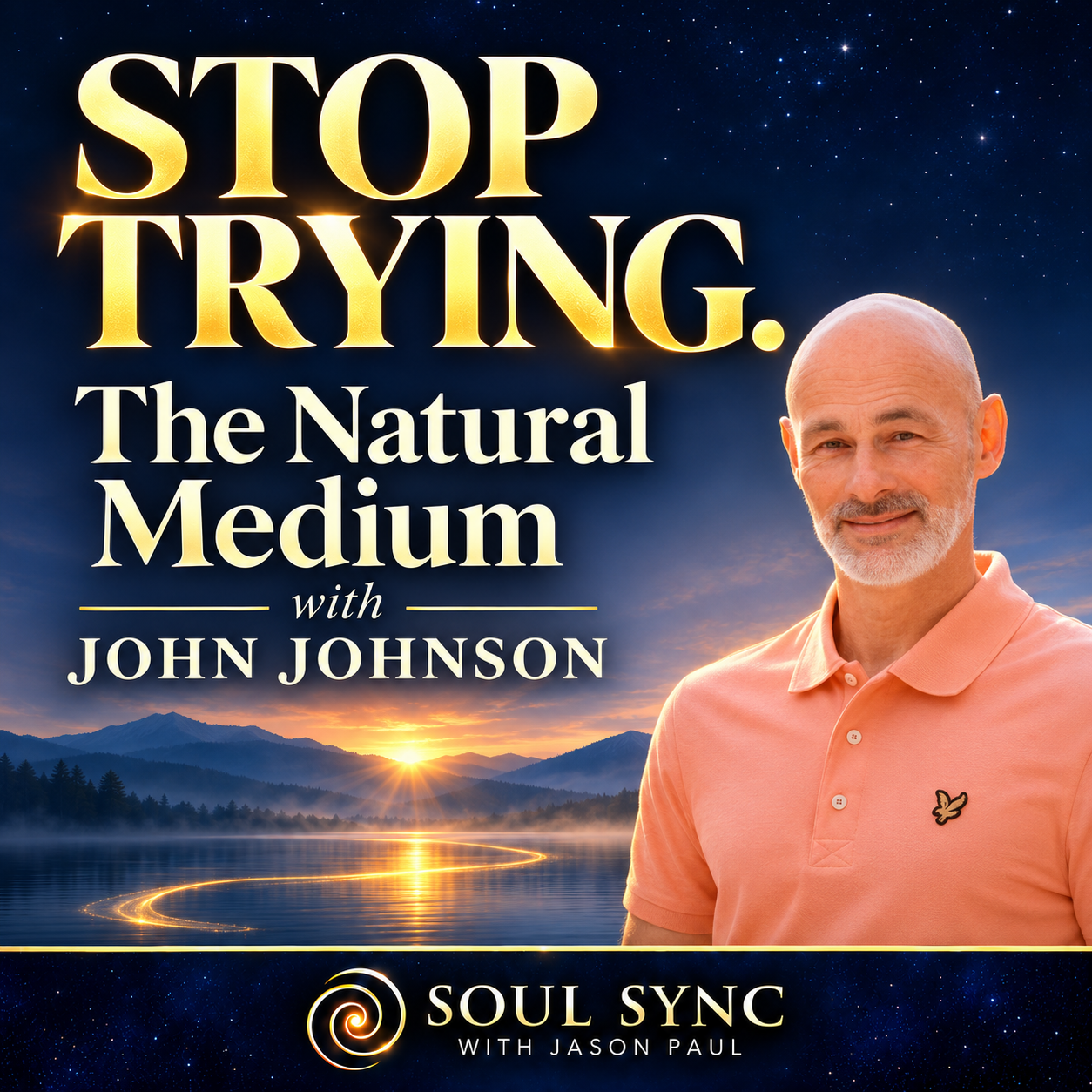
Stop Trying: The Natural Medium with John Johnson
Soul Sync with Jason Paul, in conversation with John Johnson. Listen below, or read on for the full write-up and transcript.
Try harder. Give it a go. Put the hours in.
Those words have followed me my whole life. Hard work was drilled into me in every career I've had, and especially in the police and in sales. I built a multi-million-pound company off the back of absolute graft. When I was hiring salespeople, the ability to work hard, to keep striving and to keep developing was one of the key things I looked for.
So you can imagine how much it threw me to discover that in mediumship, trying is one of the biggest things that gets in the way.
That's the heart of my conversation on Soul Sync with medium and teacher John Johnson. John is originally from Scotland, now lives in Sweden, and taught for years at the Arthur Findlay College. For over a decade he's been building a philosophy he calls The Natural Medium. It stayed with me long after we stopped recording, because it put words to something I've lived through.
My trying chapter
I think our development moves through chapters, each with its own theme. One of my biggest was trying.
I remember going into readings and pushing. Pushing the power out, trying to build the power, trying to make a link. It felt like the right thing to do. It's what had worked in every other part of my life.
But when you're trying, you're not allowing. You're not actually in the experience. Trying puts you straight into your head, and it creates friction between you and the spirit world.
You can see it when someone's trying, too. Energetically, they move in and out of the power, flickering between connection and effort. I've come to see trying as a quiet lack of trust: if I trusted the spirit world to come, why would I need to push?
It took me a really long time to get out of that habit, because it was the habit of a lifetime. From school onwards we're told to try, to have a go, to give it our all. I've had to work hard on unlearning it. And yes, I'm aware of the irony there.
Why techniques can leave you stuck
This is where John's thinking really landed with me.
Teachers teach techniques, and they teach them with the best of intentions. The problem is that a technique is usually what works for the medium who teaches it. What works for one medium won't necessarily work for another. I see so many people developing their mediumship come unstuck because they're trying to take in technique after technique, and when one doesn't work, they assume the problem is them.
There's a second problem. A technique gives you something to think about, so it pulls you into your thinking, analytical mind, which is exactly where you don't want to be when spirit is trying to reach you.
John calls this the copy-paste culture of mediumship teaching. A teacher teaches what they were taught, by someone who taught what they were taught, and nobody stops to ask why. He noticed early on that an exercise would work brilliantly for one student and do nothing for the three sitting next to them.
Let me be clear, as John was: this isn't an attack on teachers. I've learned so much from the tutors I've sat with, and every one of them gives their heart to it. The challenge is to the teaching, not the people. As John puts it, when students start trying to perform like their teacher, they've already lost themselves.
Why there's no other way to be than natural
Here's the thing that makes it all click for me. The spirit world uses you to communicate. Your memories, your experiences, the way you perceive things and how you feel about the different parts of your life all become the language they speak through.
So when you're your natural self, you're giving spirit your full vocabulary. When you're copying someone else's way of working, you're asking spirit to speak through a borrowed language. There really is no other way to be as a medium than natural.
John uses nature to explain it, and I love the image. When you plant a seed, it doesn't come with an arrow saying "this way up". Put it in good soil, give it water and light, and it becomes what it's meant to be. He doesn't even like calling mediumship a gift. He believes it's part of all of us.
My own granddad, who was a medium himself, has come through to me more than once with the same message: stop trying to be other people, that's not you. It took me a while to listen.
The microsecond trap
Here's what happens in a reading, in my experience. The spirit world gives you something, maybe an image. Then, almost instantly, it shoots up into the mind. You try to interpret it. You wonder what it is. You try to place it. And in that moment you've dipped out of the power.
I have an ADHD brain, and it works fast. I'd get a piece of evidence, and within what felt like a microsecond it had been flicked up into my head for analysis. I see the same pattern again and again in the people I mentor.
So what's the answer? Rather than thinking about what you've been given, feel it. Lean into the evidence. Breathe into it and into the experience, and let it unfold. Be gentle with yourself, because this takes time.
What psychology says about trying
There's a well-known piece of research that explains a lot of this. In 1987, the Harvard psychologist Daniel Wegner asked people to talk through their thoughts for five minutes while trying not to think of a white bear. They couldn't do it. Even more striking, people who had first tried to suppress the thought later thought about it more than people who had never been asked to.
Wegner called this ironic process theory. Trying to control the mind starts a background process that keeps checking whether you're succeeding, and that checking is what brings the unwanted thought back. These effects are strongest under stress, mental load or time pressure, which is a fair description of standing in front of a room waiting for a contact.
It's the same reason the advice "you're too much in your head" so often backfires. John reframes it beautifully. We can't be too much in our heads, he says, because we need the mind: it gives us the language to express what comes. What we can do is focus too much on our thinking. In daily life the conscious mind is the driver. In mediumship it becomes the passenger.
We don't meditate. Meditation arises.
Before John ever set foot in a Spiritualist church, he sat nine times a week for over a year. No music, no guided recordings, no incense. He sat in the dark, not to reach the spirit world, but simply to see if he could be quiet.
Out of that came an idea I'm taking into my own circles: we don't meditate, and we don't "sit in the power" as something we do. We create the space, and see whether meditation arises within us. That's why sitting matters so much. It's how we learn to simply be in the moment, which is exactly where the evidence lives.
The science points the same way. Neuroscientist Judson Brewer and colleagues found that experienced meditators showed less activity in the default mode network, the brain network linked with mind-wandering and self-focused thinking. In a follow-up study, meditators linked that quieter activity with experiences they described as "effortless doing" and "not efforting". The state so many of us are reaching for seems to come with less effort, not more.
One contact doesn't define you
If there's one phrase I'd happily retire from mediumship development, it's "you're only as good as your last demonstration". John calls it psychological warfare, and I agree. One difficult contact doesn't define your mediumship, any more than one bad sales call made me a bad salesman.
John describes mediumship as live TV. You get one shot, it'll be what it'll be, and then you move on and learn from it. That takes the pressure off, and pressure is exactly what sends us back into trying.
A balanced word, and where I stand
Many people come to these pages looking for proof that the spirit world is real, as I once did, so it's only fair to say that sceptics see things very differently. Many argue that mediumship can be explained by cold reading, lucky guesses and the sitter's own interpretation.
There's serious research on both sides. At the Windbridge Research Center, Dr Julie Beischel and colleagues tested mediums under conditions where the mediums, the sitters and the researchers were all blinded. They reported that the mediums still gave accurate and specific information about the deceased, and concluded that cold reading and fraud couldn't explain it. Critics question the sample sizes and the strength of the effects, and the debate goes on.
As a medium, my own position is clear. I believe the spirit world is real, because I've seen and felt it too many times to believe otherwise. My invitation is not to take my word or anyone else's. Experiment for yourself, and notice what happens when you stop trying so hard.
When a flower fails to bloom
John closed our conversation with a quote, widely credited to the writer Alexander den Heijer, that I can't stop thinking about: "When a flower doesn't bloom, you fix the environment in which it grows, not the flower."
If your mediumship feels stuck, it may not be you that needs fixing. It may be the pressure you're putting on yourself, or a technique you've borrowed that never fitted you in the first place. Mediumship isn't something you do. It's part of who you are. The natural medium is simply the one who has stopped trying to be anyone else.
POINTS TO SIT WITH
Trying isn't allowing. When you push for a link, you step out of the experience.
Trying is a quiet lack of trust. Trust that spirit will come, and the pushing falls away.
A technique is one medium's way of working. Keep only what resonates with your own nature.
Spirit speaks through your life. Your memories, feelings and perceptions are the language, so be yourself.
Feel it before you think it. When evidence comes, lean into it and breathe into it rather than analysing it.
Create the space, don't force the state. We don't meditate; we let meditation arise.
One contact doesn't define you. Mediumship is live TV: do your best, learn and move on.
When a flower fails to bloom, change the environment. If you're stuck, look at the soil before you blame the seed.
Explore your own natural mediumship
If this has stirred something in you, come and experiment with me. My free online mediumship development circle runs on Zoom every Tuesday, 6–8pm UK time. It's a warm, no-pressure space to find your own way. For deeper work there's my online mediumship development class, and if you'd like to experience a reading yourself, you can book a reading here.
You can find out more about John and his courses on John's website. And if you'd like to see him work, John, Donna King and I are coming together for An Evening with Spirit, an online demonstration on Friday 2 April 2027.
-
Jason Paul: John. John. John, welcome to Soul Sync.
John Johnson: Thank you so much for having me. It's a real pleasure to speak to you.
Jason Paul: Oh, it's a lovely pleasure to have you all. Thank you for taking the time. So I guess to begin with, uh, for people that don't know you, you are a medium amongst many things.
-
John Johnson: Ooh, how long a story would you like? I'm obviously originally from Scotland. I have been, involved in development awareness discoveries, I suppose, since the day I was born, but not recognising it until my probably teenage years, growing up with scepticism, growing up with, um, a family of, well, one part believes and the other part thinks it's, very cultish.
So, it was very strange. 'cause my grandmother, uh, who, who actually lived in London, she was, really decent medium, a really good medium. And growing up, my parents, especially my dad, didn't want myself or my sister to catch the bug as he called it. So he used to try and keep me away from my grandmother because it was a, it was a lady's thing and he wanted to keep me away, so I never caught the bug.
And the interesting thing is my grandmother never once spoke to me about it or explained anything or talked about anything. But obviously, uh, in hindsight, I was the one that caught the bug. So it was really interesting growing up trying to isolate me from not, not going into discuss something that ultimately ended up doing. Um, so there's a lot of that happening in the family. But my, my grandmother was actually, really good doing the altered states and she, uh, respectfully lived in the future, so she was very good at predicting and, and making predictions. So I had a lot of that sort of background things happening all the way through growing up.
I suppose my first real experience looking back for me, which was a very profound experience, was age of 11 or 12, when my next door neighbour, who was 18 years old at the time, uh, died and I was in bed. I was going obviously in bed, going to school, but I woke up at, um, probably 7, 7 30 in the morning. But right before I woke up, I was having this dream where I was talking to him and he came and he just said, just so you know, everything's okay, I'm fine.
-
John Johnson: And I was talking to him in my dream and I said, but if you're, and I dunno why I knew I made sense of it at 11, 12 years old, but I said, but that means you must be dead. And all of a sudden I shot up in my bed and I heard a scream next door from the neighbour. And it was, the parents had just found their son dead in the living room. I could rationalise it as an older person and say, well, you know, but the thing is he was 18 years old. He wasn't 60, 70, 80. It doesn't mean, obviously young people don't die. But he was very fit, very healthy. He did charity cycles. He trained, he went to the gym. There was no reason for him to, in, in an announcing world to pass.
So those little moments, really looking back the way it really started to, I suppose, recognise that this awareness is something I've always had, but just not really making sense of it or thinking it's normal, like most people. But I, I, never like to say, that's a gift, for example. I don't, I don't really believe in the gift of, I think it's something that's part of all of us.
So growing up, I think really becoming aware of that and being aware of my experiences, recognising as I got older, that actually this was happening all the way through was, um, was quite a, an awakening, I suppose in many ways.
Jason Paul: It's interesting. I, I can imagine if you're anything like me, your father telling you to stay away from it, it's almost like the forbidden box. Don't push this button, don't open this box. You almost, there's more intrigue there. Why would, why did he take that position? Because I can imagine if, if you are, and I was so involved in, the trance and all these other, forms of mediumship, it, you know, you'd almost think he'd be sort of encouraging it in some senses.
-
John Johnson: Well, growing up with his mother, who was my grandmother, um, he used to wake up during the night and all the clocks would be stopped in the house. And then the grand, his mom would say in the morning, oh, your, your uncle such and such died, or, and what time was it? Three o'clock? You know, all the, and he was always so sceptical about it.
But he, I think he was a little bit scared actually, but he had so many experiences with his own mum, things happening. And he, I think he grew up in that environment, but I also believe that he also is actually very sensitive, but he just, he denies himself to be what he is, if you like. He's, he, he was a policeman, and ...so he has that mindset, which is not a bad thing for a policeman, but he has that mindset.
But even when he tells me, or he told me stories to do with his police career and things like what happened, obviously not, not confidential, but things he could talk about. He used to tell me having inklings of this happening or having a feeling that this wasn't there or going somewhere and having, like, he had to go to a break-in, and he was there on his own and he, he shouted for backup, but he knew the guy was behind the door, so he didn't, he waited and then he surprised the guy ran, the guy surprising him.
And I said, well, how did you know he was there? I, oh, I just had this. But when you try to get him to talk about awareness, he goes, nah, nah, nah, nah, nah. nah. You know, so it, it's a very peculiar conversation to, to see sensitivity in somebody, ...for them to deny sensitivity in themself.
Jason Paul: I can relate a lot to that. 'cause I was a police officer for a few years and it absolutely so destroyed me, actually. I came out the other side in a right old, um, state, but seeing that kind of stuff every day, you know, is very difficult. And I distinctly remember having hunches all the time myself.
People used to call me quite a, they used to call me a, well, not a very nice phrase, but almost like a, what's the word I want to use? I would just attract things. I was like a magnet. There was a swear word that went before that, but I won't say that. But I was a magnet for finding things. So you had this experience, and it with, your neighbour that was transitioning, passing over, was that then the catalyst that started to make you unfold and explore your mediumship?
Because that's a very profound experience to have.
John Johnson: Not really because, because I was so young, I was obviously in UK we would say primary six or primary seven. So I was 12, 11, 12 years old. And for me it happened, you know, everybody was crying as we'd be expected. There's still a child at the end of the day. And I was like, it's okay, you know, everything's fine.
-
John Johnson: And obviously that's what people say that children do when, but it doesn't help in the moment because, you know, parents are melting down and as as expected. So it wasn't really, I didn't really change anything. The only thing, I suppose when I got a little bit older, I started to work, um, full time when I was 16 and one of the part of my job I had to go to people's houses.
And throughout from 16, all the way through to early twenties, which is when I then start to went to discover, um, I would go to people's houses and I would sit out in the, the, the van and I'd feel this. I don't want to go in and I don't want to shut the door. And I don't know why I don't, and I have to go 'cause there's an appointment, but I don't know why.
I just don't, I can't feel, oh my God, what am I gonna do? And eventually, obviously I have to go and shut the door and I would shut the door. And there was a lady opened the door and or dressing ground dressing gown. And she says, um, uh, what are you here for? And I said, well, I'm, I'm here to, to service the alarm system.
And she said, oh, I'm really sorry, but can we rebook it because my husband just died this morning in a car accident. I'd be like, oh, oh, uh, of course, absolutely no problem. And I would leave and I'd sit in the van and I'd sit and go, oh my God, why did I going open the door? Why did, why did I just not listen?
And, but obviously that's, that's your job. I've been back to this lady's house. It would've been maybe three, four weeks later. And as soon as I walked in the door, I just had this, and again, it's not me, I wasn't trained, developed. It wasn't like I was in development circles or groups or anything, but I would get into the house and all of a sudden I would have this Mickey Mouse in my head.
And I'm thinking, why, why am I thinking of Mickey Mouse? What's that got to do with what I don't? And I had, I wasn't, as I said, I'm not searching, looking, trying to be aware of anything. I just had Mickey Mouse and I'm thinking, Mickey Mouse, what we, that's a crazy thing to remember. 'cause I've never been to like Disneyland or whatever.
But so I start doing the work. I says, okay, if I'll go upstairs, yeah, no problem. I go upstairs and in the bedroom there's a photo for her and her husband in Disneyland with, uh, Mickey Mouse.
Jason Paul: How.
John Johnson: And I'm looking at going, holy crap, what is that? You know, what is, is that, or is that just so it, it makes, well, it made me, because of my own scepticism, it made me kinda go, how does that, and what does that, and I'm not really sure, but these little moments happen so many times over those first years.
That's what got me to become either, I'm either losing their mind or there's something else happening.
Jason Paul: Hmm. It's an interesting point, even that distinction of, realising at that point that the thoughts that you were having were not your own. Because I feel that that's always one of the, million dollar questions at the start of mediumship, isn't it? You know, how do I know if it's my thoughts or, or that of the spirit world where you just know if you are in a place, you know, like that, where you've just had that kind of a warning come to you or that sense come to you and then suddenly you get Mickey ba.
That's not a John fort is it? In that moment. So it sounds like the spirit world. We're obviously trying to get your attention in one way or another and, um you know, even what you've had happen with your now does bare similarities to, my granddad. It's kind of skipped a generation in my family. My mom, you ask her, she's open-minded, she believes in it, but that, that's as far as it goes.
You know, and it's kind of skipped down a generation for me. So you've come on today and um, you know, you're a beautiful medium and a beautiful soul, and I do appreciate that. We're gonna be talking about the natural medium, which is a philosophy that you've built up over 10 years. Why have you spent so much time on, uh, this natural medium, and what does that mean to you?
-
John Johnson: Well, I think as everybody else who does development, we generally, I often say we, we sort of all start for very similar kinda reasons, is that there's a sort of a list of things that happens that's either because we are in awareness, we're having experiences. It could be because trauma, it could be because somebody dies.
-
John Johnson: It could be because there's a massive thing happening in our own life. So there's a, there's things that are quite relevant to many people that will make us become curious to, to discover what, what's happening, what's going on, what opened the door to this awareness. And for me, I used to, I started just to meditate. That's the only thing I did. I didn't do training courses. I didn't do workshops. I just meditated to the point that it became addiction. So I would actually meditate nine times a week religiously. I would do Monday, Tuesday, Wednesday, Thursday, Friday. I would do two Saturday and two and Sunday just because whatever I, but for, with me being in my own space, I would just sit and I'd just have this compulsion to constantly sit in presence, but not for the spirit world.
Not for communication, not for awareness, not for simply just to, just to see if I could just be quiet. So I did that for nine times a week, almost every single week for over a year. And then I decided to go to the spiritual church. And then when I go to the church to start telling you, you have to do this and you have to do this, and you need to do this.
And I always found it funny looking back, I had a book, I remember they gave me a book to read, uh, or a book recommended. And it was about exercises and practises. And I remember it said, and um, you know, when you meditate, set your alarm for 30 minutes so that after 30 minutes, obviously alarm goes off. And, and I, so I'm thinking, what crazy idea, because if you think about being, in, being in meditation, you're being in a slightly altered state.
And if you're moving into, and you're having this wonderful moment, and all of a sudden there's a clason going on telling you that it's over and it's killing you, snapping you back. Well, for me, that that like, but that doesn't feel very natural for me. So the more I started to read Reflect, and I'm, and because of my own, I've got a bit of a crazy head and, um, I, I love to read between the lines of what's actually happening rather than just believe everybody because they're the teacher, which doesn't mean I'm rebellious, it just means that some things I ask questions about the teaching. So I started to recognise that the more things I was being taught, I started to recognise that some of it, I understood why I was being taught it, but I couldn't understand why everybody was being taught the same thing. So it was like, uh, I, I call it, I call it the copy paste culture, you know? So what happens is the teacher I had 20 years ago taught by another teacher, that teacher copied what that teacher taught and now teaches that, and then the teacher that taught them now teaches what they taught.
-
John Johnson: So it's a copy paste. Now, as soon as I ask the teacher, why am I doing this? Well, because, you know, this is what we do.
Jason Paul: Just the way it's done.
John Johnson: Exactly, and that's what we've done all these years. So why are you question it? You know, sort of a, and again, not in a, a negative sense, 'cause I don't believe, um, I don't believe anybody is bad at what they do.
I believe everybody puts a hundred percent their heart and soul into it. I believe everybody's genuine to really try to do their best. So this is not about, this is not about attacking people. It's about the, the, the challenge and the philosophy and challenging the teaching. And for me, it started to make me kinda recognise that a lot of the things I've been told to do would work for one person, but not work for three others.
And then I was been, I've been told to do that when I get this, I need to do this. And I'm like, yeah, I can do it, but the person beside me can't, so why is it I can do it and they can't? And so it started open on all these questions. So eventually when I started to, uh, train with particular teachers, obviously the teacher will always teach you their philosophy.
And their philosophy is always true because it's their philosophy. And then I had another teacher who would teach me something else and I started to recognise styles of teaching. This one's more mechanical, this one's more emotional, this one's more this. What's one's more that? So eventually I stood back a little bit and I said, so what's right for me? So I started to take parts of the teaching that made sense and resonated within my own awareness and started to then rebuild from these bits. Make sense? I understand why I've been taught this, I understand why this is important, but it doesn't work for me because my personality, my awareness and who I am is more inclined to do this.
So I started to then like reexamine. So I started to build a brand new for of my own way of philosophy from the very beginning of what it was to be sensitive, what it meant to be natural within my awareness. And what does it mean to be natural? you think about what is natural in the world, what do we have that's already natural nature.
-
John Johnson: Obviously it said nature is your greatest teacher.
Jason Paul: Indeed.
John Johnson: So what does nature do, you know? Does, does the, does the, does the flowers fight each fight against each other because they're growing in the same garden,
Jason Paul: No. Well, no it doesn't. Do they, they, they coexist.
John Johnson: exactly. They find a way to be in a nature, don't they? And, uh, the, the, the simple example I always love to kind of throw out there is, you know, when you, when you plant a seed, like whether it's a flower or a plant, when you, when you plant a seed, does it have a little arrow to say, plant me this way up.
Jason Paul: No, my mum gives me them with arrows though. 'cause she knows I'm absolutely awful with gardening. She, uh, uh, gives me very strict instructions. But no, you, you, you just, you just know what to do. You know where it goes, don't you?
John Johnson: Yeah. Well, yeah. Nature takes care of it, doesn't it?
Jason Paul: It does.
John Johnson: you, as long as you put it in the, if you put it in good soil and you water it and you give it light, it will become what it's meant to be..
Jason Paul: What made you have, because the fact that you even started, uh, uh, this kind of, um, crazy amount of sitting, you know, ...I kind of wish I'd done that myself at the, at the start, to be quite honest with you. But where did you get this? Um, what and why did you do it? And what made you sort of take that route?
Because it made much, as you were saying, that made me feel like that's what a lot of people miss out on now is, you know, the, the early days, what the pioneers said back a hundred years ago, they would sit, they would sit, they would sit, they would discover their own power. They, uh, before they even attempted that.
And it, and it really felt to me as you were explaining your experience in the circle, because of that strong grounding you had, you were, you were in a place of already, uh, knowing to pick what resonated and what didn't. But most people skip that stage. They don't even realise that stage. And in the, um, you know, in the land of, uh, giving their power over to a teacher, as you say.
John Johnson: Yeah. Yeah. I think it was actually more of, being, being curious about awareness sensitivity, but not really knowing what to do with it. And the only thing that I felt was appropriate to do was just to sit. So it was a very simple, I'd love to give a really philosophical, like a really special spiritual answer, but it was pretty much just me thinking, do you know what?
I just feel like I'm gonna just start seeing if I can meditate. And I never used music. I never used like, uh, guided meditation. I never used like incense or it was simply me deciding to sit there or close my eyes. And I had absolutely darkness and nothing, and I just sat in darkness and nothing. But I think eventually, obviously as you know yourself, the more you do it, you, you sort of drop into that space quicker and quicker.
But that also became a confusion because what we're taught is that you are now going to sit in the power, or you are now going to meditate. But if we really think about it in like another way, we do not meditate. We do not sit in the power. What we're actually doing is we are creating this, the space to see if meditation arises within us. So meditation arises, it's not something that we don't go and meditate. We create a space and we try to be in this energy of the soul of ourself, and we see does meditation arise within me? So for me to also, I've, I've got a whole thing to do with meditation, sitting in the power, and you know, I go around in circles with the whole thing, but is it me that sits in the power or is it me creating the space to be the power?
-
Jason Paul: Well, this is an interesting point, and when I first started, um, my mediumship development for a long time, I would, I even think the term sit in the power is helpful to some people, but it describes something that you're having to do, implying that you need to try in order to do it. And even the saying to someone, right, okay, you need to sit and meditate.
Right? You, that, that they take from, that I need to be doing something in order to, and, you know, make that work. And what you are saying is, I think that is the correct way to phrase it, because I used to spend so long John looking for the switch, where it was and how I ramp it up. And it is about just holding that space because, you know, the, the, the biggest, one of the biggest barriers to mediumship, I feel is, is trying in itself
John Johnson: Absolutely.
Jason Paul: it holds people back.
John Johnson: yeah, I mean, obviously you say if, if, if you say to somebody, I mean, you need to go to a therapist, then the therapy session's not gonna work because you're telling them to do it. It's not a calling from themself, you know? So for meditation's, very simple. If you want to start meditating, give yourself permission to sit, but not sit for distraction, which is music, voice recording, um, smell, you know, you're, you're, 'cause that, that's just, that's an outside distraction.
That's you using something to get away from yourself, which is the opposite of what you're trying to create. Because creating the naturalness of awareness is not out there. It's, it's in here. So if you're trying to be natural in your perception and you're trying to be naturally within the power of who you are, then for my philosophy and idea, and again, it doesn't mean it's right, but what matches for me that I don't want to have distractions that pull me away from myself. I'm wanting to be confronted with my own self. I'm wanting to be with an awareness in the power of who I am. I want to be aware that this is my thought. So it, it starts to then bring in the terminology of mediumship as well, where very common, I mean, you will, you will have your own experiences along the way.
-
John Johnson: Similar where I get told when I started, you're too much in your head, for example.
Jason Paul: Oh yes. It's a term I've heard a lot as well myself and yeah.
John Johnson: you're too much in your head. Now the problem is if I ask you, Jason, where else are you going to go?
Jason Paul: Oh, I could do in over time, I would've said, well, me, so plexus my throat chakra anywhere but the head, because you, you start to at some, for, for, me, I, the, the mind was the enemy for a period of time. But, and then I'd think, well, if I'm not in my mind, where am I? But like you, you very much strike me as someone that challenges concepts and things from your own perspective.
And I've, I've been like that very much from the beginning, um, as well because, um, you can feel if it resonates or you can feel if it doesn't. But this is, this PO point about the mind is an important point because, um, a lot of people really do, um, get to the stage where they feel that they're trying to sort of shut the mind down and that that mediumship is the spirit world are using the mind, aren't they?
John Johnson: Yeah, it's, it's of the mind. So you and I, I have to say, for me, an easy, um, sort of, well, I think it's an easy way to see it or understand it, is that what we do consciously in our daily life is the mind is the driver. So what we're trying to do with an expression and awareness is we're trying to make the conscious mind become the passenger, because we, we need the conscious mind to bring substance, language, expression, connection to express or experience.
So we, we need our heads. So we can't say we're too much in our head. What we could say is, you're focusing too much on your mind because to focus too much on your thinking mind is what's happening. It's not because you're too much in it, it's just because you're giving too much focus to the area which is interfering with that sort of, you're looking for a, a, a freedom of expression rather than a judgement of expression. And if we're focusing on the thinking, then we're, we're, we're thinking about what we're gonna do with it, which means that we are, again, we're interfering with the process.
-
Jason Paul: All of these things that you are describing are all it's under. It's so understandable to understand why we fall down these traps when we're trying to develop. I think the first reason is because we overs skip, uh, the, the very, very, very foundational stage of which you, um, you know, you discovering your energy are discovering what, what, how your own soul that energy felt like, and then kind of going on that journey from there.
But a lot of people, um, the simplicity of mediumship is what I feel makes it so difficult because in any other aspect of our life trying, um, you know, we are programmed from a very young age that that's gonna bring about rewards, don't we? And that's, and everyone loves a trier, don't they? Um, even ...people who aren't successful, I've always loved triers.
But that, that is the, the problem with mediumship is anything that you are doing that implies that you need to push force switch on, um, requires effort is the complete opposite and creates friction of that, of a mediumship. And obviously this is a massive, uh, massively passionate area for you because you've dedicated so much of your life to naturalness, which is a, a beautiful thing in itself.
John Johnson: Yeah. I mean, am I there yet? Probably not. Is there still a lot to learn? Absolutely. Does the philosophy change every other week and month? Yeah, it shifts and moves because I think within really giving yourself permission to, to sort of respectfully confront yourself and really recognise what am I actually doing within my own ability and expression, and what am I teaching everybody else to do?
Am I teaching them bad habits and insecurities or am I teaching them something meaningful and powerful? Because obviously every teacher will try to teach you what they think is the right way to do it. And for me, I, I don't believe I have that potential to make you into a medium. But what I can do is I can encourage you to, to allow you to have the space to become that what you are, to help you with my ability to help you see what I see within you without making you try to do what I do. So it means that you become the, you become the powerhouse in the room. It's not about John, it's about you. And if the teaching comes about the teacher, then the teacher needs to go and become a bus driver or, you know, do something else because it's, it is never about the teacher. It was always about the developing medium.
And then when you start to notice that students are trying to perform like their teacher, then they've lost themselves already. 'cause they'll never be able to be what their teacher is or was, or can be or is. There's no way
Jason Paul: them, is it? It's, you made the point earlier. Mediumship is so individual that what works for one person really, you know, doesn't work for another person. And that's why I don't even feel you can teach mediumship. I feel that the way you teach it is by facilitating and allowing people to experiment to find their own way.
-
Jason Paul: And I, I've never been someone that I, I got this, listen, quite early on, my granddad used to come through saying, stop trying to be other people. That's not you. You've got to break out your box. And I've just kind of embraced that. Um, in recent times, I'm a very emotional medium and, and emotion is, is always what leads me first into, into the reading.
And for anyone that's a sort of a very technical medium, uh, doesn't resonate with me. And I, I also don't feel the power behind it. I'm very much drawn to to, to the emotion and actually, so much so that, um, I would say that my readings probably, um, yes, a lot of very strong evidence comes through, but I would say that the power of the evidence most of the time is the emotion behind the pieces of the story.
Um, but you do tend to fall into one or two boxes with mediums. I found. You either get emotional or technical medium, you must be an emotional medium. I, I'm very much gonna, I've leaned towards that way with you.
John Johnson: I can, well, I can say I can un, I suppose I can be, I can be about all of everything. I can be very factual, but I can also be very emotional. But I notice that for me, my own mediumship, the way that I express my mediumship, it feels more complete when I have this feeling of the emotional expression that leads me to the evidence that then leads me to back to the emotions.
So there's this, there's this unfoldment that it's not, it's not John unfolding. It's the spirit of moving me through that emotional story that brings the evidence, that brings what it needs to bring, rather than John trying to go, oh, now I've got a box. Now I need to see what colour it is, where it is, and how many things are inside it.
That's John trying to do it. And that's not the spirit world necessarily. That's John pushing to try and sew how good he is, or that's John. If I'm like, say, I think in my, I'm always trying to be as honest as possible with students, with myself, with everybody else, and I've noticed whenever I haven't demonstrated for a period of time, my demonstrations are normally more factual, less emotional, because there's a stress of trying to get through it.
But when I'm, when I'm doing regular work, then I have more, I'm more relaxed, I have more fun, and I then the emotion starts to become more prominent. But I'm very conscious of catching, which is again, what I've done over the years is also part of the teaching that I do is also challenging the emotional mediums as much as challenging the factory mediums.
So if somebody's an emotional medium, we can say, fantastic. But are you now staying the emotional medium because it's comfortable for you? Or are you staying the factual medium because there's something about you that doesn't want to do the emotion? Because if you think about, again, what's natural, you're an emotional man, an emotional person, you run on emotion emotionally feels important, but it doesn't mean that you don't have any facts.
But sometimes you have factual mediums who never do emotion, so they have emotion, but there's a reason for some reason that it's not happening in the mediumship, and that's not because of the spirit world. That's because of the medium. So.
Jason Paul: We, sorry. I was gonna say, even as you're saying that we can fall into these comfort zones in our mediumship and we get a certain way of working, and it can be very destabilising when the mediumship starts to change and evolve because, um, you know, I, I configure myself so many times. I say, oh yes, I'm cloud nine.
It's going well. I know this is what I'm meant to be doing. Then all of a sudden, uh, readings, no, no, no, no, no. And I think, what the hell is going on? What is, what is going on there? And, uh, just recently I, I'm having that all over again with my clairaudience opening up. But, you know, we could be very hard on ourself in mediumship.
I think back to myself, when I used to be doing sales calls, if I'd do one bad sales call, I wouldn't suddenly get up and quit the job because I'd say to myself, I'm an awful sales person. That's just 'cause perhaps, you know, it was the wrong day, bit tired, whatever it might be. But we beat ourselves up, don't we, in this journey, a mediumship.
John Johnson: Absolutely. But again, for me, there's always the, the, the, the student's journey is also partly the influence of the teaching. Like when I, when I was in, I mean, I still say I'm a student today because it feels like you're never ending journey. But when I was properly a student, we get told things like, um, you know, you're only as good as your last demonstration and you're only as good as your last private sitting.
-
John Johnson: And then you start to get the stress of, well, my last demonstration was rubbish and I struggled and I get everything wrong and it was terrible. That means my next demonstration, oh my God, what am I gonna do? So what happens is they then start to get this psychological warfare that because the teaching says, you are only as good as your last contact, my last contact was tripe, which means the next one's gonna be terrible as well.
We, we start to fall into this psychological warfare. But it's actually very unfair because one contact does not define all of your ability.
Jason Paul: No, it doesn't.
John Johnson: And one sitting can't define the whole of your experience of sitting. So what it does, it actually does the opposite, where it starts to make people doubt and question rather than actually go, as you say, yeah, this one didn't work.
Okay, but all the other ones were, okay, so why, why is this one going to destroy me? Because there's no reason, you know, we're, we're human and because we're human. We've got our belief, we've got how we turn up, how we think, we've got to deal with responses within ourself, triggers within ourself. So much stuff going on that we can't, we can't be critical towards ourself because as I said, how many mediums do you know?
So I've got be said, Jason, I really hope I'm terrible today.
Jason Paul: Not many. We all, we all want to do our best, don't we? The majority of us, we all want to do a good job.
John Johnson: yeah, and I think everybody who tries is trying to do their best. Now, whether my perception of what they do is what I would regard as good or bad is not important. I've never seen anybody stand on a platform who's never tried to do their best.
And I take my hat off to every single person who's ever ventured to do it, because we know what it feels like to be there and to put yourself on the line. For me, even if somebody says they're terrible, I, I have this respect that they stood there to go and do something, that they're passionate and something they love.
And also that they were brave enough to say, okay, I'm going to share with you what I can do. And for me, whether they're good, bad, average, it's not for me to decide. Um, if they ask me from a teacher perspective, I can maybe say, well, you know, these areas are maybe gonna strengthen what you're trying to create.
The red line or mediumship is about A, B, C. But, you know, um, to watch people stand in their power and do the thing that their passion and thing that they love, I mean, what more can you ask for somebody? So I don't think anybody sets themself up to fail.
Jason Paul: I think even when I've, when I look back now to when there, there is a, a, a bad reading, uh, or reading I would deem to be bad. But, you know, that's a, a whole other story. 'cause I've had to reads where I thought, oh, that was awful. And then two months later, then in comes another booking. Um, so, you know, our perception of ourselves can be very, um, much an illusion at times.
But I always know when there's, when I've done, I always know what the reason is for a bad reading generally. And it's, it, it's always because I've either interpreted or not, or not just said what's come to me, but I'd like to think that's hopefully, um, behind me now. But it's, it's with mediumship, I think it's, we, there's nothing like sitting in front of someone and saying, in those early days that I've got, you know, your loved one here, the amount of trust that takes.
But it feels to me as a teacher, a mediumship what you're really trying to do. The, the biggest part of it is learn and give people experiments to, uh, trust themselves and trust spirit in order to just say what they're feeling. But energy follows thought and when you're gonna go in it is even not helpful.
The example you just gave. Because even if you, uh, get into that mindset and say, oh, you know, uh, I, I'll start the reading and say, I'm gonna try my best today, but I'm not having a great day energy follows thought. And you've just got to, I think in mediumship, even if you're not internally feeling it, just go into it with confidence, even if that is a slight act because it gets the energy up immediately when someone comes up and I see someone standing front to me and they're saying, or I'm not sure if it's gonna go well today 'cause it's been a while.
The energy suddenly drops and you are almost having to sort of pedal up a hill to get the energy back up, aren't you?
John Johnson: Yep. Yep. But I think again, ...you say it's, there's a lot of the psychology of it, like the, you know, what you think you'll become. It's the, it's the old cliches that I used to really, really get frustrated with when I was younger, you know? You know what you think you become are. Yeah, yeah.
-
John Johnson: But actually, if you think you can, you well, if you think you can't, you're right. You know? So it becomes all this sort of very simple, mindsets. And I always say mediumship is live tv. You get, you know, you're, you're on, you've get one shot at it. It is gonna be where it's gonna be. It's gonna be amazing, it's gonna be horrible.
It's gonna be in the middle. You're gonna get through it, you're gonna struggle, it's gonna be fantastic. It's gonna be what it's gonna be. It's going to, you can't change what it is, it's over. And then you move on to the next one and you just learn from experience, you know? So I think it's, um, it's really important to, to, to love what you do and to enjoy the journey.
And rather than seeing it as success or failure, it's more about the humbling experience of this was never about me anyway. It was about me trying to help you have an experience. And I might go as the medium, I might say, oh, that was terrible and that wasn't good enough and I should have had more evidence and I should have had more A, B, C.
But it's not about what I want, it's about your experience. So you might walk away and think, that was amazing. And I could be sitting to thinking it was terrible. Well, I don't know how good or bad I am, as you said earlier, when I'm in the presence of awareness because I'm slipping from conscious to an un, a more unconscious focus.
So we don't know how good or bad we are, so we can't judge yourself 'cause we're not in the presence to judge. And if you say it's good, who am I to say that you're wrong? And, and, you know, so it, it becomes this very, I think that is why it becomes such a humbling and why, um, for me, mediumship has taught me so much just about living and just about life.
Purely because of the teaching philosophy and what it shows me about myself. It has taught me so much about who I am as a person.
Jason Paul: Feels to me very much like it's kind of infused every part of your life. And, and it does do that, even mediumship for me, it's changed, uh, it's made me softer as a person. I feel that, you I just walk around a lot of the time in awe and it's, it is very healing. And that's why I feel that if you're gonna go on this journey, it's a journey that will change every, your life won't look the same in any way, shape, or form because, it's healed me in a lot of ways, but it's also very exposing as well because it throws up a lot within you.
And even, recently I've started to find that a lot of my readings are just getting more and more intense in the fact that when you do a reading every single time, that is touching part of your backstory, isn't it? Through emotions, through a lot. My readings always because, and you never know what's going on in someone else's, mediumship.
But mine draw draws on such strong clairvoyance and emotions based on past experiences. And sometimes you'll, I'll do readings where I, it'll be with me for days afterwards. 'cause I thought, oh God, it's brought up that, that thing of my past now. And it's like, I thought that was done. I thought I'd sort of moved on from that, but now it's back again.
And then I start asking myself, you know, these questions, we'll never know till we get to the other side. You know, why did the spirit world bring that, that person through to me? Why was I found in the director of the mediums? Did they do that? Because yes, I can communicate that, but also maybe that's something I need to look at myself as another way of, uh, you know, healing in order to, to move on.
And as I often sit here, as you probably do, wondering to myself, how does it all work in the other world? You know, when they find a medium? Because, think when you start to open your eyes to it and you start to really step into this world, I've started to look back at my life now with so much more synchronicity thinking, ...Hmm, when I look back at some of these things, I think to myself, this doesn't seem like this was free will at all.
Actually, to some degree.
-
John Johnson: I remember when I first went to, to a proper course, I was at home and I had been speaking to a, uh, a teacher who was in a, in a, one of the churches. And they said, oh, she come to this place and do this course. And I was like, oh, I dunno. And I went home and they said, well, you can phone and try and book, but there might not have any space.
'cause normally it's full. This was only two months from when the course started. And I went back and at that time I went back to see my mum and I said to her, yeah, I don't know. I've been asked about maybe going to a course, but I don't know what to do. And she, I was like, okay, nothing more was said. And about 20 minutes later, I come down the stairs holding my credit card and looked at my mum and she looked at me and she's like, what are you doing?
I said, I think I've just booked a course, but I don't know, I don't even remember the conversation. I had to phone back and say, this is my name. Have I just phoned? You did a, yeah, yeah, you've booked a course. There was one spare room and blah, blah, blah, blah. And I actually booked myself onto the course, but I have no recollec even to this day.
I have no recollection of the phone call, I have no recollection of, of the course, um, of asking about it, giving my card number, nothing. So something in that moment, as you say, I could say, oh, well make a nice little spiritual story from it. But in that moment, I actually was completely oblivious to the fact that I was supposed to go to this course and I was meant to be there whether I wanted it or not.
This was being instigated in some level because I've got no recollection of ever even lift. I, I remember lifting the phone up, I remember putting the phone down and holding my credit card, and that's the only memory I have of the experience. And I'm like, well, what happened in the middle? It's the strangest thing.
But that obviously that experience doing this course was the catalyst that made everything start to run and move.
Jason Paul: If that was me, the first thing I'd be doing is ringing the credit card company to make sure I hadn't booked anything else. Singly. It sounds to me like you was in some kinds of a trance state there, that that sort of led you to your first course. But even my, the first time I went on a course, I booked it so willy-nilly, which for me isn't out of character to do things like that.
But I do remember on the days leading up to it thinking, what the hell have I done? Why did I even book this? But it was interesting because when I went on that very first course, I went with no real care. Um, you know, not, not really, um, afraid to sort of just stand up in front of people and do mediumship because I thought, well, I'll give it a go.
And it so much flowed on that very first occasion that the second time I went on a course I cared. And because I cared and I wanted to do it again, of course it didn't, um, manifest
John Johnson: Yeah.
Jason Paul: in the same way. Why are you working on these days then, in your mediumship? Because as you said, you're on this journey of, um, you know, forever, uh, astute at the mediumship and I feel very much feel like that.
I also feel that the more I know, the more I don't know. And, um, you know, I think that's a good way to be is forever question and forever curious. But what, what do you find that the spirit world working with you on? Or what are you trying to develop these days?
John Johnson: I think what's mainly happening for me over the last years is it becomes more and more simplified, which makes sense because as you said at the beginning, it is simple, but we just make it complicated. So everything's becoming more and more simplified where it becomes more and more natural because it's more and more simple.
-
John Johnson: But it also made me recognise one day, um, I had been teaching courses and seminars for quite a, quite a long time, and I started to notice that I had never, I hadn't actually taught a clairvoyant exercise for more than 3, 4, 5 years. And I thought, Hmm, that's a bit, that's a bit weird really when you think about it.
And I thought, well, I haven't taught clairvoyance, I haven't taught colour, I haven't used mind maps, I haven't used cards, I haven't used any tools. And I thought, what am I actually teaching? You know, because I, when you, when you take away the clairvoyance and the pictures and the colours, you know, the, you're only left with with awareness, really.
And I thought, what have I been teaching all these years? Because I, I haven't, and even the students that I've had now who come, who have been with me regular, when they, when they're on a course and the teacher says, we're gonna do a clairvoyant exercise, they go, I dunno how to do it. And they're like, what?
'cause they can, they can do their mediumship, but they, they've, never had this focus on a clairvoyant experience because my philosophy says, you don't need to. So it kind of contradicts the teaching because I'm, if I've taught somebody from zero and they're now demonstrating that they've never been taught how to consciously get a picture, do this with it, then it proves that you don't need to have it.
Jason Paul: Do you know what I've, I, when you say that from the place I am in my own journey now, I totally understand that because even doing a clairvoyant exercise and saying, right, what I want you to do in this exercise now is I want you to get a picture. Again. The student medium is trying, they're reaching and, reaching is one of the things that I think is so hard to get out the habit of doing.
And you see it in mediums all, all the time I see, they say, okay, I've got this. This has come to me. Yes, okay, but I'm, now, I want to understand what that is. What does that mean? And you think the moment you are doing that, you're out the energy. And it, I can imagine the same thing must happen when you know you're trying to get a student to focus on one area.
I can see the helpfulness in it, but also I tend to find myself, because I've done a lot of courses over the years, I tend to find whenever there's, an exercise that we are focusing on a smell or we're focusing on a vision, it tends to feel a bit sticky to me anyway. And it, I kind of understand why I'm doing it, but it it, it takes the naturalness outta what you're doing, doesn't it?
John Johnson: Yeah. I mean obviously as I said, it's not that it's bad to do them, and of course they are beneficial because you get an understanding of how your mind operates. You get an understanding of possibilities of what you could do if you had this experience. So that's, that's the reason maybe we have them. But when you actually take, let's say we take Jason and we say, Jason, do this exercise and, and you're gonna work with all these, whether it's words or colours or pictures, and you work and work and work.
And you finally start to, okay, then we go, okay, Jason, thanks for being here. Lovely time having you with us. You've done a wonderful job. Now what are you doing tomorrow? Oh, well, tomorrow I've got sittings and I'm doing a demonstration. Okay. Tomorrow you will not do anything. You've just been taught.
Jason Paul: Yes.
John Johnson: You're just gonna go and do exactly what your default is, which is your naturalness.
So I can spend five years teaching you how to work with a picture in your head, but ultimately, when you go and do what you do within the nature of who you are you are not gonna do what John taught you because that's not within your nature. So it
Jason Paul: the problem with a course, isn't it? If you are just spending all week doing those exercises, how does that relate them back to the normal world?
John Johnson: Yeah. Well, as I said, you're opening the mind to possibilities, which is why maybe we use them. But as I've said, I've done course week on, week on week for the last years, and I've never taught a clairvoyant exercise because when, when people are within the true, for me, what I believe and what I've witnessed within students' experiences when they're truly within the presence and the power of awareness, whether it's an intuitive exercise or a mediumistic exercise, when they're truly in the presence of what they're meant to do, clairvoyance is happening to them, which means they actually know what to do with their experiences because they're really within the presence of what there is.
They're not. They're not, as you say, searching and trying to find, oh, now I need to find something factual, so I'm gonna try and find a picture because, and I wonder how they died. And I'm thinking, well, do you think the spirit want to talk about how they died? Or do you think they want to talk about how they lived?
Jason Paul: So if on your courses you are not doing these types of things, what are you doing to help facilitate naturalness in all its forms then?
John Johnson: Generally I will do a kind of variation of, I, I, I've got a, I suppose a lot of, um, discovery exercises, and I call it discovery because there isn't an ultimate answer of what you need to do. So let's say for example, let's say, okay, Jason, now if you sit with this person over here, um, and as you sit with them, what happens to you just by being in the presence? So what happens is that I'm not, I'm not telling you go and find this and get that. I'm just asking you to tell me your experience of what it's to be you within that experience. So you start to say, well, actually I feel a bit uncomfortable sitting here. And I go, okay, so what's the reason you're uncomfortable?
-
John Johnson: I dunno. It feels, I feel a bit stressed. Okay, are you stressed or is that person stressed? So you start to then recognise there's this, this inner perception and awareness rather than now go and find that. And I want you to go and find out what you did. Because if I'm the one who's, I have a, again, I see this might my, a crazy head. I believe that your soul has, has the knowledge and it knows what you're not listening to. So your souls telling Jason, don't do that to you Jason. Ah, Jason, why are you doing, oh, not again Jason. And you keep doing it anyway because you know, you're in the, that you're in the humanness of what you are. So if you sit with somebody who can be sensitive to Jason, but Jason's energy of Jason, not Jason, the person, then I might have this feeling that, okay, so what I feel your soul's trying to do is remind you that this is not working for you and it's not for me to decide whether you should or shouldn't.
'cause that's not predictive. But it's saying, well you're, you're, you know, Jason, you're trying to make all these changes, but you feel insecure about it and you're going, yeah, actually, yeah, yeah. But you are trying to squash everything in because Yeah. But what I feel is important for you is, so what happens is it becomes this, why would your soul give me information that's not relevant to you? Doesn't
Jason Paul: it wouldn't, would it? Yeah. It doesn't make any sense.
John Johnson: So if I'm, if I'm the one then as the practising medium, who's now deciding what to find, am I paying attention to what your soul wants? Or am I doing the exercise that you demand of me? This world is telling me what mediumship is, but this world isn't in control of my mediumship. This
Jason Paul: like the way that it's, sorry I just interrupted you again. You're pushing all my excited buttons. It feels to me that your weeks are very, are very much all about awareness, but it feels to me that just focusing on that is naturally bringing in the psychic and is naturally bringing in everything that's needed.
So it makes a lot of sense to me. It does make a lot of sense and I can understand why, but it, to be honest with you, John, I haven't come across many people that really, take that approach to the way of teaching mediumship, but it, it screens out to me that it's, it's what you did at the very beginning with the meditation.
You've always been someone to challenge and find your own way. And I think to have embraced that individuality from such an early stages is the battle. I think so many mediums really do face is to not be the cookie cutter version of the next person. Or like you said, have the Chinese whispers passed down through the generations with the purple washing machine somewhere in the middle. So I get
John Johnson: yeah. I mean it's, I mean, it's all in good faith. It's all in good practise. Everybody's trying to do their best. And again, I've learned so much from people that have been teachers. So again, this is why I say it's, it's challenging the philosophy and the teaching. It's not actually individual people.
We're talking about what does the teaching philosophy bring us? And also coming from a a, a sort of a sceptical mindset, which is what I have when I, when I was practising and developing, it wasn't about me trying to show you I could do it. It was me trying to prove to myself I could do it. You know, obviously that was my own scepticism. And having a belief in something beyond my own self, it's like, well, do I believe it does more or am I just believing? Because, I couldn't even say the word God growing up because it wasn't a word that was ever, it was more frowned upon. And then when I had, when I used the word God, I could feel myself going, oh, that's a bit cringey.
-
John Johnson: And I started to just say, well, if you spell it backwards, it's dog. So is it hard to say dog? Or why should a bar see God? You know? So I started to sort of challenge myself and think, well, your scepticism is now becoming destructive because like you say, if we practise and we think, well, that wasn't good enough and I haven't done this and I haven't done that, and I've got this, are we destroying ourself or are we also destroying the faith?
The spirit world was just being with us, you know, because that person in the spirit world could be desperate, completely desperate to just let you know that they're okay and they've done their best and you've done their best. And the person who received it thinks, yeah, yeah, this was really nice. And I really feel it, and I feel valued.
The medium goes away and says, what? Lot rubbish. I never did it. Right. How does that make the spirit world feel?
Jason Paul: Probably not very good. I reckon they must slam their head against concrete at times. With some of the challenges, it just boggles me how even complicated it is for them to come through and talk to us. I beg to even think how complicated it is to use a person's consciousness of their past memories to get a message through, but it begs the question, why do they make such an effort?
Why do they go through such legs to actually want to come and down here and talk to us? And I think it's because they, they, they want to help. They want to get these messages across, but it's, I think we've sometimes got the easy part of the, the, the stick really when it comes to the communication. So do you know what we, I, I can't even believe an hour has gone by, John, I feel like I've only been talking to you 10 minutes.
It's gone that quickly. So if you do wanna find out more about, uh, John, you can go to the show notes, but in Soul Sync tradition, leave us on a final thought today.
John Johnson: I suppose one of my favourite quotes that I've used many times when it comes to development is, it's, it's important for us as individuals to to be able to, to be able to be honest to ourself and not get carried away with the ego demand expectations, to really give ourselves permission to say, well, am I doing this because it suits everybody else?
-
John Johnson: Or am I doing it because it's right for me? And there's a quote, which is when a flower fails to bloom. You don't change the flower, you change the environment in which it grows. And I think it's so prominent for mediumship because if somebody's mediumship is failing to bloom and they blame themself, rather than it could be that they're not having the sun, they're not having the right soil, and they're not having the right water and order for them to become that which they are naturally meant to be.
So I think that that self-awareness goes beyond just self-awareness of being sensitive. The self-awareness of this is important for me. This is, this is, this is my life. Mediumship is my life. It's not something you do. It's part of what we are. And am I denying myself the truest version of myself because I'm too busy trying to be that which everybody tells me to be?
Or am I going to be the flower that moves and gets planted somewhere else? That it has the nourishment in the sun and the water that it needs to become that which it was meant to be, which is the individual, but a pure essence of beauty of God.
Jason Paul: Absolutely beautiful. John Johnson, thank you for coming onto Soul Sync. It's been a delight.
John Johnson: Thank you so much for having me. I really appreciate it and it's been lovely talking to you. So thanks so much for your time.