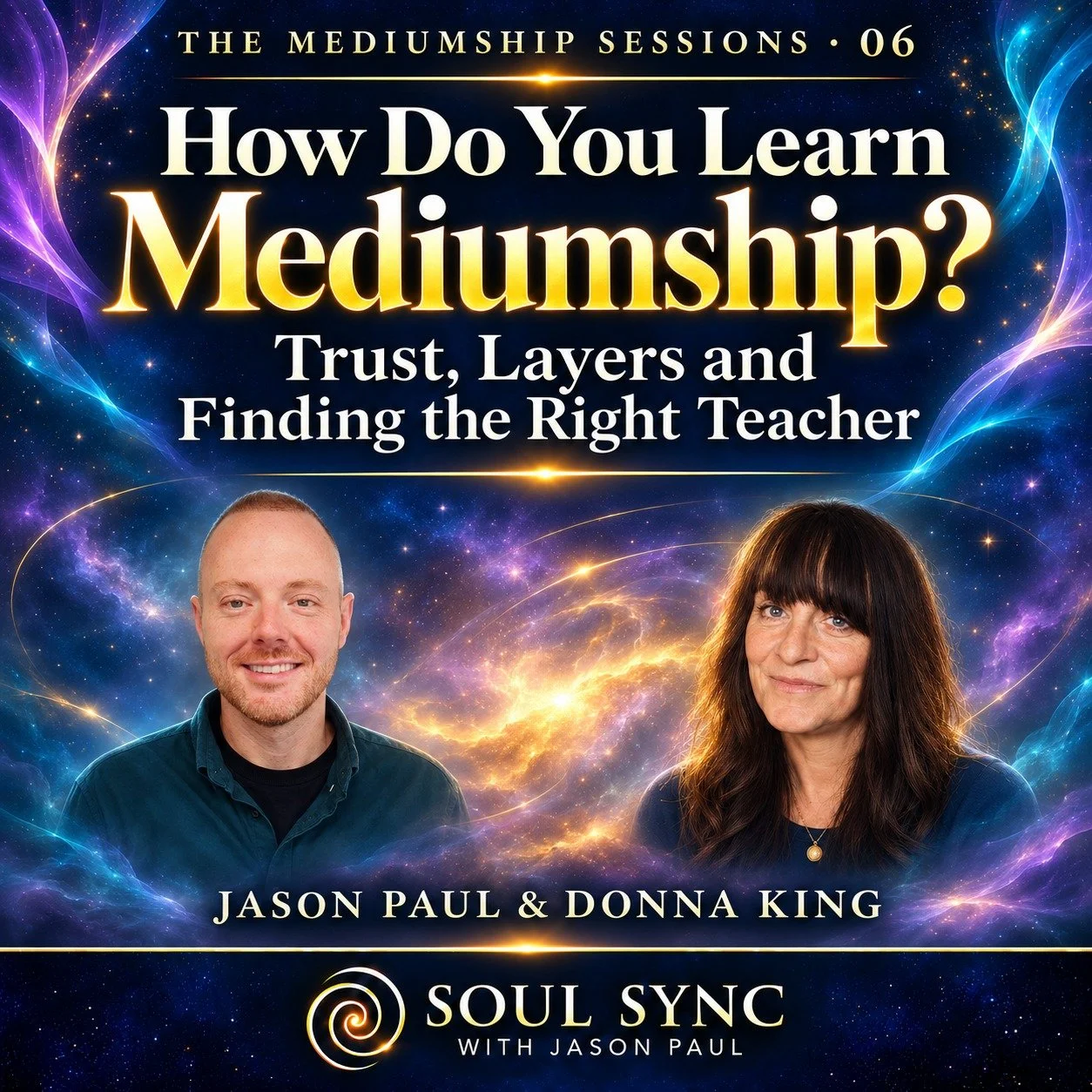
The Mediumship Sessions #6, with Donna King
Can mediumship really be taught? A week after a demonstration I’d rather forget, Donna and I talk honestly about how mediumship is learned, why no two mediums work the same way, how to find the right teacher, and why trust matters more than technique. Press play below, or read on.
A week before Donna and I recorded this episode, I stood on a platform and had what I can only call the demonstration from hell.
There was an expectation in the room about who people wanted to hear from. Every contact I brought forward was met with a polite no. It felt like wading through treacle. If there had been a trapdoor under that stage, I'd have pulled the lever myself.
I'm telling you this because I want you to know that every medium has these evenings. And because of what happened next.
Over the following week, the spirit world sent me lesson after lesson. Reading after reading, the person who stepped forward wasn't the one the sitter had hoped to hear from. Some of those readings had been booked weeks before that demonstration. When one of my mentors told me she was glad it had happened, my ego wanted to argue. A week on, I'm grateful too. That evening taught me more than a dozen good ones.
Can mediumship actually be taught?
That's the question Donna and I set out to answer in the sixth of The Mediumship Sessions. It's a fair one, because mediumship isn't like learning to drive or bake bread.
In most subjects, a teacher can give you a process, show you what good looks like, and with practice you'll get there. In mediumship, everyone experiences spirit differently. Donna reminded me of something I once said to her: who says my green is your green? Maybe my green is your blue. The spirit world work through your memories, your feelings and your way of seeing the world. Nobody can hand you that language. You have to discover it.
So when people ask me how to learn mediumship, my honest answer is that you don't learn it the way you learn a skill. You unfold it. And the way spirit works with you will keep changing. I used to always start with a face, clear as day. Then one day the faces stopped, and for a while my confidence went with them. I now think of those moments as an upgrade, a new way of working that spirit is ready to give you. They're uncomfortable, but they're not a sign you've lost it.
So what can be taught? To an extent, quite a lot. Learning about your own energy and the energy of your soul. Building a relationship with your spirit team and getting to know how they work with you. Sharing experiences, and simply being in a space with other mediums, helps more than any textbook. The rest is an unfoldment, and it takes time and patience.
The spirit world are the best teachers
Mediumship isn't learned in a straight line, either. You don't tick off one module and move on to the next. You might have a breakthrough one week and feel like you've gone backwards the next, and both are part of it.
People often get in touch to ask what the modules are on my courses. It's a fair question. From my experience as a teacher, I know the areas I need to touch on, and we cover them. But I let spirit lead the way, because they're more intelligent than any lesson plan. They know what each person needs in that moment, and very often it isn't what I'd have guessed.
At the end of the day, the spirit world are the best teachers. My job is to hold a safe space and follow where they lead.
Why your teacher matters more than you think
Because mediumship is so individual, the teacher you sit with matters enormously.
Some teachers teach from the head: technique, structure, strategy. Some of you will thrive with that. Others need someone who teaches from the heart, where it's all about feeling and sensing. In my early days, I sat with some very technically minded teachers. They were gifted mediums, but that way of teaching just didn't resonate with me. Donna has always been drawn to heart-led teachers, and she'd tell you herself she couldn't work any other way.
I'm a bit of both. I'm logical by nature, and years in business taught me to hate inefficiency. But every reading I give starts with an emotion. Donna put it beautifully: my heart leads, but the logic hums away in the background.
It's also OK to outgrow a teacher. Sometimes a mentor is there for a season, sometimes a chapter, and sometimes just a couple of pages. Follow what you feel.
Layers: how spirit builds the picture
Our word of the day was layers. When I'm working, I always seem to start with a feeling of an emotion. The emotion becomes evidence, and the evidence builds into personality, memory and message. Each layer adds to the power, and you can feel the connection expand.
The danger is when your logical mind jumps in to check every piece. Each time it does, you break that energetic build, and the next layer has less to stand on.
On the day we recorded, I had earlier given a platform-style reading. A gentleman came through who was proud of his woodwork, the sort who'd never call anyone out to fix anything. A lady put her hand up, but she looked flat to me, while another woman nearby seemed to glow. I went with the vibrancy following my feeling and the energetic pull. Then the first lady said he was never much good at carpentry anyway. A week earlier, I might have heard that as a no and lost my nerve. Instead, he laughed along with her about being imperfectly perfect, and the layers kept building.
The number one thing a medium has to learn
If you take one thing from this episode, let it be this. The biggest lesson in mediumship isn't technique. It's trust.
Most people drawn to this work already trust the spirit world. What they don't trust is themselves: their ability to interpret what they're given, and their right to say it out loud before the mind talks them out of it. I spent years trusting spirit completely while doubting myself. You need to trust both.
That's why I believe the teacher's real job is to build trust, not tear it down. I've met so many people in my Tuesday circle whose confidence was knocked by a teacher who critiqued rather than nurtured. Some of them left their development for ten years. That breaks my heart, because when you shut away your sensitivity you don't just stop developing as a medium. You suppress a part of who you are.
When you do find the right people, it should feel like a homecoming.
Why I say experiment, not practise
In my classes, I'd rather you experimented than practised. It sounds like a small thing, but it takes the pressure off. Practice suggests there's a right answer you're drilling towards. Experimenting gives you permission to try something and see what happens.
And you will get no's. How can the spirit world teach you anything if you only ever want to be right? You'll never find out how your faculties work, or how spirit work with you, unless you're prepared to get things wrong. So be gentle with yourself. Be confident enough, and safe enough in yourself, to hear a no and carry on, because that's where the lessons are. My demonstration from hell proved that.
Expectations get in the way too: the sitter's expectations of who should come through, and our own of how a reading ought to go. The more we let go of them, the more room spirit have to show us something new.
From magician to mystic: spiritualising the self
There's a book I often come back to, Magician to Mystic: A Mediumistic Path to a Spiritual Life, by Brian Robertson and Simon James. Brian founded and leads the Inner Quest Foundation, a teaching centre for healing mediumship and the intuitive arts, and he has tutored at the Arthur Findlay College since 1995. Simon is the Foundation's vice-president, also teaches at the college, and was trained by Gordon Higginson. I was lucky enough to have Simon on Soul Sync.
The magician is someone at the beginning of their journey. The spirit world has shown them their potential, and perhaps they've made their first links. It's exciting, and it can be dazzling. When Simon came on the podcast, he called that stage a stepping stone, not the end goal.
The mystic is someone who has done the inner work. And that inner work is the spiritualising of oneself: the healing. Brian and Simon talk about restoring mediumship to what it was at its roots, a sacred, healing art, rather than something purely technical or a bit of entertainment. I couldn't agree more.
Simon made a point on the podcast that has stayed with me. Mediumship doesn't fix our wounds. It brings them to the surface so we can deal with them. Sometimes that means getting proper support, from a counsellor or therapist, and there's no shame in that at all.
So what does spiritualising the self look like day to day? For me, it comes down to four things.
Healing. Facing what this work brings up in you, rather than burying it.
Knowing yourself. Your patterns, your ego, your triggers. If you don't know your own stuff, it's much harder to tell what's yours and what's coming from spirit.
Looking after yourself. Your mind, your body and your energy: rest, boundaries, and closing down properly after you work. I've come across plenty of mediums who can make a link but don't look after themselves at all, and sooner or later it catches up with them.
Living it. Letting the work change how you live and how you treat people, not just what you can do in a reading.
If you come from a Spiritualist background, you'll recognise this in two of the Seven Principles of the Spiritualists' National Union: Personal Responsibility, that each of us is accountable for our own thoughts, words and actions, and Eternal Progress Open to Every Human Soul. Development isn't something that's done to you. It's something you take responsibility for, for as long as you do this work.
This is sacred work, and the person the spirit world works through deserves care. Mediumship takes time and patience, and a lot of that time is spent on yourself rather than on the link. I don't think that's a detour. I think it's part of the development.
Mediumship is healing, in all its forms
The longer I have done this work, the more I believe that mediumship, in all its forms, is healing.
It heals the sitter. Someone hears from a person in spirit, and something that's been stuck for years starts to move. Even when the person who steps forward isn't the one they hoped for, there's healing in it. As Donna says in the episode, spirit know better than we do why someone has come.
It can be healing for the communicator, too. Sometimes they come back to put something right, or to say what they never managed to say.
And it heals the medium. My own journey into this work has been one of healing: through loss, through finding my way again after leaving the police, and through learning to trust myself. I see it every Tuesday in my circle. So many people arrive carrying something, and simply sitting in the power with like-minded people is healing in its own right.
Then there's spiritual healing itself, which the SNU and many Spiritualist churches offer alongside mediumship, and trance, which so often brings healing to those who sit in it. It's all part of the same healing work.
Spiritual Takeaways
A difficult reading or demonstration isn't failure. It's often the lesson you most needed.
No two mediums perceive spirit the same way. Your job is to learn your own language, not copy someone else's.
When the way spirit works with you changes, see it as an upgrade, not a loss.
Mediumship doesn't unfold in a straight line. Let spirit lead: they're the best teachers.
Choose a teacher whose energy fits you, head-led or heart-led, and know it's OK to move on when a season ends.
Spirit builds a link in layers. Let each one land before the logical mind steps in.
Most developing mediums trust spirit. The real work is learning to trust yourself as well.
Experiment rather than practise, and be gentle with yourself when you get a no. That's where the learning is.
Let go of expectations, yours and the sitter's.
Do the inner work. Spiritualising the self matters as much as making the link.
Mediumship, in all its forms, is healing: for the sitter, for those in spirit, and for you.
If you've had your confidence knocked, find a space where you feel at home and begin again.
Learn with Donna and me
If this has stirred something in you, Donna and I teach together live on Zoom every week, and we try to make our classes exactly the kind of space we've just described: warm, honest, and a place where getting it wrong is part of learning.
The Power of You (psychic development) is where to start if you're new: Wednesdays, 6–8pm UK, from 25 November.
Moving in the Intelligence of Spirit (mediumship development) runs on Mondays, 7–9pm UK, for all levels.
Our Trance Circle runs on alternate Thursdays, 6–8pm UK, from 3 December.
And if you'd simply like to sit and experiment, my free development circle is every Tuesday, 6–8pm UK.
You, my lovely reader, are a powerhouse of potential. Start listening to what you feel.
Learning Mediumship FAQ
Can mediumship be taught?
To an extent. Sharing experiences, and simply being in a space with other mediums, helps enormously. But no one can hand you a technique that makes you a medium. A good teacher creates the space and the encouragement for your own way of working to unfold.
How long does it take to develop mediumship?
It never stops. You're always learning, and the spirit world will keep teaching you new things for as long as you do this work. It's an unfoldment that takes time, patience and a fair bit of self-work.
How do I develop my mediumship?
Learn about your own energy and the energy of your soul. Build a relationship with your spirit team and get to know how they work with you. Then experiment, sit with other mediums, and be gentle with yourself when you get a no. That's how you discover how your faculties work.
Is there a set syllabus in your classes?
I know the areas every developing medium needs to cover, and we cover them. But mediumship doesn't unfold in a straight line, so I let spirit lead each class. They know what each person needs in the moment.
How do I choose a mediumship teacher?
Notice how you feel in their classes. Some people thrive with a structured, head-led teacher, others need someone heart-led. If you leave feeling smaller rather than more confident, they may not be the right teacher for you right now.
What is the most important thing to learn in mediumship?
Trust. Many people trust the spirit world but not themselves, and you need both: trust in spirit, and trust in what you receive. Letting go of expectations comes a close second.
What does spiritualising the self mean?
It's the inner work that sits alongside the link: healing, knowing yourself, looking after your mind, body and energy, and letting the work change how you live. In Magician to Mystic terms, the magician is at the start of the journey, discovering their potential and making first links. The mystic has done the inner work, and that inner work is the spiritualising of oneself.
Is mediumship a form of healing?
I believe it is, in all its forms. It brings healing to the sitter, it can bring healing to those in spirit, and the journey of development is a healing one for the medium. Spiritual healing and trance are part of the same work.
-
Jason: Donna King, here we are again on The Mediumship Sessions. We've made it to number six. Lucky for some, unlucky for others. Lovely to have you back, my darling.
Donna: Hello, darling.
Jason: It's been an exciting week. So what have we done over the last week? Well, I had the demonstration from hell, which I do want to talk about to some degree, because it was like treading treacle. There was an expectation within the room about who people wanted to hear from, and that expectation meant people wouldn't accept the contacts that were brought forward.
Jason: I'm a week on from this now, and I have to say, that evening was painful. I basically wanted a trapdoor to open up under the stage and swallow me. But I already feel really glad, because what I've learnt from it has way outweighed the experience itself.
Jason: And the funny thing is, throughout this week the spirit world have really taught me that lesson, because I've done several readings where the person who's come through isn't the person the sitter wanted to hear from. Isn't it funny, the intelligence of the spirit world? Even in those moments when we feel like we're in the gutter with our mediumship and our confidence has been knocked, and I've heard it all over the years on this podcast, people who feel they've even lost their connection, the spirit world use those experiences. And the proof, the synchronicity, is that some of those readings were booked with me before the demonstration.
Jason: So this is where we get into linear time not existing. That was meant to happen, because it taught me the lesson, and the spirit world reinforced it all week. Isn't it funny how these things work, Donna King?
Donna: It is. The journey of the medium is not an easy one. People presume you start doing this, you learn how to do it, and off you go. Actually, the moment we learn how to do it is the moment the real lessons start kicking in, and navigating that can be really challenging. But once you work through it and come out the other side, the learning changes, and spirit find other things they can teach you. You never stop learning. I know I will never stop learning about my mediumship. It's not a job where you get to a point and think, oh, we know what we're doing now. And if you do, as people will have heard before, you've arrived at the wrong place, because it's a never-ending journey. But in the grace of the lessons, once you come through the other side, the benefits far outweigh the experience. And of course, in mediumship, the last thing we want is a constant 'No, no, no.'
Jason: Oh, it's every medium's worst nightmare. When you're thinking about going out on the platform for the first time, that's the experience you don't want. The journey of a medium is a very hard one, and it's not one you take on lightly, partly because of the responsibility and partly because it's genuinely difficult. But what I've thought about over the last week is how we can only communicate what we know, what we've experienced, what we've seen and felt and heard, and the list goes on.
Jason: When a couple of my mentors said to me on Monday, 'I'm sort of glad it happened for you,' instantly the ego jumped up: 'What do you mean you're glad this awful experience happened to me?' But I'm glad it did now. I've seen it time and time again in my work empowering people in recruitment: it's the really difficult experiences that make you grow the most. Even when I left the police, I was in the gutter then, I'll tell you. But if I hadn't done that, I would never have started my own business. There's a lesson in everything, and I could have kissed my granddad this week for how many things he's brought through about that evening. He comes through for me all the time, bless him, and the synchronicity this week reassured me. Spirit really do have our backs.
Jason: So the topic of discussion today, very timely, funny how it all ties in, is learning and developing mediumship, and teaching it. Mediumship is a funny old subject, because in most subjects you can, to some degree, learn by being taught. But mediumship is unique, because everyone experiences it differently. If you're learning another skill, it's generally not that individual. What are your thoughts on that?
-
Donna: Well, every person has their own thought process and their own way of perceiving things, so there's a uniqueness to the individual and a uniqueness to their mediumship. You talked about life experiences, but spirit will also pull on things that are in your subconscious, not always things you've experienced. Their intelligence and their ability to influence us to get the message through is, as I've said before and I'll say it again, far greater than we can possibly comprehend. How one person works will never be how another person works. There's a similar basis, the clairs, clairvoyance and so on, but how the messages come through will always be different. As you said to me once, who says my green is your green? Maybe my green is your blue.
Donna: They never cease to amaze. They'll use your own unique perception to bring things through, and it will probably always be different. It can look as though mediums are all doing it the same way, but in your teaching you notice the subtle differences in how people work. There's a feeling in the way they perceive things that I can sense but don't fully understand, because it isn't a human kind of perception. I know that sounds far-fetched, but it's an energetic perception of how different individuals work.
Jason: No, it doesn't sound far-fetched.
Donna: She doesn't know what she's talking about! But I do, because I can feel it. That again is about the layers.
-
Jason: The example you gave is a really good point. The way I see green, you'll never know if that's what another person sees, because you only know how you perceive it. It wouldn't surprise me at all if your blue was my pink. The only person who really understands how we experience the world is ourselves, and that's why in mediumship everyone experiences it differently.
Jason: I've made this point before, but I'll make it again because it's important. A lot of people assume that when a medium gives a reading, the spirit person is talking into their ear, like an earpiece in a television studio. I used to think it was like that, because of the fluidity of it. What you don't realise is what's going on in the medium's mind during a contact. The spirit world are giving impressions, sensations, feelings, memories, and it's so individual because no one will ever experience things in the same way.
Jason: So when you start learning mediumship, you've got to practise, practise, practise, because it's about understanding how the spirit world work with you. And even that will develop, evolve and change. This is where people get their confidence knocked, because they get into a groove, a way of working. I used to always start clairvoyantly with a face. It was vivid, I'd always see it, and that became my way of working. Then the spirit world decide you're ready for a firmware upgrade, a download, the latest patch, call it what you like, and suddenly the medium's confidence is knocked: 'What's happening to me? Why am I not sensing it the same way?' The first thing to do is look at that as a blessing. We have to look at the bad experiences with a level of gratitude. Like I said, I wanted that trapdoor to open up, but there were so many lessons and developments in it, and that is how you learn mediumship.
Jason: I've noticed in the teaching I do, and in the Tuesday free circle, that everybody has a totally unique way of working, interpreting and sensing. That's why you can't teach someone to do mediumship, and it's also why you need to make sure you work with a teacher or tutor who resonates with you. There's something about the energy between you and a teacher, isn't there? I've sat with teachers where my mind's trailing off and I'm getting bogged down in technique. They were teaching from the head, and it just didn't land with me.
-
Donna: Yes, it does matter. Some people are very logical, and it makes sense for them to be with a teacher who teaches from logic. I'm not saying those teachers aren't spiritually influenced, but they're very involved mentally with the teaching and the strategy. Others need somebody very heart-led, where it's all in the feeling and the sensing. And even in that there are layers in between. For me, the teaching definitely works through the heart, as it does for you, but you're very logical as well. So there's a balance with you. Your heart leads the way, but there's still this real intelligence playing in the background. I can feel it with you. It's almost like a subconscious ticking in the background, and it influences your heart, which is amazing.
Jason: Explain that to the listener, because I've said on this podcast before that mediums tend to fall into one of two camps. Labels aren't always helpful, but they're either heart-led or technical. How would you explain the way I work, being both, and what do you feel it brings to the mediumship?
Donna: With you, it's like an organisational skill. And I feel it's a learning process you're still moving through, which is allowing you to move away from the logic, from that intelligent mind that's been very business-orientated, into moving within the power that you are. That naturally sits in your heart, because you're a very heart-led, sensitive, empathic person. That's the essence of you. It's not that you work from the logic, because you don't, but I can still feel it simmering in your energy while you learn to be in the true essence of who you are in your work. Other people may disagree with me, but that's how I feel it energetically. And to be honest, I would not be working with you if you weren't a heart-led medium.
Jason: Well!
Donna: Working with somebody who works too much from the logic, I couldn't possibly do it, because I'm too heart-led, and to me that matters. I've always gone with teachers I feel drawn to who are more heart-led than logical, and you can see that in the list of teachers I've been to at the college. The further you get down the road of mediumship, the more you learn and the more you go to others for teaching and advice, the clearer it becomes who sits better with you energetically. There's quite a difference
-
Jason: There is, and I understand what you're saying. If I tried to explain to the lovely listener what actually goes on in my head... don't worry, I'm not going to divulge anything outside the watershed. My mind is a weird and wonderful place. I'd say I'm technically minded, though not academic. What I am is very logical. Even in my recruitment career, I was all about the most efficient way to get things done. One thing I can't stand is inefficiency. But when I look back through my own mediumship, I'm very much led from the heart, because it's always about emotion. A reading always starts for me with an emotion, and that emotion fuels everything that follows.
Jason: One of the big things I've learnt recently is this. When the power starts flowing, I can read very quickly, which is a blessing in a sense, because I've got a quick mind. But what I've started doing a lot more is just allowing the power to build. What I'm feeling internally is a build-up of emotion, and it gets to a simmering point, like a pressure cooker, and then it's 'Okay, now go,' and I'm off again. One of the big barriers I had for a long time, and we all go through periods where we feel we can't get past a certain point, was that I'd get a piece of information and couldn't allow it, because of how logical I am. I'd get the evidence in a nanosecond, it would go straight up to the brain, and then I'd be in and out of the power.
Jason: Now, on moving in and out of the power: as a teacher, how do you recognise it? Take the lovely Power of You psychic class we did yesterday. There were moments when you said to our students that they'd moved in and out of the power. I can see that myself now in other people. How would you describe it to the listener?
Donna: For me it's an energetic shift. I work closely with a guide, so they'll be prompting me alongside my own natural intuition, which has been built on for a lifetime. You can feel the slightest movement. I'm feeling to describe it as a rising in the energy, almost a movement from here to here. I don't see it, I perceive it. And then you can read the difficulty and understand the emotion behind it.
Donna: But that's getting into the complexities of teaching, when you start being able to see what students are feeling and seeing. As a teacher, and I feel emotional saying this because it's my passion, you need to learn the art of seeing what they're seeing and being with them in that moment, perceiving how they feel about it. We had one student yesterday who saw a boat, and I could feel there was nothing else with it. God bless her. She wanted more, but there wasn't more. It's about being able to feel that, perceive it, and be prompted in what needs to be said to encourage her and let her know that it was perfectly great in itself. It's always the layers, apparently! But it's the layers of perception and how they're built, and that only comes with time. There's nothing like time and commitment in the world of working with spirit
-
Jason: I agree. When someone's developing their mediumship... I'm not going to name names, but I've come across teachers who take a very different approach, one of critique: 'Do you want to be this? Do you want to be that?' The problem is, take the example you just gave, someone receiving one thing and feeling that everyone else got more. That person will probably go away, as we do as humans, and beat themselves up, and it can really stay with them. You've got to be so careful. A lot of people come to the Tuesday circle whose confidence has been knocked, and the next thing you know, they've left it for ten years.
Jason: And that's not just about their mediumship stalling. What they're probably doing in that time is suppressing their sensitivity, not knowing how to navigate their life with it. If you're sensitive and you're suppressing it instead of embracing it and learning how to work with it, you've essentially got a superpower you're not activating. That's sad. And if you're meant to be on this path, meeting other mediums and sensitives should feel like a homecoming, because there's a certain understanding there, a sense that you can just be yourself
-
Jason: Now, to bring you back to the word of the day. What do you mean by layers?
Donna: It's an energetic building of the picture spirit give you, and how it's used to determine the information that moves forward. As I move in, I'll see the person, I'll generally know the relationship, and then the feelings come, and it layers itself up. It's the same in teaching. Yesterday I could feel the possibility of someone wanting to bring mediumship in, because I could feel an individual making themselves known to me. That's why I said no mediumship. Being a teacher, you've got to have that. That's why I love it. It's kind of nosy work! You know what's going on. Actually, I probably am nosy. It's the intrigue of the question.
Donna: But it's about the layers of my own intuition, working with spirit, them showing me, and the building of it. Everything we do is an energetic build of layers. There are probably lots of misconceptions that the pictures just form in our minds, but there are energetic layers that allow spirit to imprint us. Even clairaudience is an even more complex layer of energy they have to put in place to get words into my ear. And it's usually subtle. Very rarely do I have spirit shouting in the middle of my head, but when I do hear it, it's clear, like a shout.
Jason: Do you know why? When they need to do that, it's probably because you need to be shouted at, so you give it a different level of attention!
Donna: When they're being firm with me: 'Well, we want to talk!' Yeah. Listen.
-
Jason: You're absolutely right about layers, because it is like that in mediumship. When I'm doing a reading, I'm building up the layers. It starts with emotion, the emotion builds into evidence, and that builds into whatever it might be. You're stacking it up. The problem is, if you keep moving into the left side of your brain and going logical, every time you do that, and this is where trust really comes in, you're breaking that energetic connection, and the layering doesn't have the same power. Because what I'm really feeling is that you're building the power with each layer. One thing comes, then another, then another, and you can feel that expansion.
Jason: This morning I did a reading, a platform-style demonstration. The first thing I got was a man with a sense of pride, not ego, and a sense of humour. He was showing me himself working with wood, a fabulous carpenter, one of those people where if something broke around the house, there was no need to call anyone in, he'd fix it. I brought through a few more pieces of information, the layers were building, and then I put it out to the room, and a lady put her hand up.
Jason: Now, because of the lessons I learnt last week, funny that, isn't it, the spirit world, gotta love you, I noticed that the lady who put her hand up looked quite dull to me. And there was a vibrancy to another lady. I could feel her power building, and she was almost becoming more vivid. If I'd gone with the woman who put her hand up, and she was the only one who did, the energy would most likely have dropped. I'd got it to a point where it was building enough for someone to put their hand up, but then it would have gone down. By going with the vibrancy, which did shock a lot of people, it was almost like saying to that first person, 'Just listen on.'
Jason: Then the first lady said, 'Well, I'll tell you this about the carpentry. He wasn't the best at it, if I'm being honest.' What would happen to most mediums in that situation is, that's a no. 'Goodness me, he's making such a thing of the carpentry, how have I got that wrong?' But the first thing he came back with was his sense of humour: 'Well, yes, the carpentry wasn't great.' He was having fun with it, laughing at the beautiful nature of being imperfectly perfect. Then the layers were going again. Building, building, building, and up went the energy. Because I'd started slow, by the end of the reading, when the person running the session wanted to come in with some feedback, I was like, 'I might have no feedback right now!' Because it had been delivered.
Jason: I think that explains layering well. What you're really doing is building that energy. And what a teacher needs to instil in people, and what I've learnt through the teaching I've been doing, and I'd be interested in your thoughts on this, is that the number one thing, the core focus above everything else, is trust
-
Donna: Yes, absolutely. It's rarely about trusting in spirit. Normally, by the time somebody's working with spirit, they trust them. They've had the experience. They know.
Jason: Funnily enough, if you'd asked me years ago, I'd have said that once I got to a certain point, I trusted the spirit world implicitly. It was my ability to interpret it that I didn't trust.
Donna: And that tends to be the problem. We can even believe we trust ourselves with it, but then there are the layers of the human and the emotions. Were we really trusting ourselves with that information? Because the intellect does want to come in. I could feel that yesterday with somebody who was questioning what they got. Just allow it to move. The information isn't for you, so it isn't for your human intellect to intervene. It's that real sense of being of service, because it's never about us. We're just the bit in the middle passing the message on. And the layers of that work unfold more as you develop.
Donna: There's always more. I now understand that it's all been layers from the start. We can't possibly comprehend it all. By allowing yourself to be in the moment and let the unfoldment happen, moving with that energy, it changes. I'm a quick thinker, but sometimes spirit will keep things slow, and I believe it's because that's what works best, for the person coming through and for the recipient. Other times it moves much quicker, because that person might have been quicker, and they may need to hear more than you'd get through if they spoke slowly. People always say slow down, slow down, and I agree that in the beginning you probably do need to. But it's that whole thing of trusting spirit, because they know what they're doing. We've never got all the answers, and I never will. I'm going to be the nosiest person when I go home, I'll tell you now.
Jason: Oh, me too.
Donna: I've told them, 'Put it on the list, put it on the list.' I've forgotten what's on the list, mind you
-
Jason: I know now without a shadow of a doubt that this is my life's calling. But what kept drawing me in during the early days was that I needed to know what had happened to my loved ones. I wanted to know what goes on in the other world, and no amount of information was enough. I've never been the sort who believes what I'm told. I make up my own mind. My own granddad was a medium, and even that wasn't enough for me, because I hadn't sensed it myself. So I came into this very discerning, and you've got to be like that as a student.
Jason: If you're on the journey of mediumship and you've been working with someone, you've also got to accept that sometimes a mentor is there for a season, or a chapter, or sometimes just a couple of pages. You're not meant to be with someone forever, and you've got to follow the way you feel. Once you start listening to your intuition, your gut, your soul, whatever you want to call it, you'll notice life starts flowing. My mind is blown all the time, because mediumship and the spirit world really are magic. I'm in awe so often of how much the spirit world want to help us. At the very beginning, I'd see synchronicities and brush them aside as coincidence. But when you start listening to how you feel, what unfolds is literal magic. This last week has shown me how much I'm being guided, and that I couldn't be further from being alone.
Jason: Trust is so important, and everyone listening will have a different relationship with how much they trust themselves. You might be at a stage where it's flowing: you trust, you say it, it's received, it's taken. Then something comes up. I saw it this morning in a circle. A lady got completely thrown because the communicator who came forward had transitioned, and she wasn't sure how to refer to them. In that moment it eroded her trust, because she'd received something she hadn't come across before. What you've got to realise is that this is going to happen. I feel that over the next twenty years there will be huge changes in the communicators the spirit world bring through, because we're changing as a society. Ten years ago, were we getting communicators who were au fait with the internet? Your mediumship never stops evolving and changing. A lesson I learn one day is immediately added to the vocabulary the spirit world can draw on over the next week.
Jason: So when we're teaching people, what stands out to me is that at a foundation level, all of mediumship is about trusting and relaying what you get. You made the point that you're nosy, and so am I. I'd call it curiosity, and that often makes the best mediums. But it's not your story or your journey, and you're not going to understand it all. The sooner you let go of the need to interpret, and I was a right one for it, the better. I'd get something, and before I knew it, it had gone round the purple washing machine like Chinese whispers and come out as something else. So how do you facilitate and build that trust in your work? Because you don't have a trust magic wand you get out once a week and sprinkle over people.
-
Donna: By not being a teacher of critique, if you ask me. Even for those whose life's purpose isn't to be of service to spirit as their main career, every person has a part to play. So it's about making sure everyone who steps forward wanting to learn can become everything they need to be, want to be and strive to be, and build on that. Even if somebody gives two good readings in their whole life, those readings had purpose and they brought healing. For me the intention is always to come from the heart and encourage people to be the best they can be, because aren't we just being of service? If it isn't about being of service, what are we doing? It has to come with the right intentions: helping people develop, be confident, build their self-esteem, learn to get their mind out of the way, and become that beautiful channel of power for the message to flow through. I think I've answered your question. I'm not sure!
Jason: You have. And a key point here is that, as a medium, and I make no bones about it, just look at my website, it's a declaration of service to spirit. Of course I'm in service to the person in front of me, but they're second to spirit if what's happening is a spirit communication. In a psychic reading, my attention is with the person. But in a mediumship reading, you're with the spirit person first. Most people understand that. The problem is, you start a reading with your attention on the communicator, and that's where you need to be. But this is where building and holding the power comes in, because before you know it, you've drifted over towards the sitter, or your attention's up in your head.
Jason: In the early stages, you might not even know where you are. You might feel, 'Oh, I'm with them,' but I've seen people start with a spirit person and then drift into reading psychically. If someone's dad has come through, there's psychic energy around the sitter too. They'll have impressions of their dad, and the medium could be saying things that are right about life memories, but the attention has actually moved away from the spirit person. How would you address that?
Donna: There's a very different energy between someone reading psychically and someone reading mediumistically. You ask that person to take a moment, pause with that information, go back into their own power, and remake the connection. I say it's as simple as that, but it isn't, because people do drift. And there are people out there who believe they're doing mediumship when they're reading psychically, because they've never been shown any other way.
Donna: When you're reading from the heart, you can really feel the emotions move. You can feel them in the sitter, and I'll always feel the emotions of the communicator who wants to pass the message to their loved one, even when they're not showing it, because there's a movement in that energy. In psychic work, that won't quite be there. It's almost like reading a book. The volume, the emotion, the real senses dissipate, because you're reading facts intuitively. You can read intuitively with your guides, and that's a blend, but working from your own intuition feels very factual. You might say, 'I know you felt emotional about this,' but the depth isn't there, because the connection isn't there.
-
Jason: There's always a lot going on. In many connections, when you bring through that love, that feeling of being a kindred spirit, there's a meeting and merging of emotions that builds the energy of the connection. But you can get readings where the person in the spirit world is bringing through an abundance of love, and the sitter doesn't want to hear from them and isn't particularly happy. And that goes back to trust. You're bringing through all that love, thinking, 'I've got a dad here who wants to talk to his daughter,' and then you can feel energetically that she's not pleased to hear from him. That can absolutely throw a medium, and before they know it they're in their head. But why are you sensing that? Why are you getting it? We like to think, of course a daughter would want to hear from her dad. But every person in front of you is different, and every communicator is different.
Jason: In one reading you might not have just one person coming through. I've had whole families come through recently, and the sitter feels differently towards each of them, especially when relatives come from both Mum's side and Dad's side. In my own family, you'd know instantly which grandparent you've got, because one was a medium and the other was all about status and where you sat in life, and was very hard on me. My granddad loves to experiment with mediums. He shares the same passion for teaching and empowering people that I do; he just does it from the other world now. I've had readings that start, 'Your granddad's come through, he wants to show you this,' all very upbeat, and then, 'He struggled quite a bit with certain things.' The energy has completely changed, because the other grandfather has stepped forward. That's why it comes down to trust and moving in the moment. One question we get asked a lot is how you maintain the power. How do you make sure, Donna King, that you're at full voltage for as long as possible?
Donna: Again, it's about the time you give to it. For me it's learning to sit within that power, in total trust, and trusting yourself to move with the messages and with what's going on. I've had many readings where I could feel the sitter didn't want to speak to the person who came through, and then we have to unlayer why. You have to be quite skilled to pass that message forward, because there will always be a form of healing in it. Even if the sitter isn't open to it at that point, spirit know better why that person has come forward. There are layers of intelligence we don't always comprehend, but the more you work with it, the more you understand. It's about trusting your own ability and giving it the time to build on staying in that power. You can't just flip a switch, as we said at the start. You have to keep giving yourself the opportunity to work with it. For me it starts with the psychic, the intuition. That's the basis that lets people feel their own power and move within that energy, and that allows the expansion into other areas.
Jason: If I could give the lovely listener one bit of advice, it would be back to basics, but not really basics. You, my darling listener, are an absolute powerhouse of potential. You have so much power within you to achieve so much and make your dreams come true, and it's about starting to move with what you feel. And be discerning about who you listen to. I could go to my mum's house now, tell her something I know is right, and she could talk me out of it. We all have people around us who love us, and many of them are risk-averse and want to play it safe. If you come up with an idea and you feel it, but the people around you are putting you in your head, I can honestly say that in my business career, every time I followed my gut, even doing some crazy things, and I'm someone who'll roll the dice at the best of times, I've never lived to regret it. That comes from a well-trodden life and a filing cabinet of mistakes that probably stretches from my house to yours, Donna King. So, it's been a blast on The Mediumship Sessions. What final thought would you like to leave the lovely listener with today?
Donna: Just trust. Trust in yourself, trust in what you feel, and trust in allowing yourself to take the opportunity for growth. Trust.
Jason: Trust. And the word of the day: layers. We love layers. Donna King, it's been a blast. The Mediumship Sessions are back next week. Enjoy