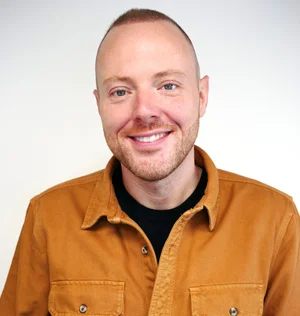
Steven Trolland was sitting at the top of a hill in the Scottish Highlands, looking down a valley over a loch and the tops of the trees. His brother had died, and grief had swallowed everything.
He'd found meditation, and it wasn't working. His brain, in his words, "jumps all over the place". The harder he tried to focus, the more strain he created in his own mind.
So he took his headphones off, took a breath and simply breathed out.
Something in him surrendered. His attention drifted to the treetops bending in the wind, then up to the clouds, and everything started moving together in harmony, with him part of it. What he understood in that moment is the line from this week's Soul Sync I keep coming back to:
"I am not my thoughts. I am not all my grief."
When the mind won't be still
I know that racing mind from the inside. I've got an ADHD brain, and at the start of my journey, and at the hardest points since, I couldn't get hold of my thoughts at all. I'd sit down to meditate and get up feeling like I'd failed at the one thing that was supposed to help.
In the episode, I asked Steven what mediumship has taught him about being alive. He answered by starting with being dead first. Before all this, he said, he wasn't living. That was his grief. I recognised that straight away. There were long stretches of my own life, before mediumship, when I was existing rather than living.
If you're grieving and can't find stillness, please hear this: it isn't a sign you're doing it wrong.
What grief actually does to the mind
There's a reason grief makes the mind so loud, and science is starting to explain it.
Mary-Frances O'Connor is a professor at the University of Arizona, where she runs the Grief, Loss and Social Stress (GLASS) Lab. Her work describes how hard the brain works to keep track of where the people we love are, and how badly it struggles to absorb a new fact it can't ignore: that they're no longer there. Hospice Foundation of AmericaThe Marginalian
She and her colleague propose a "Gone-But-Also-Everlasting" model. One part of us holds the sense that our loved one is permanent, while our memories of their death say otherwise, and the two collide. They suggest grieving is a form of learning that needs time and lived experience. PubMed Central
Read that as a medium and it's quite something. The mind is wrestling with two truths at once, and we'd say both are true: they've left the physical world, and they're still here.
You'll also hear a lot about Bessel van der Kolk's The Body Keeps the Score, which argues that pain is held in the body as well as the mind. It's been hugely influential, and parts of it are debated by researchers. But most of us recognise the core idea: we don't just think our grief, we carry it.
The soul doesn't need healing. The mind does.
Steven turned a familiar spiritual saying on its head. People talk about healing the soul. After that hillside, he stopped believing it. In his words, it's the purity and beauty of the soul's natural expression that heals the mind.
I think he's right, and it reframes everything. The soul is eternal. It isn't broken. When we're struggling, it's usually the mind: the loops, the replays, the stories we can't step out of. And Steven's answer to that is simple. Whatever we give our attention to, we give our power.
What his brother taught him about evidence
Near the end of our conversation, Steven shared the moment that made me stop.
Before he'd trained as a medium, his brother came close to him. So close that, as he put it, his brother's tears were his tears and his emotion was Steven's own, two souls as one. There was no conversation. Nothing else was needed.
Then, as his brother withdrew, the evidence came: his sister, his nephew, a rubber duck, football. He texted his sister, and she confirmed that his nephew had just finished playing with his favourite rubber duck in the bath while she watched football with his dad.
That's brilliant evidence. And Steven's point is that it doesn't come close to what came before it.
That matters for anyone thinking about a mediumship reading while they're grieving. Evidence matters, and it's how you know the connection is real. But evidence isn't what heals. What heals is feeling your person's presence again, even for a moment. Steven's own website puts it this way: information can reach the mind, but spirit's presence reaches the soul. Steven Trolland
I'll be honest about what a reading can't do, too. It isn't a replacement for grief support, counselling or the people around you, and it won't make grief disappear. What it can offer is evidence that the bond hasn't ended. Grief researchers call this "continuing bonds": healthy grieving is often less about letting go than finding a new way to stay connected.
They're closer than "going home" suggests
We often say that when someone dies, they've "gone home". Steven questions that, and so do I. As he sees it, home is here, now. We're already in the spirit world, just looking through physical eyes. Our loved ones see through our eyes, hear through our ears, and are even in our emotions.
For years in my own development I was reaching up and out to somewhere that wasn't right here. If you're grieving, I'd gently offer the same shift. They haven't gone somewhere far away.
If you can't meditate right now, stop trying
When Nicola Farmer was on the podcast [link: /insights/what-are-we-really-capable-of], she said the word "try" allows failure. Steven's hillside proves it. Nothing happened while he was trying. Everything happened when he stopped.
So if stillness won't come, don't force it. Walk. Sit outside. Breathe out without an agenda. And let people help you. Steven described the friend who won't let you sit inside, who says, "You're coming out with me, let's go and see these waterfalls." Like a rose planted in dry sand, you can't grow in the wrong conditions, and nobody would blame the rose.
Connect with Steven Trolland
Steven Trolland is a certified spiritual medium who lives in the Scottish Highlands with his family, and his awareness of life after death opened up during his competing years, after his brother passed. He's also the reigning British snowboarding champion, with 13 British podiums to his name. He has trained with renowned mediums and at Arthur Findlay College, and offers psychic, mediumship and soul path readings online, by phone, or in person near Inverness. The Steven Trolland Recordings
Find Steven at steventrolland.com
Listen to the full conversation
This post follows one thread. The full episode goes into much more, including why Steven puts his attention on his stomach when a demonstration feels flat, and the reading where he says he "robbed" a woman of contact with the mother she'd never met. Listen above, on the Soul Sync podcast page [link: /soul-sync-podcast], or search "Soul Sync with Jason Paul" wherever you get your podcasts.
If you're grieving and feel ready for a mediumship reading, I work with people worldwide over Zoom. Find out more on my services page, or get in touch via the contact form
-
This transcript has been lightly edited for readability.
Jason Paul: Steven, it's so lovely to have you on Soul Sync. Thanks for coming on.
Steven Trolland: Oh, thanks so much for having me. It's an honour and a privilege to be here and just talk about spiritual matters. As always, it fills my heart and soul.
Jason Paul: It's an honour to have you on, thank you. The clue is in the title as to what you are. You're a medium and a teacher, amongst many things. But before that became a central part of your life, so we can get to understand you, what was your life like before mediumship came into it?
Steven Trolland: Oh my gosh, where do I start with that? Let's just say my passion, my love, is snowboarding. I grew up in the beautiful Highlands of Scotland, more or less at the foot of the Cairngorm Mountains, where there's a small ski resort. I found a passion for the snow in Primary 7. We used to go up with the school every second Thursday or something like that, when it wasn't stormbound, of course. Ever since then, it's been something that really fulfils me, and it's never, ever left me. I started off skiing and then went to snowboarding. And there's nothing like the exhilaration of it. Anything and everything that could ever trouble you just dissolves, for me personally, as I'm snowboarding down the mountain. That led into competing for my country, competing for Britain, for a good few years. To date I've had 13 podiums in the British championships and, I think, seven British titles. I'm the current British champion, at the good old age of 52 or 53, I think?
Jason Paul: Well, I was reading about your snowboarding accolades, and one of the things that fascinated me was that you realised it wasn't just a physical ability. A lot of snowboarding is about mental perception. That struck me as interesting, because it sounds like that was your first real understanding that our inner state changes what becomes possible.
Steven Trolland: Yeah, absolutely. Thank you for highlighting that. You've just put it in really simple words for me, too, so thank you.
Jason Paul: Is mediumship actually more similar to an elite sport than people might imagine? The ability matters, but the state of consciousness matters just as much, doesn't it?
Steven Trolland: Absolutely. There's the fun, the love, just blasting around the mountain, as I mentioned, and the perception that puts me in. But when it comes to competition, you go through certain types of nerves, and nerves can change your perception, which then changes your performance. It's similar in some ways when it comes to mediumship. But for me personally, nerves are good. Embrace nerves. I call it excitement. Because the nervous system needs to be stimulated for us to become hypersensitive, to perceive the expression of those that love us in the spirit world, and also our own soul expression, too.
Jason Paul: I completely agree with that. Now, when I was reading the notes you provided me, it very much sounds like the passing of your brother was one of the great turning points in your life. And it also sounded like it was a very profound spiritual experience.
Steven Trolland: Absolutely. Many people will know what I've gone through, and we know grief is completely unique to each individual, and to the relationship with the person who passes away. But for me, it was the depths of complete hardship. The world of grief was completely all-consuming. There were a couple of other things happening in my life at the same time that added to it, so my tiny little brain cell didn't have a clue where to go or what it was doing. The emotion took over me completely.
To cut a long story short, I found meditation. It didn't really work for me to start with, because I was trying to focus, and my brain jumps all over the place, you see. So I created a strain in my mind, and it just wasn't working for me. And then there was one particular experience. I was sitting at the top of this hill, looking right through the valley over a beautiful loch and down on the tops of the trees. I took my headphones off, and I just took a breath. I just breathed out. And in that moment, this is where it moves to the naturalness of the soul, without the conscious mind trying to make things happen, because we know the conscious mind will always roar louder than the sensitivity and gentleness of the soul. Within that breath, something in me just surrendered, because it was like, "It's not working." And I just surrendered.
Then my awareness went to the tips of the trees. Again, this experience is so much more than my words are saying. As the wind blew, the tips of the trees were all bending and making patterns up the side of the hills. And as I was looking at that, my awareness was up with the clouds, and everything started to move in harmony together. It couldn't have been more perfect. And the thing is, I was a part of it. That's what gave me the realisation that I am so much more than my physical form. I am not my thoughts. I am not all my grief and all the hardship I was going through. From that moment onwards, that led me down the path to where I am now. That's where my healing started, really.
Jason Paul: It's really fascinating to hear that, and it sounds like a very moving experience. What did you understand in that moment that you hadn't understood before?
Steven Trolland: I think it was that I am not just my thoughts. That I am a part of nature, of life. It was an inner experience, an inner expression. That's where I found the understanding that we are all an expression of life, woven within its beauty. And whatever takes precedence within our awareness is what gives us our reality. Whatever we give our attention to in life, we give our power. So, what do you want to grow in your life?
With complete hardship, of course, we need to move through grief. It's a natural thing, it's natural law. But at the same time, I learned, and I'm always still learning, because this physical world is quite loud, isn't it? It takes precedence in the mind quite a lot. But through that time, moving forward, I started to realise more, and that gave me the thirst. It was an experience so much more than words, and it also gave me a knowingness in myself. There's a saying, "heal the soul." And from that moment forward, I don't believe that's true. I believe it's the purity and the beauty within the natural expression of the soul that heals the mind, and that can change your perception, bring clarity, bring spiritual experiences. I've never stopped doing my best to give time for that expression.
Jason Paul: So that very difficult, hard experience seems like it was the catalyst that started the unfoldment of your mediumship.
Steven Trolland: Absolutely. I believe many people come into this spiritual understanding because things just start happening to them, and they think, "We need to figure out what this is. Why are these spiritual experiences just naturally happening?" But many people look for a bigger and better reason to life, rather than just how it presents itself. It's an inward experience. They're forced within themselves to look for it. To me, it's a kind of soul-searching.
Jason Paul: You wrote something that really grabbed me, which is... let me say that again, I'm getting all tongue-tied, that's what happens when it's 35 degrees in England, Steven... "Mediumship is only a facet of the diamond, and the soul is the diamond." What do you mean by that?
Steven Trolland: As I said, everything in all of life is around us all the time. It depends what we're aware of, which can then limit or enrich us. Mediumship has been around for thousands and thousands of years. It's nature, it's natural law. I guess it's our soul's connection to that greater reality, the Great Spirit, God, higher consciousness, that has an intelligence within it. It's just a different state of perception.
And I'm not devaluing mediumship. Say, for example, I've got your mum here, I've got your gran here, and the evidence that falls around it. What we're really doing, in some sense, is giving clarity to an individual who comes to us, who may be grieving, or maybe just trying to figure things out: is this real? And we're bringing their own soul's hypersensitivity to the surface of their consciousness. When it's really working well, it becomes more than words. For the person who comes for a reading, it's not just words saying "this is so, and I have to believe it." It's an inner knowingness, their own soul's perception saying, "We've got this. We are already connected with those that we love." I don't know if I'm going around the houses a little bit.
There's also the expression many people use, and it's not wrong in some sense, that when we pass, we go home. I question that in some way. Is it that inner knowingness, that feeling we perceive as we pass, or as we touch that soul space, that feels like home? In my understanding, home is here, now. All we are doing is looking through physical eyes. It's this physical perception. We're in the spirit world at this very moment in time. Our loved ones aren't just sitting next to me saying, "Hi, how are you doing?" They're in our experience more than we know. They see through our eyes, they hear through our ears, they're even in our emotions. And when that happens in a reading, when those words touch somebody through the expression, the feeling and the emotion from the spirit world, they're embracing the emotion of the individual who comes. It's a living, breathing atmosphere. It's alive.
Jason Paul: You can feel the power, can't you, when someone's demonstrating? The readings that really touch me, whenever I have a message, and whenever I give a message and I know I'm really in that power, move the sitter. But there are a lot of times when you see mediums work where yes, there's evidence, but they're not bringing through the power, the essence, the personality, the emotion. There's a big difference, isn't there?
Steven Trolland: Absolutely. And the more we're able to connect with our own true nature as a unique individual, not like anyone else, not like other mediums, the better. For example, if we put a rose into dry sand on a beach and expect it to grow, it's not going to grow. It has to be within its own environment, with what's going to help it grow into its own true nature. If we can understand our own true nature, then our own soul presence will grow. And as that expression moves through us, as you say, it becomes more than words.
Jason Paul: Yes, you don't blame the rose when it's in the wrong conditions, do you? It's funny, a lot of my friends have houseplants and don't have very green fingers, but they don't tell the houseplants off. They know it's them: the wrong amount of water. Or, like me, killing them with kindness.
But you make an interesting point about the spirit world, and I do think it's unhelpful at times to say "going home." You've put it in a way I've never really thought about. The spirit world is all around us, and thinking that you're going back to somewhere creates separation. It's not helpful. But it took me a long time to understand that. For a long time in the development of my mediumship, Steven, I was reaching up, reaching out, reaching to somewhere that wasn't right here.
Steven Trolland: Yes.
Jason Paul: It took me a long time to realise that.
Steven Trolland: I completely agree with you. For me personally, it was explained to me through my own true nature. I was wondering about techniques, and I'm not saying they're wrong, whatever works for one person might not work for another, but I was questioning it and questioning it. And the spirit world came close and gave me the analogy of snowboarding, because again, it's part of my true nature. In the morning, when I'm out snowboarding, I don't have to think. I don't have to consciously make things happen. It's so easy and natural. I can turn this way or that way without really thinking about it. But when the legs start to get tired and the body starts to get tired, the body isn't reacting to what the naturalness of the mind wants it to do, so I have to think about it more. That's where a technique needs to come in.
And one of my own tools, as I mentioned, is that whatever we give our attention to in life, we give our power. It came to me once when I was demonstrating. I took my attention to my abdomen, and the whole atmosphere completely changed around me. The spirit world felt so much more tangible. If you think about where we feel nervous, it's usually the stomach. You get butterflies and so on. So if we give that part of us our attention, we're giving the nervous system our power, and it can be stimulated to help create that atmosphere. I forget about it sometimes, I do. But usually, starting a demonstration or a reading, I'll do my very best just to allow it to be what it is. Then, if it doesn't feel so tangible, or I feel like I'm working a lot harder, I'll take my attention to that space and just relax.
Jason Paul: Why is focusing on the stomach making it more powerful? What's going on there?
Steven Trolland: As I say, it's the nervous system. When we're nervous, in my understanding, we're more hypersensitive to perceiving the expression of the spirit world. An incredible lady, you probably know her, Mavis Pittilla, who I've accompanied many times, says that's where clairsentience is, down by the abdomen. When she mentioned that, it made sense why it would work. It's in that sensing, as I understand it, that all the other senses come alive.
Think of a light bulb on a dimmer switch. If it's dim, that light isn't touching the mind. But if we give ourselves more strength, the dimmer starts to turn and the light gets brighter. Think of the light that emanates from that as our auric field, starting to light up the room. The spirit world needs us to be more present, our presence of self more present in the room. That's what brings the spirit world alive, as I understand it.
Jason Paul: Nothing's made that point more clearly for me recently, Steven, than selling the business I'd had for ten years. I've suddenly found myself not having to work every day, and oh my goodness, my mediumship has unfolded at a rate of knots. It's made me realise the power of presence. I genuinely thought I was present a lot before, but actually, I was trying to be present.
Steven Trolland: Oh yeah, yeah. Maybe I need to give up my grass cutting, then!
Jason Paul: Yes! It's interesting what you say about that little trick with the stomach, too. In those sticky moments of mediumship, when perhaps you've gone up into the analytical mind, turning your attention back to the stomach, the solar plexus, that power area, seems like a good trick. Because in that moment where a reading might not be going the way we want, or we're not quite understanding, the challenge with mediumship is to stay present rather than being in the analytical mind, isn't it?
Steven Trolland: Yeah, thank you. As I say, everyone works differently. I always do my very best to give time to relax before a demonstration or a reading. I might even go for a little snooze. It shuts everything down, and you wake up with a clean slate for them to present their experience.
Jason Paul: You make an interesting point. No two people experience mediumship the same. A lot of people go through a stage of mediumship development where they compare themselves: "Oh, you have this relationship with a guide. Oh, it feels like this for you." All of that takes you out of the present moment, and the key to mediumship, I think, is being present. Like you said earlier, what you give your attention to is where the power is.
There's nothing like mediumship for this. In those early days of learning to trust yourself, you've got someone sitting in front of you, and a communicator comes through, and you're telling them you've got a relative with them who passed away. It's a massive responsibility. And a lot of us who come into mediumship are sensitive people, so it's really pushing us outside our comfort zone. I remember one of my first readings, thinking, "I can't believe I'm saying this to this woman, but she's agreeing with me!" It took me a long time to really believe and trust in myself. But you've got to surrender, you've got to trust. To get that emotion through, you have to totally surrender to the spirit person in that moment. The reading doesn't have that power unless you do. And actually, when I do a mediumship reading now, a lot of the time I can't remember it that well afterwards.
Steven Trolland: It's like borrowed thoughts, isn't it? Borrowed thoughts from the spirit world. For me personally, even now in my mediumship, I need to try not to be self-analytical. I believe this touches everyone, at least when they're starting, because we want to do a good job. We want the best for the spirit world. We want to touch the person in front of us, and we want to do well. And if you think about what I've just said there, I want, I want, I want, it becomes more about me. When I'm self-analytical, I realise it's become more about me. So every time now, my little thing is to say, "Okay, it's not about me anymore."
Jason Paul: Yes.
Steven Trolland: And the more it becomes about the spirit world.
Jason Paul: The challenge is getting out of the way, isn't it? We put a lot of pressure on ourselves. Even recently I've noticed a difference in my mediumship when I go into readings. I used to sit for too long, which would put me back up in my head again. Now I have a nice little routine, which is relax, relax, relax. I don't really want to get a pre-link now. I allow it to flow. When I used to sit for too long, there was all sorts going on, and I'd find myself reciting information I'd been given five minutes earlier, so I wasn't actually in the energy of the communicator.
Steven Trolland: Walking with it, yeah. Again, everyone's different. When it's happened to me, I've just felt their presence, or the feeling of a gentleman, and that's it. I'm like, "Okay, thank you, that's all I need to know. You're here." Just that feeling, that connection. There's no information, really, just the feeling and the presence. I guess that's the blending, in some way. That way, when we come to the demonstration or the reading, we can be more in the moment as the information unfolds. There are people who get things beforehand, too, and they're able to work with it.
Jason Paul: I have a way of working now where, if something comes to me, I'll roll with it, as long as I'm in the present moment as much as the present moment can be. Actually, this happened to me in Amsterdam the other night. I was doing one of my first in-person platform events. Of course I didn't do it in this country, I chose to do it in the Netherlands, where there's a language barrier, although luckily everyone did speak English. The format for the evening was me and another medium, and we decided to alternate readings, because I felt that would make the energy flow better than having one of us on and then the other.
I was glad we worked like that. I went first, and during the other medium's contact, this lady came through to me very strongly. Very jovial, extremely arty, a real chatterbox, and she was really trying to get my attention while the medium was working. So when it came to my turn, I started with her. On reflection, I didn't give enough evidence, and no one could take her. I was very conscious that I was moving through this woman and no one was taking her, and then there's that moment: do I stay with this or not? Anyway, I brought another communicator forward. But after the reading, two people said, "Oh, we could take that woman." And I said, "Well, why didn't you put your hands up?"
On reflection, my responsibility was to stay firm with her, because I knew she wanted to come through, because of the effort she was making during that other contact. But as soon as no one was taking her, I got in my head and slipped out of the energy. Where was I? Up in the analytical head.
Steven Trolland: I had a similar experience. Now, especially when the energy's strong, even if someone's putting up their hand during a platform demonstration, I'll sometimes say, "Thank you, but I feel I'm over here."
This was a good few years ago now, and you can understand how you can get pulled, depending on the congregation. I stood up and had a lady in the spirit world. I knew she'd been a cleaner in a hospital, and I knew she was a mum, and a couple of other things. Two people could understand it. But one of them was a medium sitting behind me, and every time I got more information, he'd go, "Yes." And my conscious mind thought, where's it going to be easiest for me to go? So I ended up with him.
But at the end, the other lady who'd had her hand up came to me and said that through the demonstration she'd changed her perception: "Gosh, I think there's something in this, I think it might be real." But I know now that I robbed her of a contact with her mum, because her mum was the cleaner. With him, there wasn't that big, deep, emotional connection, and that's what made me question it at the time. When she spoke to me, she said, "I never met my mum. I've been trying to find her, and I've just found out she was a cleaner in the hospital." And I'm thinking, "My gosh, if I'd just stood there and stayed firm with what I was getting, where I felt drawn to..." But my conscious mind came in, and I ended up going with somebody else.
The spirit world will never waste time or energy, so if they see the medium's made up their mind, they'll think, "Okay, let's not waste this time. Here you go." The people in the spirit world can change.
Jason Paul: There's a lot going on in that moment of doing a reading. You're keeping your attention while also manipulating the energy, being the composer of the energy. I can understand why, in that moment, you'd have gone there, because mediums are very helpful with their yeses that empower the connection.
Steven Trolland: It comes back.
Jason Paul: It does. But you learn so much from those. You don't generally learn anything from the readings that go really well. You feel great about them, don't get me wrong, because you feel you've done a great job. But it's always the readings where something like that happens that teach you. I've had a very similar situation where I felt I took the communication from someone by making a decision in that moment. You learn that lesson, and next time you make sure you're following what you feel. But there's a lot going on there.
Steven Trolland: That's where our learning comes in, isn't it? As I mentioned before, everyone's unique, and so are those in the spirit world. So how unique is that relationship, and that moment in time with them? There's always something to learn.
Jason Paul: I seem to work very quickly, because I've got an ADHD brain, and I do want to talk to you about neurodiversity in a moment, because that was something I picked up on in your notes. But I work very quickly, and I've noticed the spirit world have started testing me and experimenting with me more recently. Even as I start to ask a communicator to come forward, I can feel a hell of a lot of energies.
I had a right funny situation the other day. I was doing a reading and this husband and wife came through. One of them would start talking, then the other would push in, then the first would come back. It almost felt like they were having some kind of barney! I'd never had that happen before. So I suddenly thought, "Hang on a minute, I need to control this as the medium. I'm not getting anywhere." But no, the spirit world knew what they were doing. That dynamic between them was the message. That was the personality, that was the emotion. And funnily enough, the moment I tried to get involved and sort it out, they stepped back. I learned a big lesson from that moment.
Steven Trolland: I'll say this one very quickly, because again it's about learning and where the conscious mind comes in. In training, for those who've stood up and done it, the first question is usually: who's there? Who's communicating? But sometimes, I believe, the spirit world does its best to move beyond our limitations, beyond who we think can come from the spirit world. Sometimes the information comes first. I just feel a presence and there's information, and I don't know if it's a man or a lady, but they're moving beyond what I already know. It might be, I don't know, a lady of 99 in a miniskirt, smoking a joint. What are the chances of that? I'm making that up a bit! But that information can come first.
I'll go the long way round here. I'd done a demonstration the night before and ended up with a lady, and there was a nice connection there. The next day, at the spiritual centre I was part of, we were all doing little one-to-one readings, and she heard I was there and came along and asked for me. So I started the contact. The information that came first was a little girl, physically with a lady who my conscious mind thought was probably her mum. My awareness went to the little girl, and I said, "I just feel like she's my princess. I just want to call her my princess." And the lady sitting opposite me, you could see the emotion building.
But then my conscious little brain cell came in and went, "Oh, wait a minute, who's there?" So I went looking for who was there, and who I was most receptive to, and I grabbed a gentleman in the spirit world. And I just saw her sadness. Later, I found out it was the mum of that little girl, who had been adopted, coming forward first, saying, "That's what I called her, my princess." All of that was coming forward straight away. But I mucked it up by saying, "Wait a minute, who's there?" I grabbed the first person I was most easily receptive to, a gentleman, and it just killed the contact.
Jason Paul: That's why you have to experiment in mediumship, and you have to take the pressure off yourself. If you're trying to develop mediumship, become comfortable with, and learn to love as much as you can, the word "no," because that's how you learn. I'd even say that in those early days, one of the best things I could have done was tell myself, "This is an experiment. You're learning how to use these faculties of yours." Because it's the pressure we place on ourselves that makes us step out of the energy and makes the flow break down.
What has mediumship taught you about being alive?
Steven Trolland: I just love how you expressed that, and you're smiling there, too.
Jason Paul: Well, we talk so much about the spirit world and death, don't we? But the reason we do that is to help people who are here, alive, right now. So what has it taught you about being alive?
Steven Trolland: Being alive? Well, let's start with being dead first, because that's the position I was in before. I was in a space where I wasn't living before I came into this knowingness. That was my grief. I was lucky enough that some knowledge came with experience, and then through that journey you grow. Every moment counts. But it's difficult at times for people like us, who are maybe neurodiverse, to be completely present in this very moment, because the brain comes up with such passion in lots of different directions. But that's also an analytical part of us that can see more detail in life.
I believe it's about being more present for ourselves and for those around us who really, truly honour us for who we are. As I mentioned with that flower, and it's not just about mediumship, like the diamond, it's our own presence. And being around the right people who can nurture us. Some people see us better than we see ourselves. Everyone can relate to this: that best friend who comes along and says, "No, you're not going to be stuck inside, just sitting there. You're coming out with me. Let's go and see these waterfalls." It's being in that environment, nurturing ourselves, being around the right people who nurture us. When they do that, we can see ourselves better, and then we have that to give to others. Life gives life. Our souls grow. Our perceptions grow. I felt as if I went around the houses a bit there.
Jason Paul: No, I think the very nature of these topics means you can go down a million rabbit holes. I start episodes sometimes wanting to talk about one thing and go off in a million different directions. But it's an interesting question in itself. It's been lovely to have you on. These episodes fly by, and you've made some beautiful points.
Steven Trolland: When you asked what it teaches us about life: when I see through my little boy's eyes, I'm learning more about myself. And in some way I feel like saying, "Sorry, Mum!" because he's running around like I was.
Jason Paul: You do see that in children, don't you? You get to see the world through a child's eyes.
Steven Trolland: Yeah, it's that complete innocence. And we are that, because every step we take in this life is a new moment. Every moment is new, and so we have that innocence, and in some way it brings a part of us alive. Have you ever wondered, when you see a baby dreaming, "Wait a minute, you've only been born three days, what are you dreaming about?"
Jason Paul: I think when a child's asleep, they're sort of walking between two worlds. You start to see the innocence of a child. We can get so preconditioned, and at a certain age we can become a bit cynical, can't we? Sometimes we have to stop and remind ourselves that we are boundless, we are limitless. Life can be bloody tough at times, and it can take us down a million different holes. You made an interesting point there, because I can very much remember times in my life before mediumship when I was existing, not living. And it's not a happy place to be. It's really not.
Steven Trolland: Sleepwalking.
Jason Paul: It is. I think a lot of people have a dark night of the soul before they're awoken in some way. For me, I think I needed to go through hell and back to be woken up, because I'm one of those people the spirit world could have slapped in the face with a ten-ton lorry and I probably wouldn't have paid attention at certain points in my life. So I probably needed to get to the depths of despair on my own journey. But we all learn the way we do.
So, Steven, my dear, in true Soul Sync fashion, leave us with a final thought today. It's been lovely talking to you. I know you're an absolutely beautiful person and medium, and you came very highly recommended, so thank you for that.
Steven Trolland: Oh my gosh, I've got a million I want to share with you.
Jason Paul: Yes, I can imagine!
Steven Trolland: Let me just relax my awareness and see which one is most present to be said, for those who may need it.
I feel it goes down this route. Nature does not lie. It can't lie. It's pure. When you see what is pure, you see what is true. When you see what is true, you see what is true to you as a unique individual, and how it'll move through you. And your soul will connect with that space. Find your way. Honour your own true nature. That will walk you through this life. Embrace everything.
There's so much more. I've had experiences where words can't touch it. Words are far too small. I'll share one little experience quickly. After my brother passed, and before I went to the college to go down this journey, I'd sat with a couple of CDs. With one of them, I had my headphones on, and the voice of the person speaking through my headphones went into a separate room, as it were. He was there, but he wasn't taking precedence. And then my brother came so close. So, so close. Again, there are no words to embrace that. His tears were my tears; my tears were his tears. His emotion was mine. It was completely as if two souls were one. You'd think he'd want a conversation, but it was so beyond that. The completeness of that moment. Nothing else in this whole world was needed. Absolutely nothing. Because it was so perfect.
And as he started to withdraw, that's when the conversation came in. I saw my sister, my nephew, a rubber duck, and then I saw football, and I'm like, "What on earth is that?" My sister knows I'm not nuts. Well, I think she might differ! So I texted her at the time, and she said your nephew's just finished playing with his favourite rubber duck in the bath, and she'd been sitting watching football with his dad.
Many people would say that's great evidence. But it doesn't ever skiff the surface of that moment before. Not devaluing it, but it doesn't. And this is what I really want to leave everybody with, not just those on their spiritual journey as mediums or spiritual teachers. That moment I've just described: can you imagine, truly, soulfully, what a hug is like in the spirit world? Because it was simply that. And even now, I'm still only skiffing the surface of that moment. So for those who pass from this perception of life and end up in the arms of those they love, animals included, that togetherness is beyond measure. And with that, I hope that gives comfort to some people.
Jason Paul: Thank you. Beautiful. It's been lovely to have you on Soul Sync, Steven. Thank you very much.
Steven Trolland: Thanks so much for having me.