The first time I told my mum I was thinking about doing a trance course, she said, "Absolutely not. You can do anything else. I'm not happy with you doing trance."
I understood why. Even within myself, the word trance stirred up fear. It does for a lot of people. We picture someone losing control, or being taken over, or something dark happening in a room with the lights down low.
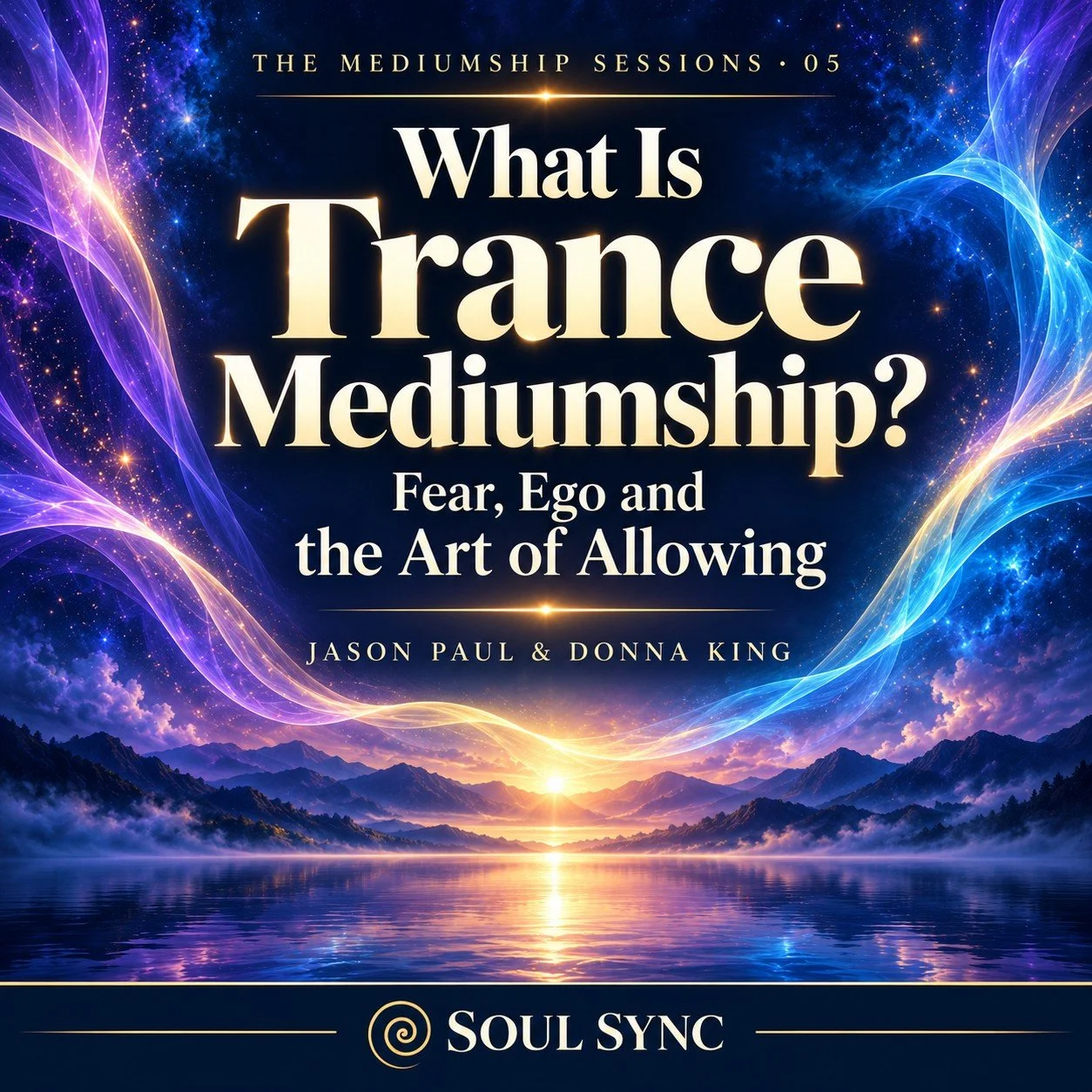
The truth is gentler than that, and far more beautiful. I've recently come back from a week of sitting in trance for hours a day, and I came home calmer than I have felt in years. In this episode of The Mediumship Sessions, my dear friend Donna King and I set out to bust some of the myths. Donna is a trance and physical medium with decades of experience, and trance is the area of mediumship closest to her heart.
This article picks up where our conversation left off. I want to explain what trance actually is, what it feels like, what the pioneers and the researchers have found, and why I believe it's one of the most healing energies you can ever sit in.
What is trance mediumship?
Trance mediumship is a way of working where the medium gently steps back in their own energy so that spirit can step forward and blend more closely with them. Donna puts it beautifully: you allow the spirit world to use you as a vessel, so they can bring forward whatever they want to say or do.
It helps to see where trance sits alongside the other ways a medium works.
Mental mediumship is what most people see at a demonstration or in a reading. The medium is fully awake and actively playing a part, sensing, seeing and interpreting what the spirit communicator gives them.
Trance mediumship is passive. Rather than working the link, the medium is learning to get out of the way. In the lighter states, that might be inspired speaking or a guided meditation that flows through you. In the deeper states, the medium's own mind becomes so quiet that spirit can speak more directly.
Physical mediumship grew out of the very deepest states of trance. Here, the phenomena aren't only felt by the medium, they're said to be seen or heard by everyone in the room.
Trance is an altered state of consciousness
Science has a name for what we're doing when we sit in trance. In 1966 the psychiatrist Arnold Ludwig described an altered state of consciousness as any mental state that is recognisably different from your normal, alert, waking awareness. A few years later the psychologist Charles Tart brought the idea to a wider audience.
Here's the thing I most want people to understand: you've already been there. Have you ever driven somewhere, looked up, and realised the last fifteen minutes passed without you noticing? Or felt that soft, drifting place just before you fall asleep? Artists and musicians talk about a bolt of inspiration that seems to come from somewhere outside of them. These are all doorways into a trance-like state.
As human beings we love a label. Are we a beginner? Intermediate? Advanced? When I look back, I'd been reading people in my old career in recruitment for years without ever calling it psychic. Donna says the same about trance. She sat for years before she went on a course and realised, "Oh, okay, so I've been doing this."
What does trance feel like?
Everyone experiences it differently, and that matters, because if you're waiting for someone else's description to happen to you, you'll be waiting a long time.
For Donna, it can feel like going down, or up, or a kind of whirling, as her guides find the best hold to work through her. With practice, the body becomes very still, almost unmovable, and the thoughts sort themselves out. As she says, "It's almost like you couldn't hold a normal thought if you wanted to." Early on, her guides even gave her the experience of feeling like a much larger person, with big, broad hands, so she could understand what the merging feels like.
For me, it has changed over time. I used to feel as if I was melting upwards into it. These days I go down into it. Either way, there's a moment where your active mind starts to quieten and you can feel yourself, as Donna puts it, clocking out.
The art of allowing
If I could go back and tell my younger self one thing about trance, it would be this: stop trying.
Trying creates resistance. When I first sat, I was constantly busy in my head. Right, push the energy out. Right, raise the vibration. All of that kept me in my mind and out of the very place I needed to be. We've been conditioned from our first day at school to try harder and make more effort. Then you sit down to blend with the spirit world and discover that the trying is the very thing in the way.
Trance is the art of allowing. And even when we think we're allowing, so much of the time we're still in control.
Donna describes trance as taking a back seat and letting spirit take the wheel. When I heard that, I had to laugh, because in my early days I'd happily sit in the back seat, but I'd keep one eye open on the sat nav, checking spirit was taking me the right way. That isn't allowing. That's trust still waiting to be built, and it only comes with time.
The pioneers of trance
I used to assume trance was something you did once you were advanced. Yet when you look back through our history and lineage, so many of the great mediums began there. Donna believes it's partly because they had far fewer distractions. They would simply sit together in the dark, week after week, and in doing so they were creating the perfect space for spirit to blend.
A few names worth knowing:
Leonora Piper (1857 to 1950) worked from her home in Boston and was studied for years by psychical researchers. The philosopher William James was so struck by her that he wrote, "My white crow is Mrs. Piper."
Gladys Osborne Leonard (1882 to 1968) worked with a spirit control called Feda. The physicist Sir Oliver Lodge sat with her from 1915, and his book Raymond, about communication with his son who died in the First World War, brought trance mediumship to a huge audience. She also pioneered "book tests", where the communicator would name a book in the sitter's home and a passage by page.
Eileen Garrett (1892 to 1970) was an Irish trance medium whose controls were known as Uvani and Abdul Latif. In October 1930 she sat with the researcher Harry Price, two days after the R101 airship disaster, in a séance that is still debated. In 1951 she founded the Parapsychology Foundation in New York.
Maurice Barbanell was the medium for the guide Silver Birch, whose teachings are still read in circles today. He was one of the founders of Psychic News in 1932.
What moves me about these pioneers is their honesty. Eileen Garrett spent much of her life funding research into her own gift, and she never settled whether her controls were spirits or part of her own subconscious. Leonora Piper also wavered in public about where her messages came from. You'll find evidence for whatever you already believe about trance. That's exactly why I trust my own experience over anyone's theory, and why I'd encourage you to experience it for yourself.
Physical mediumship, ectoplasm and the red light
For Donna, physical mediumship has been an extension of trance: sitting in a much deeper state so that spirit can work with energy in a way others in the room can see or hear.
In the classic séance room of the pioneers, physical mediums were said to produce ectoplasm, a substance spirit could use to make themselves visible or audible. The word was coined by the researcher Charles Richet in 1894. Because ectoplasm was believed to break down in ordinary light, sittings were held in darkness or under a dim red light. That's why people still ask me, if it's real, why not switch the lights on? It was about how the phenomena were produced, and about protecting the medium, because these sittings were known to take a heavy toll on the medium's physical health.
The most famous British physical medium was Helen Duncan. In 1941 she was said to have brought through a sailor from HMS Barham before the sinking had been made public. In 1944 she was tried at the Old Bailey under the 1735 Witchcraft Act and sent to Holloway prison for nine months. The Witchcraft Act was repealed in 1951.
I want to be honest here, because authenticity matters to me. The history of physical mediumship also includes mediums caught faking ectoplasm with cheesecloth and other materials, and that's part of why the subject is surrounded by so much suspicion. It's exactly why discernment matters, and why the genuine article is so precious.
Over 20 years ago, Donna's guides made it clear that physical mediumship was something they wanted to do with her. Her first reaction was no. She had young children, and she wasn't prepared to risk her health. They reassured her that, in time, they would work in a new way that would be safe for the medium. She describes deeper trance states as uncommon today, largely because of the way we live now. We rarely give the time, and our minds have so much to process.
You may also have seen photos and videos of "overshadowing", where a spirit person's features appear to move across a trance medium's face. Donna explains it as spirit building energy over the face with time and practice. It's rarely crystal clear, and in red light it can look a little unsettling to someone who doesn't know what they're seeing, which is why it can stir up fear.
What the research says
Science is finally starting to take a serious interest in trance, and what it's finding is fascinating.
In 2012, a team including the neuroscientist Andrew Newberg published a study in PLOS ONE of ten Brazilian mediums doing trance writing, known as psychography. Five were very experienced and five were at the start of their development. Their brains were scanned while they wrote in trance and while they wrote normally.
The experienced mediums showed lower activity in areas linked to focus, self-awareness and language during trance.
Yet the writing they produced in trance was more complex than their normal writing. Usually, more complex writing needs more activity in those very areas, not less.
The less experienced mediums showed the opposite, with activity going up, as if they were working harder at it.
That last finding made me smile, because it's exactly what Donna and I talk about. Those starting out are trying. Those with years of practice have learned to get out of the way. The researchers were careful to say their findings need repeating and can't tell us where the writing comes from. Still, it's the first time trance has been looked at this way, and it shows something real is happening in the brain.
Another question people often ask is whether trance is somehow unhealthy. A study of 115 practising mediums in São Paulo found they had a low rate of mental health problems, a good level of education and were well adjusted socially. The researchers' point was that unusual experiences in a healthy, supportive setting aren't the same as illness.
How do you know if trance is genuine?
There's a lot online that isn't real trance, so discernment matters. I've seen people claim to go into a deep trance in 30 seconds. In my experience, moving into a deeper state takes time, often up to ten minutes.
The simplest test is this: you should be able to feel it. When Donna sits with genuine trance, the energy in the room feels thicker, almost as if you're in the presence of more. You might feel cold breezes around your legs. Me? The end of my nose goes icy cold, like Rudolph.
Above all, genuine trance touches everyone. The spirit world is clever. In every genuine trance sitting I've been in, something has spoken to every single person in the room, even if it's only two words that mattered to them that day. If you leave feeling only that the medium knows a lot, and you've felt nothing, trust that.
Ego, and choosing the right teacher
Years ago, I went to a trance workshop with a local medium. The group felt cliquey, and there was a lot of ego in the room, with people puffing up their feathers about who was the best. None of it touched me. At lunchtime, I left.
In another early circle, newcomers were asked to speak within a couple of minutes of sitting, and pressed again when nothing came. All that does is put you straight into your head. That experience put me off trance for years. Pressure to talk is the very thing that will stop you ever talking in trance.
So be discerning about who you learn with. Gravitate towards teachers who teach from the heart and leave you feeling more confident, not less. If an environment is knocking your confidence, step away from it. I get so many emails from people whose confidence has been dented because they were in the wrong place for them.
Donna says it perfectly. When someone thanks her after a sitting, she asks them to thank spirit, because she is just "the plastic phone in the middle." Feeling good about how you're growing is healthy. But we are only ever the vessel, and it's all about being of service.
Why trance is so healing to sit in
On my recent trance week, the state was mellow, passive and almost sleepy, and I came away feeling that I had been healed in a lot of ways. I've never felt so calm. Even now, when I've had a rough day, the first thing I'll do is sit in the trance energy, because I always come out of it feeling settled.
There's a reason for that, I believe. You're giving the spirit world a closer seat, and you're spending time in a state where your busy, striving mind finally gets to rest. You don't need to speak, perform or give a single message to feel the benefit.
That same week brought one of the most beautiful moments of my life. During a service, I felt spirit getting my attention, and I just knew my dad was about to come through. He did. My dad would struggle to say "I love you" when it was just the two of us, and here he was, saying it in front of a whole room of people. To me, that's what can happen when we get out of the way.
Is there anything to fear?
When Donna talks about feeling like a large man with big hands, I know that might stir up fear in some readers. Her advice is simple. If you have worries about stepping aside for spirit, work on those first, because trance is built on trust. Spirit aren't going to take you over or stay with you. You're offering yourself as a loving vessel, and fear, doubt and worry will only get in the way of the blending.
That's why she encourages people to spend time with their team in meditation first. Ask them who they are, what they bring, and why they're working with you.
How to begin
Set the intention. Donna's answer to "How do I start?" is refreshingly simple. Before you sit, just tell your team in your thoughts that you'd like to sit with them to learn and move into trance. That's it.
Commit to a regular time. Once a week is a lovely start. Consistency gives spirit the time to keep building with you.
Sit with no expectation. If you go in expecting a certain experience, you limit what's possible.
Start in the lighter states. Inspired speaking and guided meditations are a gentle way to learn what it feels like to blend.
Don't rush to speak. In the early days, simply sitting in the energy is the foundation everything else is built on.
Be gentle with yourself. Moving into these states can bring things to the surface, including old fears and beliefs. That's part of the unlearning, and it takes time.
Experience the beauty of trance for yourself
If this has stirred something in you, I'd love you to sit with us. From Thursday 3 December, Donna and I are opening a fortnightly online trance circle on Zoom, on Thursdays from 7 to 9pm UK time.
It's an intimate circle, because trance needs a space where you feel safe. It's for those who already have some experience of connecting with spirit and would like to explore trance and a closer blending with the spirit world. Places are £20 a session and limited to 20.
Find out more about the trance circle
New to mediumship? Start with my free weekly development circle every Tuesday evening, and you'll be very welcome. Join the free circle.
You can find out more about Donna and her work at donnakingspirit.com.
Listen to the full conversation on YouTube, Spotify, Apple Podcasts or wherever you get your podcasts.
Spiritual Takeaways
Trance is the art of allowing. Even when we think we're allowing, we're often still in control.
Trying creates resistance. Set your intention, then step back.
You've touched trance before. The moments before sleep, or when inspiration seems to come from outside you, are doorways into it.
Genuine trance is felt. It should touch everyone in the room in some way.
Choose teachers who build you up. Pressure to perform will only hold you back.
We are the vessel. The thanks belong to spirit.
Trance is deeply settling. You don't need to speak to feel the benefit.
-
Jason: Hello, and welcome back to the Soul Sync. The first time I told my mum I was thinking about doing a trance course, she said, "Absolutely not. You can do anything else. I'm just not happy about you doing trance." And if I'm honest, part of me felt quite the same because trance asks you to do the one thing most of us find the absolute hardest, which is to let go.
Trance mediumship is the art of allowing, and even when we think we're allowing, so much of the time we're still in control. For years, I'd sit back like a passenger and let spirit take the wheel, but I always kept one eye open, checking they were taking me in the right way. That wasn't allowing. That was me still holding the map.
Not long ago, I spent a week sitting in trance for hours a day. Something in me softened that I didn't even know was holding on. And that week of all weeks, my dad came through, a man who at the best of times could barely say, "I love you," when it was just the two of us, and then proclaiming his love in front of a whole room of people.
That's what can happen when we get out the way. In this episode, my dear friend, trance medium Donna King, joins me once again. We talk about the fear around trance and about how the ego can creep in, and what it really feels like to step back and let spirit come forward. If something has drawn you to this episode, trust that.
Sit back, breathe, and let go with us. This is the Soul Sync and the Mediumship Sessions.
Donna King, welcome to the Mediumship Sessions
Donna: Hello, Jason. Glad to be back.
Jason: Oh, we're back again. I am excited. I am really excited actually to talk about today's, subject, which is something that's very close to your heart, I know, because it's the area of mediumship which, you know, if I was to... someone was to ask me, what is Donna as a medium? The first thing I would say is trance, physical mediumship.
That's very much, you know, what you're drawn to. So we're gonna be talking about trance today, and I guess to begin with, there's gonna be people here who are gonna be listening to this, wondering what trance is. Because I'll be honest with you, the first time I even said to my mum that I was considering doing a trance course, she said, "Absolutely not. You could do anything else. I'm not happy with you doing trance." And even within myself, that invoked fear, and it does for a lot of people. So to myth bust that and to clear that up, what is trance mediumship?
-
Donna: Trance mediumship, my, my terminology would be that it is about allowing your side to just sort of like gently sit back in your energy and allow spirit to move forward to create a, you know, a closer blend, as one, to be able to use you as a vessel, to be able to, you know, vocabulize whatever it is, or do because of the art, whatever it is that they may want to bring forward.
And so it is kind of like stepping as... just allowing them to use you as a vessel, to be able to, you know, bring themselves forward, you know, definitively.
Jason: Hmm. 'Cause I, I, I, my experience of trance, I've just recently come back, as you know, from a week of doing trance mediumship, which, going into that week, I was kind of very unsure as to what to expect from that because, you know, I, I, I have to say, I went on that week, and it was everything and more that it needed to be because it, gave me a lot of inspiration in every department.
Because we weren't just sitting there talking in trance. We were doing things like inspirational talking in a lighter state of the trance. We were doing things, like guided meditations, and that was really helpful for me. But it's a very, I must admit, on that week, it's a very mellow, very passive, very sleepy kind of state, and I felt that, you know, I've kind of been healed on that week in a lot of senses.
And there's something about sitting in the trance energy that is very healing, even if you don't necessarily feel like that in the first place, isn't there?
Donna: There is, because it is allowing spirit, like, a closer seat, if you like.
And, and as you say the word passive, it is, you know, like, mediumship is very, is, they, you know, they say it's mental, mental mediumship, you know, because you're still very active in that, in playing a part, whereas with the trance, it's a passive action, so you, you know, you're very much trying to get out of way and allow them to move through you, you know.
And the experience of, like, doing the, you know, the lighter states to, to, you know, bring forward, like, guided messages is, that's a really good technique for, beginning and allowing yourself to learn what it is to sort of submissively hear and move within that emotion, to build up the trance states.
Jason: Because a lot, a lot of the time back in the days of, pioneers and if we go back in our history and lineage in mediumship, that was a state that a lot of people, the trance state really began their kinda journey with in a lot of senses, kinda sitting in that. And I feel that in the modern day, we, we've kind of very much, I think changed our relationship in the way that we look at trance.
Because even myself, when I was first looking at doing trance, I almost automatically assumed that that was something you would do when you was advanced. So why do you feel people would, kind of explore the trance states earlier on, you know, back in time? And how, how do you feel that's, that's changed with the world that we live in?
Donna: I do believe it is a lot to do with, you know, they had a lot less, distractions. And obviously during the war, that was really when, you know, the mediumship and speaking spirits seemingly, you know, picked up a lot in that it became more publicly known, in England. And so they just used to sit in the dark. So, you know, without, I feel without the great intention, they were already sort of sitting for the art, the, you know, the trance and the physical type states, which was allowed for a deeper state of blending and movement for spirit to, to... You know, it's like creating them the perfect space, which is why it is imperative with any, you know, part of your spiritual development to allow the time to sit.
I don't know if, I, sometimes I think people get an intrigue and an interest into trance, and then that leads them to want to, you know, do and, you know, experience and, you know, what is this about. And I think sometimes it is just very much a calling. I don't believe that everybody is a trance medium.
I, I believe that, that you can, you can attempt to be, you can try, you can give yourself that space to do so, and in that, the potentiality will build. But, I do feel very much it was a calling. I mean, I used to sit, and for years I didn't even realize that that was what I was doing. It was at a course that I then thought, "Oh, oh, okay, so I've been doing this."
You know, like, there was, it was just, you know, a natural process for me, and there will be many others out there that maybe are already going through that natural process and just don't realize it. And then, you know, the, the tide will turn, and they'll think, "Oh, okay, so we've been doing this for a while now."
-
Jason: You make an interesting point there because we are obsessed as human beings with labels and putting labels on everything. And even as you're saying that, it reminds me of when I first went to, a mediumship teacher, and I'm laughing at this because it was a day psychic course, and it was my very, very first, sort of journey into this world.
And I'd found a lady on Google. She lived about half, about an hour away in Exeter. And I drove to go and see her, and it was at her house, and it was like a psychic day where she'd do a bit of the tea leaves, and it was quite funny actually, 'cause one of the things, she got me to do during the day was she would give me a photo of an object and then hide that object somewhere, and I had to psychically find the object.
Now, I have to say, she was very, allowing in this experience because, you know, you could have quite easily found yourself rooting round all her drawers and cupboards. But actually, I did, she said, "The item will be somewhere downstairs." And I thought, "Oh, my goodness." You know, I could, I could have found myself pulling all her drawers apart.
However, I found the object quite quickly. But when I first started doing psychic readings, I got in my head about, "Right, okay, I need to feel into this person." And when I look back now, I absolutely laugh because what had I been doing for the last 15 years in my career, screening candidates, is I'd been psychically reading them.
Because I'd get a candidate on the phone and I'd think, "Mm, this person's lying to me. This person isn't really wanting to leave." And what I'd got very used to was reading in between the lines, because what a candidate says to you, in my experience of legal recruitment, and what they actually do are two different things.
You know, a candidate might say, "Oh, I'm looking for 85,000." And I, I'd think, "Actually, I know that you'd look a little bit less than that. What you're doing is over-batting." So, I'd developed those skills in the police, I'd developed them in legal recruitment, but then I come to sit down, do a psychic reading, and I thought, "Oh, right, okay, now I need to learn how to be a psychic."
And like you say there, in the trance states, a lot of people are already in that kind of state in some way, and it... Even what's coming into my mind now is a musician, an artist, someone that's got inspiration. And I, I've heard it so many times, you know, when you listen to artists and they say, "I just got this bolt of inspiration from somewhere."
And they know that this was, you know, in some way, you know, outside of themselves. So it's, the point I'm trying to make here is about labels and about, you know, when you're starting to develop these states, as soon as you suddenly say, "Right, I'm doing trance now," it's, it's, it's even you identified that you've kind of been, within that state in some way.
But it's, it's this ability that we have as human beings to want to label everything. Are we a beginner? Are we intermediate? Are we advanced? Are we, professional? It's, we're obsessed, aren't we, with the need to label everything?
Donna: Yeah, that's the natural part of the human being I think, and we're in line with the ego.
I mean, there's this great myth that, you know, you, you can't have ego and, and in some, and in many instances of the ego, it isn't, it doesn't align with being a spiritual person in spirituality and within this work. But actually it's natural form to have in part ego, and that's where we wanna label everything, where are we, you know.
And it, it, I suppose in a way there's this undertone affecting of the self-worth and confidence. But it's true, the trance state is in anything, you know. You know, art is a form of a trance state, you know, because there's different levels, of, of, you know, you know, the mental mind in the blending and allowing of the sort of like natural influence, whether it be of your own psyche or whether it be from spirit, in the movement of that.
And even in driving, you know, as an example. You know, you think, "Oh, God, got another hour," and before you know it's 15 minutes left, you know, 'cause you've sort of been just in pilot mode. But, you know, it's, you know, trancy type state.
Jason: It worries me when that happens.
Donna: Sounds mad to say that.
Jason: Well, no, it does, because you suddenly think to yourself, "Oh my goodness, I've not really, been, you know, absolutely paying attention at the wheel." And we can all relate to that because we do go into some kind of autopilot mode. Do you know what you're actually making me remind me of?
This is funny. I was driving up a hill in Bristol a few years ago, and I was in that kind of mode where I'm, of course I'm paying attention, I'm driving a vehicle. But I suddenly was going up this hill, and there was one of those speed cameras, vehicles of the police, and it gave me terrible anxiety, and I thought to myself, "I think I've got a ticket."
And my mum said to me, "Well, if you get one, you're gonna get one." And I said, "No, no, no, no, no. I want to go knock on the door to ask him if I've got a ticket." And next thing you know, I'm knocking on the side of the door, and no one answered of the, the police van.
And, then I knocked again, and he opened the window really abruptly and he said to me, "Can I help you?" And I said, "Well, well, I'm really sorry, but I was driving up the hill now, and I think I might have maybe been a bit over, I'm not sure. Could you just clarify if you caught me or not?" And then he proceeded to give me a 15-minute lecture on how I'm driving a deadly weapon. And I said to him, "Okay, so did you catch me or did you not?" And he said, "Well, no, but..." You know, we go into that state, don't we? And you know, you have to, be, be careful. But then you could come to do and want to sit in the trance state, and then we fight that battle with the mind because now we want it.
Now we want to sit in the state, and it's, it, it, it's difficult to maybe move into it because of the battles we have with the mind. But this is where we can be so hard on ourselves because actually, most of us have been in the trance state. Well, we all have in our life at some time. We have all entered that state unconsciously because...
-
Jason: How would you describe it to people, that kind of moving into the state? What does it feel like so people can kind of understand their relationship with it? Because I believe that we have all moved into it, because it's that, that state before you fall asleep, it almost feels like in a lot of senses.
Donna: It is, actually.
It is a lot, a lot of it. And, you know, you know, the problem being is, you know, we try. And, it's in the trying that we're getting in the way. You know, a very human thing to do. I mean, the, you know, going into the trance states is, I should imagine is quite different for most people. For me, it was very much a feeling of sort of like going down, up, whirling, and a, you know, real essence of this energy sort of pushing me around and just feeling, you know, the different sort of like influences, you know, working to find the best way to sort of like get me into the best hold for them to work through me.
But there, you know, there's a real essence of peace within it, but you... The, the, the more you practice, the more you move in that, and then the, the more you sort of like become very still, the body almost becomes unmovable, and the thoughts kind of, you know, sort themselves out because it's, it's almost like you couldn't hold a normal thought if you wanted to.
And that's when you know, really, the spirit have got a, a good hold because, you'll almost go feel, you know, if you're still buffering around which, you know, is very, very common, you know, you'll sort of almost like go to and it just sort of like moves out of the way and the, you know, the transition is, you know, it's a, it's a very fluid thing, I would say, 'cause you, you feel the movement of the energy in the process of doing so.
And, you know, a lot of people do have this sort of like going down feeling, but you know, you can just as well have this going up feeling because, you know, I experience both, depending, I believe, on where I'm at that day, and what they need to do to sort of like clock me in, if you like, before I clock out.
Jason: Ah, ah. Well, it literally is like that, isn't it? It's you are, you are clocking out in a lot of senses, because it's about moving into that state of being where, you know, your, your conscious mind, your active mind is just starting to quieten. And I have to say, when I... And this is the thing when you describe trance, we all experience it differently.
And I have to say that, it's changed for me in a sense that I used to feel that I was sort of just melting into it by going kind of up. But actually, these days I'm going down into it. And if you were wanting to develop, trance, I think you've got to really understand that it's so individual. And if the way that you are trying it, and this is again, this you have to be very careful with this word trying, because trying is what creates resistance.
It's what creates the block. And my God, I know about, you know, how much trying can, create that resistance. And, and people are gonna be going, "Well, if I'm not trying, what am I doing?" You are allowing. You are allowing, and there is a big difference. Trying is there's resistance in that. You are, trying to reach, trying to grab, and it, and it feels different.
And it can be really hard to just overcome that very simple step in understanding that trying, and, and, and yes, okay, trying, if we want to really sort of dissect this, the very act of you sitting and allowing is you trying, is you attempting, is you experimenting. But the actual act of you trying means that when you are sitting, you're trying to push, and the problem is, is with that, you...
I understand it, 'cause when I'm sitting, and in those earlier days, I would be constantly within my mind doing something. "Right, okay, I need to push the energy outwards. Right, okay, I need to raise the vibration." And all of these things are putting me in my mind and not in the place that I need to be, and it can be so difficult for that penny to drop because we have been conditioned from the very first day you was at school, you need to try.
You need to make an effort. You need to go and, you know, work hard. And all of these things and this conditioning is so strong within us because it's, it, it's the very fabric of everything we've ever known within our consciousness. And to, to, to really understand that in mediumship, you need to allow, it, it's...
That is a journey in itself, and it's a journey that took me a very long time, and still I will find myself sometimes, you know, when I sit, and I will have to go, "Jase, what are you doing? Like, get back to just sitting and allowing." Because it depends. If you're not sitting often or you're not being in that state often, and you're, you know, back in the real world and perhaps you sit twice a week, and you've been in the world of work, in the world of being there with your boss, the KPIs, the metrics that you need to hit, the sales target quota that you've got, and then you're trying to step from that sort of day, from that existence into allowing, that in itself is difficult because you've just got to be very gentle, with yourself.
And I, the reason I have to make that point is because if you're listening to this, episode, there is something within you that has called you to this episode, and there is something within you that's probably going to go away and to want to work with this. And I have to say that, this whole trying thing, I wish I'd really understood that sooner, but this is because it's different for everyone.
Now, I wanted to ask, because we all experience mediumship differently, and at the very beginning, you will experience physical sensations, but those physical sensations differ, greatly. Now, these days in my mediumship, I, the physical sensations I get are actually quite strong. They're very powerful. They actually really sort of in a way, you know, kind of move through my body.
But what is it in those early days of you discovering this that you would sense, that you would feel within moving into that state?
Donna: Well, for me, I obviously had a close relationship or have got a close relationship with my guides, so I could kind of feel this presence of them moving in, if you like. And almost like being able to clairvoyantly sort of see them sort of like, you know, sitting directly with me rather than, you know, just working from the sides. So for me, you know, it may be different to, to, to many other people out there, but it will just be this general sense and sensation of like it is like a becoming, you know? A becoming of, of like, you know, one with, you know, the essence of your team. And they... in, in it there's like this real transition of energy of, of like...
-
Donna: It's like a suppression in a way.
But suppression feels like the wrong word because, you know, you're not suppressed, but you're just... It's like taking a backseat and letting them take the wheel, you know? It's, it's, it... So it's, it's a good way of saying it because it is just like moving out the way. And they, you know, there's different, as you've already said, there's many different levels, in that, in, in, you know, the hold that they can gain with experience and time, and it's all about time, which leads to greater experience.
Jason: The funny thing, that's jumping into my mind there as you're saying about being in the backseat is if you're gonna sit in the backseat, and I know we're using a lot of metaphors here, but sometimes that's, that's needed and a good analogy or two. But if you're sitting in the backseat, and allowing spirit, as it were, to be in the driver's seat, right, straight away what's jumping into my mind there is trust because, you know, if it was me in those early days, yes, I'll sit in the backseat, but I definitely wanna be keeping one eye open.
I wanna make sure that the spirit world is, is moving me on the route with the sat nav in the way that I need to move in my life. Now, that is a problem, isn't it, when trying to move into the trance state?
Donna: It is, but it's so common. And, you know, it'll be part of the journey all the way along I believe until you've sort of mastered it. You know, it's a never, never ending, cycle of like, you know, getting out the way, and it depends on what levels you're working in as well. I remember once, the, you know, it was probably the one first time that I actually felt the, you know, from top to bottom, oh my God, I was built like Buddha.
And I remember my hands feeling massive, you know? And that was one of the first sort of experiences they gave me of like feeling totally that. And it was almost like I'd come in and I could feel, you know, I was humongous. For me, 'cause I was tiny then as well.
Jason: That's not necessarily sounding like a nice experience.
Donna: No, it isn't. Yeah. But, you know, I could just feel the physicalities of my hands feeling very much like a large man's. I could feel the broadness within my body. I could almost feel, you know, the, the, you're just the essence of it, you know? I, it was, it was just like this. I think, I believe they gave me the experience to give me this understanding of like part of the merging. You know, because obviously when you are in a state of trance, when you've sort of like been sitting, that, that sort of dissipates.
You will have like the odd feelings in your face, maybe pulling, you know, and feeling like your face is being pulled or moved, and actually it isn't. It's just a greater stance of the energy. And I mean, you may move your jaw then, you know, it may, that may happen to you, or pull faces. But it's, it's more about, it, it really is them trying to, you know, use that energy and getting a stronger hold so it starts affecting the physicalities more, you know?
And I do, I do believe they totally did do that with me, just to sort of give me the experience of, you know, feeling, like, shift out the way and, you know, and then off you pop, you know?
Jason: As you're describing this, you know, we have to address this because you're saying there about the spirit world, your hands getting bigger, you're becoming sort of what you feel to be, energetically like a man. Now, that sounds, to a lot of people listening to this, it's probably invoking fear.
Now, is there anything that you need to sort of worry about or anything that you need to prepare for when kinda going into this state? Because a lot of people are gonna be thinking, you know, they're going to be, you know, worried about this to some extent.
Donna: Yeah, I mean, I do feel here that if, you know, if you've got any worries or concerns about, you know, allowing spirit to move aside and, you know, and working as, you know, one vessel if you like to, to allow spirit to be able to speak directly, then you're gonna have to work on that first because it is a basis of trust and understanding.
You know, they're not gonna stay with you, like these people have got, you know, these spirits have got nothing better to do. They're not gonna take over, you know. You're just allowing yourself as a loving vessel to be able to give them a space to work through you. And obviously any elements of fear, doubts, concerns and worries are gonna get in the way of the work, and of the blending.
And so, you know, in that then it's also important to spend time with your team just in a state of meditative, you know, space to allow them to show you who they are. You know, ask them what they did, you know, who are they, what, what, you know, what's their personality like, what do they bring to the table? Why are they working with you, you know?
And these things are important as well, I believe, for anybody that's a spiritualist and doing this work. It's an imperative part of the work as far as I'm concerned because it all goes hand in hand, but especially within the trance because, you know, there'll be this, you know, for me there's this, you know, feeling within my heart, you know, this knowing.
And, you know, I don't question, I don't... You know, I've got different people that work with me for different elements of my abilities. But in that knowing is just the trust of it, you know?
Jason: See, the problem I have had in trance, with the trance states, and, going back some time, and this last week for me, that I immersed myself in it on a course, was absolutely beautiful. There were so many things that happened. I felt that sitting in trance really made me feel, so much... I could just feel the power instantly.
And there's always something so magical about being on a course in the fact that, I can literally turn my attention to the spirit world, and so strongly I could feel the power of them around me. And it's almost like in the days after the course, I was doing everything to try and keep that feeling and sensation, but the problem is, when you're on a course like that, and you're immersed in that, and you're sitting in the energy for hours a day, you're never gonna be able to recreate that in the normal world, because you're sort of within the magic of, of that, environment.
-
Jason: But, and I have to say, I'm going off topic now, one of the most beautiful things to me of that week was, my dad coming through. And this is all about trust, because I was sitting in the Arthur Findlay College, people who know what it is, in the sanctuary. Anyway, as I sat for the service, I started to become aware of spirit getting my attention, and the way they always get my attention is my right temple, and you can physically see it, starts going constantly, like pulsating.
And I, I must admit that this is the interesting thing. For years before I even started developing my mediumship, I would get that, and it would freak me out 'cause I would think, oh, in some way that I'm... And it would always happen at moments when I was, kind of elated, and I now know I was in my power at that stage.
So for instance, I would speak at a conference, and just before the conference I'd be like, "What the hell is going on with my temple? Why is it doing that?" You know, and I'd start having a freak-out thinking maybe there was something wrong with my head. So when I first started discovering being in the power, and it would bring that sensation on, it almost... This is interesting, though, because it's about fear, and fear then would move me out of it. So the sensation that I would get of being in the power would move me out of the power because I had fear attached to the sensation. Anyway, I was sitting in the sanctuary and I started to get that feeling, and I thought, "What the hell is going on here? Why are you trying to get my attention?"
And I suddenly sat there, and I was sitting next to this lady, and I said... And I don't know what came over me. In my mind I thought, "Oh, I think I'm gonna get my dad to come through." And I thought, "Shall I lean over and tell her that?" And then I thought, "Well, I'm not sure."
And then I thought, "Well, worst thing that happens, Jason, is he doesn't come through, so just spit it out." And I said, "My dad's about to come through." And she went, "Oh, okay," probably looking at me strangely thinking, "What's he going on about?" And then he came through and he gave this message of, you know, my dad, let's, let's be, completely frank about this, would never, you know, he'd even struggle to say I love you, you know, just me and him, let alone make declarations of love in front of an entire auditorium of however many people.
But it moved me, and it moved me because I have seen how his evolution and language has evolved over time because, you know, when you're a medium doing mediumship readings all the time and practicing with people, you know, one of the things that I love about that is I get to hear from my loved ones all the time.
But he came through with some information, like my road name, it's things that had happened in recent years. It's in the last year since he passed away. And what that showed me is that he's around, he's been healed, and to come through on a trance week of all weeks was just beautiful. But when I was sitting and going into the trance state, it is a physical experience, and it really requires, especially if you've got a busy mind, it can be really, really, challenging.
And it takes a long time, trance, and it's not something where, you know, in this world of now, Amazon delivery, next day Prime, it is a really... it's a journey that takes a while, because to move into that state of being and that state of consciousness takes time. And even when you find that someone, and in the mediumship, the trance mediumship I've seen, people going into that deeper state, it takes, you know, up to kind of 10 minutes to move into it.
-
Jason: And, you know, I've seen, and this is where you've gotta be discerning, there's a lot of rubbish out there online and whatever, but there's a lot of... I've seen people move into the trance state in 30 seconds. And how can you know if trance is, you know, what you're seeing is, is genuine or not genuine?
I think we have to address that, because there's a lot out there that isn't real trance. And, you've gotta be discerning about that, and you've gotta be discerning about your teacher. What's your thoughts on that?
Donna: I just, it's a sense of feeling. You know, you can almost feel the presence within the room.
You know, so you just feel the energy shift. It almost starts feel... To me, it just starts feeling, I mean, I actually see objectively energy, so you know, if I sort of shift my eyes, you can see it. It's just like it builds within this energetic feeling of, you know, you know, expansion. It feels thicker to me.
That's a, that's a... I don't know the way to explain. It's like a, a biggest feeling within the room. Like, you know, the, you almost can feel this energy of feeling that you're in the presence, you know, of more. You know? And in that is that knowing, because there'll be emotions. You'll feel your, your energetic self sort of like shift and move with the words that are being said.
Because spirit are very clever, you know. When somebody's speaking to you in a, you know, in a real trance state, there will be words, brought forward, then there'll be something that will touch everybody. Even if it's two, two words that are significant to that person for that day, you know, there'll be something touches everybody and, or at least it should, you know, in a real trance state.
So there will, there'll be this, movement for you, energetically, and there's... You can feel it. It's the same really, well, it's not the same, but it's more intense, feeling like when somebody's having a mediumship reading and, you know, and you can feel the essence of that person coming through. You know? That's when you know you're really in, you know, the hands of a, a, you know, a, a heartfelt good medium because you can feel the essence. You feel moved by the message. And it's the same with trance, but I feel, it's much larger, it's much thicker if you will. There's, it's more intense, energy that will permeate the room.
And you'll also, you know, you might get little cold breezes moving around your legs or within the room, you know.
Jason: You should be able to feel it, I think,
Donna: Oh, good, yeah.
Jason: The first thing. Because when I have seen... And I, I've seen trance, in both, this is where I need to be careful with language here, but I've seen what I believe to be someone not in trance. I will never forget. Actually, what put me off trance was years ago, I went on a trance day workshop with a medium local to me.
And I went into it, and I, I must admit, I didn't feel comfortable in the group, first of all, because there was this cliquey-ness to everyone where they all kinda knew each other, and I thought, "There's something about the energy here that felt to me like there was a lot of ego about, you know, the trance state."
And I was in the room, and, everyone was, sitting there obviously in the red light, and we'll talk about the red light in a moment because, you know, what the hell is the red light all about, people are gonna be thinking, because it almost feels like you're developing photographs back in the 1980s. So I would sit there, and it's me, it didn't touch me. It didn't, it, I could almost... It, it's funny because even when you're in an early stage of development, you've got to trust the way you feel, because trusting what you feel is the bedrock of everything. And in that experience, I just felt that it was egos, people puffing up their feathers, who's the best?
But it, I'll be honest with you, it didn't touch me in any way. So much so that at lunchtime I thought, "I've had enough of this. I'm out of here." So I left, because it didn't feel right to me. But when you see genuine trance mediumship I always have analyzed and felt that everyone in the room takes something from it, because the spirit world, are very clever.
They, and and this is even mind-blowing in itself, they will tap into the collective consciousness of the entire room to ensure that something within that speaks to everyone. And if you see genuine trance, it does. Every single person feels something from it. I've never come across, in genuine trance, someone who hasn't got something from that, or it's not moved them in some way.
But you can feel the power. Like you were saying, you might feel it by just knowing it. You might be feeling it by the physical sensations. And a lot of the time, when I watch trance, you can feel that, kind of icy coldness. I always get it on the end of my nose, like Rudolph. You know, my nose goes a bright red when there's genuine trance.
But you've gotta be discerning, because I even, used to sit in a trance circle at the very early days by, by, quite a well... And this is a very well-known medium, a medium that has a lot of people, kind of under their, traineeship in some way. And, this particular medium used to lead people in, within two minutes of being led in, the first question is, and he used to say this to each person, "Friend, what would you like to say, friend?"
And to me now, looking back at that, the first thing you're doing to new people is you're putting them in their blooming heads, and then you wouldn't speak for a minute, and he would go back to them and say, "Come on, friend. Tell me what you'd like to say, friend." And I'd be sitting there thinking, "Well, I, he's, he, I've gotta say something."
And he would encourage people to sort of speak, knowing that they weren't in the trance state. And if you keep asking someone, "Friend, what are you here to say, friend?"
You're putting them in their heads. And I would sit there going, "I just can't go to this trance circle anymore," because I... And, and the problem with that is you can get one facilitator that's not facilitating right, and, and that put me off trance for years. And, yeah, and then when I went back to trance, I'd had this bee in my bonnet that, you know, oh God, I can't talk or whatever. But when you start anything, if you're gonna start trance mediumship, you are not going to be on day one of doing it going into a deep blend with spirit and starting to talk fluidly.
It takes time, and if you're with a teacher that's, you know, there's this expectation that someone new comes in and talks straight away, you know, it, it, it's completely bonkers, because it takes a very long time to, I believe, get into that state.
Donna: It, it does. And, you know, sure, sure there's some of us that may move quicker in it, but I do believe that it's, it's a lengthy process, and there's absolutely no way, you know, that you can do it in a matter of moments and, allow spirit to have that hold.
I kept laughing then because it was the way you kept saying friend. But that, you know, that, that, that's interesting because, you know, you know, either they... And I mean it with the greatest respects, but either they, you know, they, they didn't have a greater understanding themselves or there was ill intention in that, you know, which is quite, you know...
But we find that a lot within the, you know, within our field. You know, there's a, there's this misunderstanding, I believe, with, with trance and the development of it and understanding the, the, you know, the really the sort of like respect and love that needs to come with it to be able to step aside and trust and, and move aside to just be the vessel, you know?
And I've heard that word so many times, but in a way, that is what you're doing. You're, you know, you're not leaving your body by any means, but you're just sitting back and allowing it to be used and blended by, for, with spirit, for spirit to, to be able to vocalize whatever it is or do whatever it is they wanna come forward and do, you know?
Jason: And it really... Well, I'll be honest with you now, even on that, I look back at that medium now, and when I think back to the trance communications that he would do, it would always be about the, the complexity of the universe, and he, it, it, the, well, proclaimed spirit through him would give these really technical descriptions of the other world.
And I look back at that now, like, there'd almost be parts of sacred geometry, and it wasn't. It was ego, because I'll be honest with you, that never spoke to me at all. If anything, I, I left the trance sitting not feeling, kind of inspired. I left feeling that, my God, I've got so much to learn, and it was almost now I look back and I feel about that, that it was almost a way of, having this grandeur about himself to say, "Look at what I know. Look at what comes through me. Come into my world, come into my orbit and be trained by me."
Because it wasn't speaking to me at all. It was only speaking to me in a way of going, you know, oh God, this, this, this guy's got a lot of knowledge. But it wasn't, you know, making me feel anything. And he did a reading for me once actually, and again, I now look at it, you know...
So I don't want to, whack labels on it, but I, I think that there was a lot more going on there with the ego, and, sort of, proclaiming to be this magnificent medium. But, you know, even when I look now at the, the way that it was done, it, it, it didn't resonate with me at all. But, you know, I've always been very good in being very discerning about teachers, and if I don't feel a teacher is right for me or it's, it's sort of, you know, erasing my confidence a bit or whatever, then get out of that environment because it's not right for you and you've got to, you know...
And you can do this. In this world of mediumship, you can suddenly go, "Oh, this person's a medium," put them on a pedestal, put them in a certain, you know, place of grandeur in your own mind. But at the end of the day now, I always will only gravitate towards teachers who really resonate with me, that I really feel teach from the heart, and you can feel that.
And, and especially with something like trance, where what you're trying to do is to move into what is ultimately a really relaxed state of being, and if you're being taught by someone where you're feeling pressure to talk, pressure to perform, pressure to get into something, you're not gonna get into that state because it's triggering within you, feelings. 'Cause if you feel any pressure at all, and I've been on, you know, trance courses prior to the week I've just had, and the pressure to talk is what will make you never talk in trance.
-
Donna: It's interesting, because, you know, the, there is a lot of ego battles within... And you do see it, you know.
Often when I've gone to a trance course in the past, I, I kinda prepare myself for that ego. And it, I, and it, it really comes from the human perspective, that this is an advancement of being a medium. and it's almost like there's some sort of grandiosity put on it, and, that makes me feel quite sad as I'm saying it now.
Because actually, you know, really You know, what, what part are we playing? You know, again, we are just but the vessel to move out of the way to allow to be of service with spirit, you know? And so there really in a, in a way for me, there shouldn't be... You know, yeah, we need to feel confident and good about ourselves and what we do, and own the greatness that you are.
But, you know, respect, to, to, of be humble in that, you know, you are just working for spirit. You know, you are sort of like the, the, you know, the, the machine in the middle doing the work, you know? Like, and passing the message on, you know, from spirit through spirit to spirit. You know, so really in a way it's like, yeah, we need to feel good about ourselves when we know that we're doing well, when we're, we're moving and we're, you know, we're, we're growing in, in, in our abilities.
But, you know, respectfully remember there is an intelligence far greater than we as humans can possibly comprehend. We can only ever slightly touch on that to be able to then be of service for spirit, and I think that's very... You know, that's something that people sort of like need to get a greater understanding of even within themselves that do, you know, you just are, you know, if you like.
I always say it's like the phone, the plastic phone in the middle, you know? That's what I am, you know? When somebody says to me, "Oh, thank you," you know, I, I do want to say, "Please, thank spirit," because actually it's them, you know, that have like, you know, passed, passed the teaching forward, passed the message forward.
And I feel really emotional, 'cause I feel really passionately about that, you know? I think human, the human needs to take credit, which feeds the ego to be able to be comfortable within themselves, and actually the ego doesn't build the confidence and the self-esteem, it just strokes it. So, you know, there's this real depth, and I, I do believe, you as spiritualists we need to learn about the self and we need to constantly be looking at self to be able to be aware, to be able to be...
And I feel emotional again, 'cause I feel so passionately about it, to be able to be the greatest, you know, vessel, you know, be a person to be of service for spirit. Because as you've said before in previous podcasts, you know, it is a massive honour, you know? And in that it should be recognised. But it's all about the human growth, you know?
Because, you know, we, we grow as people and we learn, you know? So there's no judgement in anything, of anybody that's doing anything differently. But that, you know, to just to be open to the idea of, you know, that maybe, you know, it, it, it isn't you that's been great, you know?
You know, you're just being the best that you can be in, in service of, because it is all being of service.
Jason: It is, and I think that's a very good barometer to use for when, discerning between even having a mediumship reading or selecting a teacher, is looking at, you know, that person's relationship with the spirit world. Are they in service? Who are they serving? You know, how do they come across? And, and that, you know, for me, I, I only want to go with people forever now, that have that, that kinda priority in the right place.
And for me, you know, being of service to the spirit world is ultimately the reason why I made the decision to go into mediumship. It wasn't to be of service to the sitter. Yes, that does form a part of it. I wanna help people, but ultimately I want to understand the role I play, and the role I play is I'm here to focus on the spirit person to help them get across what they want.
And all the work that I've ever done in mediumship is focused on that of, the spirit person. It's, it's developing the ability to be able to communicate, but we can blur these lines, and I think the reason I keep coming back to this is because so, I get so many emails from people whose confidence has been dented, their confidence has been knocked in some way because they're not in the right place for them.
And I even had an email yesterday that just jumped out at me, that someone had been in the wrong environment, and I could just feel that instantly from the email, for the last year. And then they start to begin to doubt themselves and even if they're able to do that. And, and you've got to be, you know, go with what you feel.
Now, with the trance states as well, When you wanna develop these states, you don't... 'Cause obviously, if we talk about just trance speaking, that implies that you need to have someone to talk to. So to develop trance, you need to be in front of people. Now, that's just not the case, is it? Because you can start that, that journey of the trance energy and state, and actually, it's not just about starting it by sitting by yourself in that energy.
It's actually, I feel, the bedrock of developing it, because, you want to be not just sitting there in front of people speaking, because in the early days, you shouldn't really be speaking straightaway, because if you are, then I'm gonna start to think, "Well, actually, maybe it's inspired by spirit, but it's not the spirit world talking," because you haven't developed it enough.
So how you start developing that is sitting with the intention of, being in that energy. So if someone wants to start to feel what this, trance, you know, energy state of being, this state of consciousness feels like, and it's, and it's beautiful because by doing that, you are going to feel much calmer afterwards.
You're going to feel much more settled. You're gonna feel healed in some way. Whenever I have had a rough day, the first thing I always will do, is sit in the trance energy, because I, I leave feeling settled, and I must admit, I've never felt so calm after doing a week of trance. so if someone wants to start developing that, they can sit in it.
How do they activate, this? Because, a lot of people are gonna be sitting and going, "Okay, you're telling me to allow, but how do I allow? How do I get it going? What's the button that I need to push to kick this off?"
Donna: Intention.
-
Donna: Ah. It's as, it's as simple... The human wants to overcomplicate everything, don't we?
But it is simply as the intention. You know, just say to your team, you know, "I'd like to sit, you know, with you for the experience of learning to, you know, move within my trance." You know, and just allow them then the space to do so. You know, it's nice to make a weekly commitment or, you know, as often as you can make that commitment, to, to give them the time to, you know, continue building on that, that experience with you, or that ability with you, depending on where they're leading you with it. and it, it's just literally as simple as setting the intention, you know?
Jason: Do we have to verbalise this to our team, or are we doing this in our head?
Donna: Yeah, it's just a thought. You know. I mean, in saying that, there's times when I've said, "Oh," you know, I've said to spirit, because obviously they know what I need better and, you know, that's okay.
But there's times when I've thought, "Oh, I'll sit in my power," and off we go. We're going into trance. You know, like, so but because they know obviously the, for whatever reason, that's the, the need to do that, you know, for them, and because they've got the ability and the, the, you know, experience in me to do that.
But it's all an intention. The human wants to complicate everything, you know, and we just do. And so it is just by simply setting the intention, you know? Yeah.
Jason: It goes back even with the power of intention, you know, it, it really proves the point, mediumship, and it's such a penny drop moment for me in my own journey that if we can simply, by the power of one thought, get a spirit communicator next to us. It literally, within a millisecond, you know, you put the thought out, instantly next to you is a, is a communicator.
I've never ever, ever had an instance, and, you know, people might be mind-blown, in all the readings I've done, which, you know, I couldn't even imagine the number now, but I have never had an instance where there's not someone there, you know? At, at the earlier in my journey, of course, you're gonna, in the very beginning, not feel that there's someone there.
If you're feeling that there's not someone there, I guarantee you that's because you're in your head somewhere, you're not feeling it. There's always someone there. And it really begs the question that if you can, I don't wanna say the word summon 'cause that's not really the right word, but if you can literally in just so much as a thought and an intention, get a spirit person next to you, then it shows the power of your thoughts.
And our thoughts now, I believe are so powerful. and that, that's why you've gotta really be aware of the way that you're thinking. And if you're in a state of being where you're constantly being hard on yourself and beating yourself up, the, the damage that is doing to you, your dreams, your potential, where you could go in life, is huge.
And, you know, we're never gonna be able to police every single thought that we get because it's impossible. We're, we... You know, the amount of thoughts we get a day are crazy, and if you try to, you're gonna go mad. You're gonna send yourself into some sort of mental asylum. But what you can do is become aware of patterns.
You know, if your, thought processes are one of constantly being hard on yourself, then that's something that you need to work on because you're never gonna manifest your dreams if you are beating yourself into it. Now, in the early days of building my business, I was quite hard on myself, but where I managed to manifest was I believed that it was gonna happen.
I believed in it so hard. I vibrated that of a successful person. But eventually the wheels did come off because, you know, there's only so long you can be in that state of being because eventually I got the, my business to where it needed to be, but what actually started to happen then was I stopped vibrating as a successful person because I'd arrived at that place.
So then the only thing I was left with was the thoughts of worry and stress, and before you know it, the wheels were coming off. They were coming off. So you've just... You know, one bit of advice I'll give someone is just be aware of the power, the magnitude of what your thoughts can do. And if you can harness your thoughts in the right way, it will literally change your life, and your life will never be the same again.
-
Jason: Now, to talk about, you know, some of the fear-based elements here of trance. a lot of people are gonna be familiar with, you know, mediums love nothing more than to take photos, videos. again, it probably comes back to part ego here of overshadowing, spirit people coming across their faces and whatever.
Straight away, if you're gonna look at something like that, that is going to probably evoke within you fear. What is happening in these kind of overshadowing images that one might see? You know, is, is, how is that happening? Why is that happening? How is the camera capturing it? because, you know, I, I always feel that, you know, you ask most trance mediums and they're, they're, they're very keen to get out their, mobile phone device and start showing you their repertoire of, ghost hunt memorabilia, so to speak.
Donna: It's about, you know, that is about time and practice, and then, you know, spirit being able to of like build the energy, on the face, which then creates this overshadowing potentially shows, you know, the face of, you know, the, the person, you know, coming forward. I mean, and they can do that in any instance if they want to, really. but it, that's, you know, it is about it's literally an energetic thing. and again, you know, people get carried away with it, and because, you know, it's, I, I mean, it's to be fair, there is a level of ability that is built to get to that stage, you know? And it's very much about, you know, building within your power and the energy being created to get to this you know, this sort of state.
But, you know, spirit can also do that with somebody in their early stages because they're sort of saying, well, this is where you can go, you know? The thing is, is with you know, you know, the overshadowing is that for me, you often find, you know, like it's, you know, it's not often very it's distinctively clear, you know? and you know, that can be off-putting to somebody that doesn't know, because that can create fear in itself because it can almost you know, look a little bit like, "Oh, what is this?" And then, you know, people often do it in the red light, which in a way creates its own shadows, you know? And this is about, you know, like the back at before with physical mediumship, you know, the, the light and the essence, you needed silence, you needed clean room, you know, and the red light to be able to allow spirit to work with that ectoplasm that could still then be seen to be brought forward.
I know now that there's, they've got many other different ways of working, you know. back in 2020 it was like, sit in the dark, sit in the light, sit in the dark, sit in the light, sit in the dark, sit in the light.
Jason: What is the dark and the red light all about? Because a lot of, you know, a lot of people are gonna be listening to this going, "Nah, okay. Well, you know, if it was really phenomenon, why would we need to... Surely we wanna put a floodlight on that to show the world, what's possible. Why are we doing it in the dark with a red light?"
Donna: It was to do with the way the spirit used to be bringing physical phenomena forward and the effects of light on that, you know, within, you know, the ectoplasm and et cetera.
So it was, you know, it was, it was about that. And so, you know, I do know now there is change in that and, you know, there is people that, you know, can levitate, in India in broad daylight. you know, so there is, you know, there's different ways of doing things, but it was very much sort of like, you know, like a protective barrier for the medium because it actually did used to put a lot of strain on the physical health. back over 20 years ago when Spirit, you know, was made it very clear to me that, you know, that the, that this is something they wanted to do, X, Y, Z, and that that was my main concern. And I was like, "No, because I've got kids, if it's gonna affect my health, we're not doing that." And they just reassured me that, you know, in time that when I was going to be ready to be able to, you know, use this you know, for, for the good of being of service that, that, that, the, to trust them that actually would be within this new movement of being safe for the medium, and that they'd been working, you know, energetically, tirelessly, in, you know, in spirit, if you like, you know, in the energy of home to be able to do these things and bring them forward, through people that were physical mediums. Because obviously you've got a lot of you know, people that do physical mediumship, but it's energetic, you know? So, you know, there's, a, there's a bit of a difference in that. but you know, the physical mediumship is sort of, for me it's been an extension of trance, you know, sitting in that much deeper state. And there is, you know, there's a deeper states of trance is not common, I do have to say. It is not common practice.
Jason: Why is that?
Donna: I feel, and I'm led to believe, that it is a lot to do with the way of the world and the way we live in it now. You know, because the time isn't allowed, the time isn't given, and even when it is, the human has, the human mind and then, you know, our energy source, you know, the, has a lot to deal with and comprehend.
And in even, you know, not even in the, you know, the subconscious, that then it sort of has created this barrier. You know?
Jason: I believe in that as well. I've, I feel that the spirit world, I've identified that about our modern existence and how, you know, impatient we are these days, and the distractions that we have, and I feel that they've kind of acknowledged that, which is why I feel that a lot of trance now is done in, in lighter states.
-
Jason: But you know, I, I do also feel as well that, you know, we're finally starting to catch up scientifically as well, with, you know, how we view trance. There was even, you know, if we go back to 2012, there was a, study, a brain scan study that was done where they scanned 10 Brazilian mediums doing trance, writing.
Five who were very, very experienced, five who were at the beginning of their journey, and the experienced mediums showed so much lower activity in areas of their brain tied to planning, language, and self-monitoring, yet, their trance writing scored higher, for complexity than normal writing. And I guess what the point of all of this and the studies that are being done at the moment, is it's really kind of showing when they... 'Cause scientists are starting to take a real interest now in, in, you know, what once, upon a time they would have, probably labelled as fake, in terms of looking at the brain and what's actually going on during those states of being in, the altered states of consciousness, and it's clear as day that, you know, the science is starting to back up, at long last, what, you know, the mediums have done.
And by bringing these two worlds together, I don't think it's any bad thing. but you know, even if we, you know, kind of look at people like Eileen Garrett back in the day, she wrote that in all her years of mediumship, she'd had no proof, I would... Actually, this is quite contradictory what she said. Let's see what you, you have to say about this.
But it even says here that Eileen Garrett wrote, "In all her years of mediumship, she'd had no proof she'd ever reached another world, and treated her controls as products of her subconscious. She spent, a lot of her life funding research into just that." Isn't it amazing how, you know, we are all, constantly in the pursuit of what we believe is our own truth?
And you know, you can, whatever you want to look for and whatever your state of belief is into trance, you will find stuff to back up what it is that you think, because there's always gonna be arguments on both sides. But that's why I feel that you have to be discerning and really be very careful and make up your own mind, and there's no better way to make up your own mind than experiencing it.
And now, you know, I'm very much about I believe what I know, and what I know is what I've experienced
Donna: Yeah, and, and, and that, that is, you know, your greatest teacher and in what you feel in that experience.
Like you said, you if you're not feeling something, you know, don't partake, don't be there. and that would've been Eileen Garrett's experience, you know? you know, for me, my experience has been very different, you know? and you know, as a result, that's led me in very different ways. That's, that's, you know, that because that's my perception of it, and even when I do, when I do sit for trance, you know, and I, you know, and I'm, I'm getting out of the way, if my brain, when my brain at the sort of, starts, when I was doing this, my, my brain would be thinking, my brain would be thinking random day rubbish, let's be honest.
You know? Like, "Oh, I knew I should've done that," or, "I didn't buy that, I'll need that tomorrow," you know? meanwhile, spirit are, you know, sort of like doing their thing to sort of like simmer that down and quieten it to be able to create that blend. And even in my teenage years, I'll never forget, you know, I was about 14, 15, saying, "Oh, oh, you know, I'm hearing the voices."
And they was like, "Oh no, it's your mind." And I thought, "Nah," 'cause I can see these people and these different men and, you know, like women and, you know, these ain't my voices. so, you know, but, but I think people just have an, have perceptions from their level of experience in what's right for them as an individual, and that doesn't make any right or wrong.
That makes that right for, you know, somebody else, and what experience is for me make it right for me. Because if not, then I must be nutty as a Froot Loop, and I'm not. You know? Like in, in my world... I'm not.
Jason: Well, to some degree, but we like that. That's, that's not bad, embracing one's own personality. But I feel that, you know, it, it, it is a journey, starting to look at these states of being, and you've just got to trust in what you feel. And the very process of starting to explore those, states of consciousness in a way is almost like the, kind of, eroding and the, kind of, erasing in some way of the ego.
And the thing you've got to bear in mind is, that logical part of your brain will try every trick in the book to try and keep a hold over you, in terms of, you know, saying that, that, you know, "Yes, you do. This isn't real. Yes, this you know, you do need to perhaps not believe in this," and whatever.
And that's, that's why it is a journey. It's not just when you're trying to move into that state, literally move into a state of consciousness. You're, you know, going through the process of, unlearning certain beliefs, erasing certain, kind of, ways of being, and that's why, you know, there's a lot more going on behind the scenes than you would ever perhaps imagine.
And that's why, you know, it really can be life-changing. But, you know, you're also gonna find that sitting in those states is probably going to invoke, a lot of different things within you. You know, it might evoke, you know, traumas that you've had, things that are kind of holding you back from being in that state.
And, you know, I know myself, at the very beginning, and like lots of us do because of, you know, fear-based beliefs that we have, that, you know, what was stopping me from moving into that state was fears I had about the state. Where then, so actually, the process of starting to develop the state was actually, you know, challenging a lot of the beliefs I've had, kind of unlearning a lot of things, and that's why you've just got to be, gentle with yourself about that because it's not just moving into a state, it is going to bring things to the surface that are perhaps from being in that, kind of state of being, that flow and so on.
There's so much that we could talk about, in regards to trance, and I do feel that, you know, we should do another episode on it because we haven't even touched on sort of physical mediumship, trance healing. The list is just endless of areas we could talk about, so today really is kind of a doorway into it to do a bit of myth busting for the dear listener, and to kind of encourage you to experiment with, the trance states, because there's one thing I can guarantee you is by working with that, that state of consciousness, you will get, things out of it that are really gonna help you, even if you're not aware of it, right, right then.
And that's the problem with expectation. You must not go into it with an expectation, 'cause one, you're limiting the limitless, by doing so, and two, you've just gotta be gentle with yourself because, it takes a lot of time. And if you're anything like me at the beginning of my journey with about 10 bazillion thoughts every two, two seconds, you know, that's gonna take a lot of time.
-
Jason: And I know that this is, you know, an area of yours that you're very passionate about. It's what you've devoted your life to doing, and so much so that we've got a beautiful trance circle starting very soon, which I have to say, I'm so excited even to be in that, have that opportunity to sit in that, energy every week.
So, you know, if you wanna find out more about that, just go to my website. It's a very intimate circle. I might say that, but trance is intimate, isn't it? You need to be in an environment where you feel safe. And I do feel we should do a whole 'nother episode on trance because, you know, that you've got so much knowledge, about it, and I feel we've only, we've only literally touched the tip of the iceberg today, have we not?
Donna: We have, and I am more than happy to, come back and have that conversation. I do love speaking about trance because it is one of our passions. Yeah.
Jason: Well, that's it for today. Thanks very much.
Donna: Thank you.