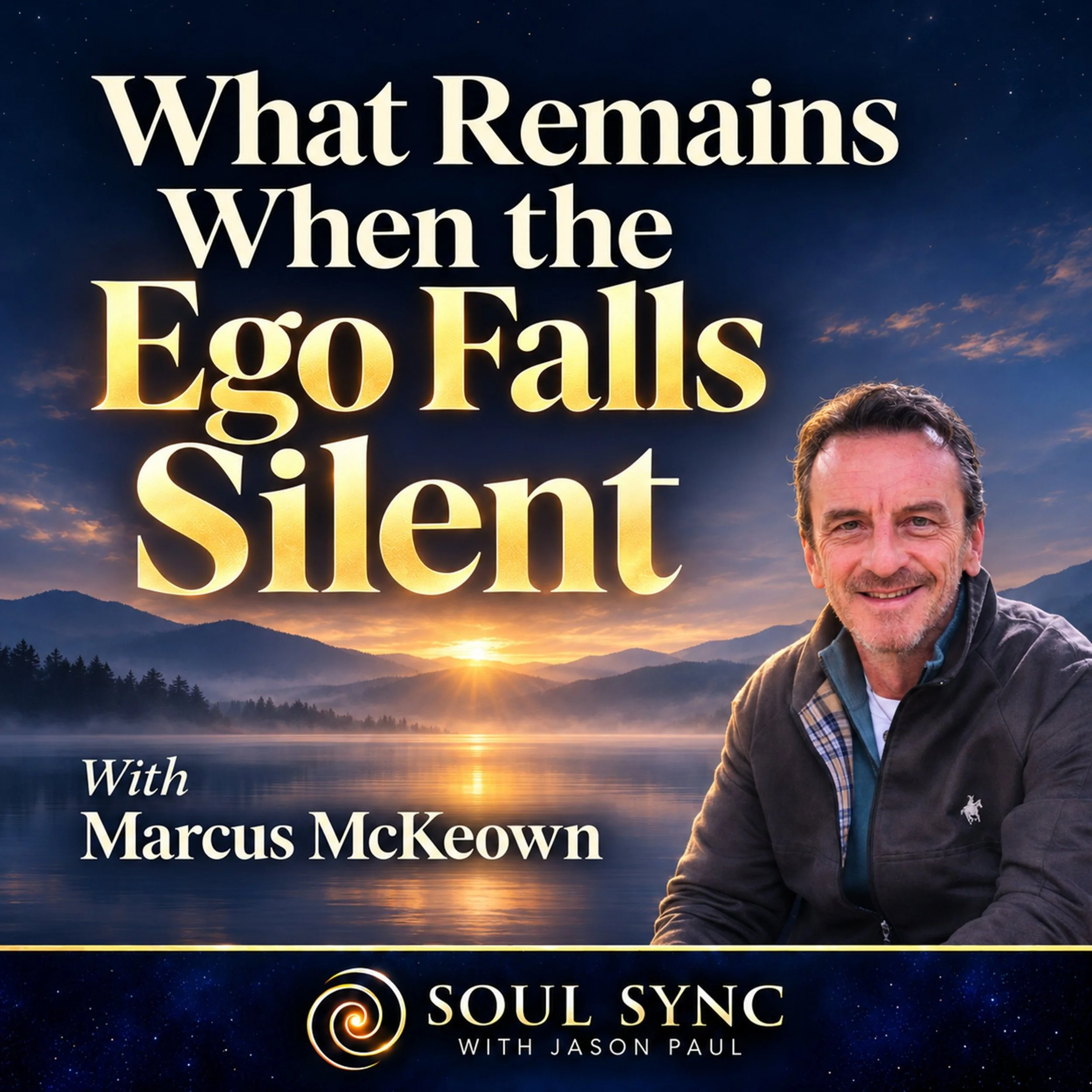
What Remains When the Ego Falls Silent with Marcus McKeown
Soul Sync with Jason Paul, in conversation with Marcus McKeown of Yellow Rock Sanctuary. Listen below, or read on for the full write-up and transcript.
Perhaps your life looks complete from the outside. The house, the car, the career, maybe a partner and children, the kind of life you once only dreamed of. Every box ticked.
And yet, now and then, something quietly asks: is this it? For some, there's an undercurrent of fear beneath it too. I've built all of this, and one day I'm going to die. What was it all for?
If that question has ever found you, it can be genuinely puzzling. You've done what you were told would make you happy. You might even feel guilty for not feeling happier. How do you explain an emptiness when, on paper, you have everything?
If you've found your way to this page because something in your own life feels quietly off, I'm glad you're here. Feeling this way doesn't make you broken, and it doesn't make you ungrateful. Sometimes the sense that something is missing is the most honest part of us, asking to be heard.
That question sits at the heart of my Soul Sync conversation with Marcus McKeown of Yellow Rock Sanctuary in County Armagh, Northern Ireland. Marcus spends his days with people who arrive at exactly that point. What he shared stayed with me long after we stopped recording.
Every box ticked, and still miserable
I know this place from the inside.
I came from humble beginnings in London. My first job was at a florist's, then I washed pots after leaving school. I've been a professional magician, Virgin Atlantic cabin crew and a police officer. Then I found my way into recruitment and spent ten years building a multi-million-pound company.
Two or three years into that business, I was hugely successful on the outside. People said "well done" all the time, and there were awards and celebrations. Inside, I was under enormous pressure and deeply unhappy. I was battling addiction, and none of what I'd achieved seemed to matter. I remember thinking: what is the point of all this?
Looking back, I believe that was my soul crying out for something money couldn't buy.
Years later, as I weighed up whether to leave the business, I finally asked myself the question I'd been avoiding. What is it I'm actually seeking? The answer was surprisingly simple. Not more growth. Not the next milestone. Peace.
Why more never seems to be enough
Marcus described two kinds of people who arrive at the sanctuary. Some have the nice home, the family, the car and a healthy bank account, yet something inside isn't fulfilled. Others have searched so hard, through course after course, that they're simply worn out. Some, he said, are even living in fear of their own death, because they don't yet feel they've truly lived.
What they often share is a familiar thought. When I get that, I'll be happy. When I reach that place, then I can rest. Marcus called it "the old 'when I retire, I'll enjoy life' conundrum."
Psychology has a name for part of this: hedonic adaptation. We get used to good things, so the lift they give us fades. In a well-known 1978 study, lottery winners were no happier than a comparison group, and they took less pleasure in everyday things such as chatting with a friend. The study was small and has been debated since, but later research broadly agrees: new circumstances rarely change how we feel for as long as we expect.
It isn't only money and possessions. We chase youth, trying to hold on to how we looked or felt at 25. We chase status and recognition. Sometimes we chase a person, believing the right relationship will finally make us feel whole.
Research suggests why these can leave us short. Psychologists Tim Kasser and Richard Ryan found that people who put great importance on financial success, an attractive appearance and social recognition tended to report lower vitality and more physical symptoms. People who prioritised self-acceptance, close relationships and community reported higher wellbeing and less distress.
Relationships matter enormously, of course. Harvard's Study of Adult Development, which has followed people's lives since 1938, has found that the warmth of our close relationships is one of the strongest predictors of a happy, healthy life. But there's a difference between sharing a full life with someone and expecting them to fill an emptiness only we can meet. No partner can hand us a peace we haven't yet found in ourselves.
So we chase the next thing. And then the next.
What might be stirring in you
If any of this resonates, it's worth gently asking what that feeling might be. There's no single answer, and only you can know your own experience. But in my work, I've seen it take a few different shapes.
For some, it's the soul crying out for more. Not more money or status, but more meaning. A sense that there's something you came here to do, and you haven't started it yet.
For others, it's the beginning of a spiritual awakening. You might notice you're more sensitive than you used to be. Old ambitions lose their pull. You may even begin to sense things you can't easily explain: a presence in the room, a quiet knowing, signs that feel meant for you. Some people describe it as an activation, as if something has switched on.
I believe that when this happens, the soul is nudging us back towards our true nature, and towards what we came here to do. It's also why chasing the wrong thing can feel so exhausting. You can chase something all day long, but if it isn't meant for you, it isn't meant for you.
None of this means something is wrong with you. It may simply mean something in you is waking up. And if your experiences ever feel frightening or overwhelming, please talk them through, whether with someone you trust, an experienced teacher or your GP.
What Marcus helps people let go of
Most guests at Yellow Rock Sanctuary stay for a few days, a week or a fortnight. Their days are built around silence: meditation each morning, time in the woodland, organic food, and gentle support such as yoga, breathwork, reflexology and singing bowls.
The aim isn't to add anything. Marcus describes it as coming back fully into the present moment, emotionally, psychologically and physically, and then letting even that go.
Some of it is beautifully simple. Guests walk barefoot in the woods and sometimes just stop, feeling the earth beneath their feet. "It's a detox from the world and the noise of the world," he told me.
Rather than handing people more to do, the sanctuary asks gentle questions:
What's the thought you need to let go of?
What's in your heart that needs to be allowed up?
What's the thing you need to let fall away?
Marcus was clear that there's nowhere to go, nothing to do and nothing to achieve. If you're exhausted, the last thing you need is someone handing you another to-do list. So his answer is the opposite: let it all fade, and notice what remains.
He doesn't take the credit, either. When guests thank the team, the reply is simple: "We're not doing, we're just being."
What changes when you live from your true nature
So what happens when someone begins to discover their true nature, and to live from it?
In my experience, and in the experience of many people I've sat with, life starts to flow differently. Decisions feel clearer. You stop forcing doors that were never meant for you. The right people and opportunities seem to arrive with less struggle. Many spiritual teachers call this living in alignment, and I believe it's where real abundance begins: abundance of peace, of purpose, of connection, and often of opportunity too.
Psychology doesn't use the word alignment, but it points the same way. Kennon Sheldon and Andrew Elliot studied what they call self-concordant goals: goals that grow from your own values and interests, rather than from pressure or other people's expectations. In their 1999 research, people pursuing these goals put in more sustained effort, were more likely to achieve them, and gained more wellbeing when they did. Later work by Sheldon described this as a possible upward spiral, with each step feeding the next.
In other words, when what you do comes from who you really are, the effort feels lighter and the rewards genuinely nourish you. Achieving a goal that was never truly yours can leave you exactly where I was at the top of my business: successful, and strangely empty.
I'm careful with the word abundance, because it's so often sold as a promise of money. That's not what I mean. Living in alignment doesn't guarantee wealth, and it doesn't make life's difficulties disappear. What it can give you is something money never could: the feeling of being at home in your own life.
Thoughts come and go. What remains?
Marcus doesn't try to teach people anything new at the sanctuary. He helps them notice what's already true in this moment.
Thoughts come and go, he said, so they can't be the real you. What is real never leaves; it remains. The ego isn't the enemy either. It's simply the part of the mind that wants certainty and control. The deeper question is: what is aware of the ego?
Then he turned it on me. As I was talking, was I thinking my thoughts, or were they just showing up? I had to laugh, because the honest answer was that they were just appearing.
There's research that echoes this. In 2010, Harvard psychologists Matthew Killingsworth and Daniel Gilbert used an iPhone app to check in with 2,250 people at random moments. Their minds had wandered from what they were doing 46.9% of the time, and they were generally less happy when that happened. As the researchers put it, "a wandering mind is an unhappy mind."
Not every researcher agrees on which way cause and effect runs. Still, it's striking that science and the contemplative traditions arrive somewhere similar: much of our unhappiness lives in our thinking, not just our circumstances.
Sensitivity, addiction and looking inward
I want to be honest here, because addiction is part of my story and I don't believe it should be hidden.
I've come to believe that addiction is not uncommon among sensitive people, mediums included. When you feel the world intensely, something that dulls it, or seems to take you inward, can feel like relief. I understand that pull.
So what does the research say? Psychiatrist Edward Khantzian's self-medication hypothesis proposes that many people turn to substances to ease emotional pain, though the evidence for it is mixed. A 2022 French study of 862 adults found no overall link between being highly sensitive and substance use, although there was a trend towards alcohol problems. And a UK survey of Spiritualist mediums found they reported better psychological wellbeing, and less distress, than Spiritualists who weren't mediums.
So the science doesn't say sensitive people or mediums are destined for addiction. What it does suggest, and what I've lived, is that when pain or overwhelm has nowhere to go, we reach outside ourselves for something to quieten it. Marcus described the same in his own story. At his lowest point, he tried coffee, cigarettes, cannabis and shouting at the wall. None of it worked.
What finally helped was turning inward in a kinder way: sitting with what was there until the noise stopped.
If you're struggling with addiction, please don't carry it alone. Your GP is a good place to start, and the FRANK helpline (0300 123 6600) can talk you through your options.
When the searching stopped
Marcus's own path wasn't gentle. He grew up Catholic and worked happily in his church for years, until even that stopped making sense. Over time he lost money, relationships and his faith. Then came two years of health problems.
Eventually he sat in a chair and told the heavens he wasn't moving until he understood. He only got up to see clients so he could pay his way back to that chair. Then one day, after all the anger and the tears, the noise simply stopped. In the stillness, he sensed a quiet message: even the idea of God, or of oneness, gets in the way of knowing it.
It reminded me that sometimes the soul has to reach a point where nothing outside satisfies any more. That, Marcus said, is when the real question can finally be heard. If none of this makes sense, then what does?
What about mediumship?
At one point Marcus said that once you know your true nature, nothing else is needed: no shamans, no Reiki, no mediumship. As a medium, I don't entirely agree. I believe the spirit world is real, and that mediumship can bring comfort and evidence that life continues.
But I agree with the heart of what he's saying. No practice, mine included, can give you peace if you're using it to run from yourself. And something Marcus said about my own work really landed: you don't try to connect as a medium, you are the connection. The more I stop trying and simply allow, the clearer my mediumship becomes.
Listening to what you feel
I believe the soul speaks through feeling. It knows the path it wants to take and the decisions it needs to make, often long before the mind catches up. That uneasy sense that something isn't right, or the quiet lift when something is, can be the soul trying to get your attention.
The trouble is, many of us live almost entirely in our heads. We analyse, plan and push on, and we lose touch with how we actually feel. That's understandable. When life is hard, sitting with our feelings can be the last thing we want to do. Staying busy, or numbing things altogether, can feel safer.
But feelings don't disappear because we ignore them. They tend to wait. And there's encouraging research on simply naming them. In a 2007 brain-imaging study at UCLA, psychologist Matthew Lieberman and colleagues found that putting feelings into words reduced activity in the amygdala, the brain's alarm system. Lieberman compared it to gently putting the brakes on an emotional response.
So try this, a few times a day. Pause and ask: what am I feeling right now? Name it, even in one word. Tired. Anxious. Hopeful. Lost. You don't have to fix it; just let it be known. Over time, that simple honesty can help you hear what your soul has been trying to tell you.
Making time for you
You don't need to book a retreat, although after this conversation I'd quite like to. Here are some gentle ways to experiment with what Marcus shared.
Ask the question. Marcus suggests beginning now, not once the episode has finished. Ask yourself: what is aware of this moment? The honest answer is "I don't know." Stay with that, without trying to solve it.
Notice the trying. When my own sitting stalled, it was usually because I was trying: pushing my energy, thinking about attuning. Trying is still thinking. See what changes when you let it be.
Give stillness a place in your week. Ten quiet minutes with a cup of tea counts. You don't need candles, a special chair or perfect posture. I've tried all three, and they were never the point.
Don't use allowing as an excuse. I still believe in discipline. You won't build the life you want from the sofa. What changes is where you act from: fear and lack, or a settled sense of who you are.
And if looking inward shows you that something outside does need to change, that takes courage of its own. I wrote about that in The Courage to Be Yourself When Your Life No Longer Feels Right.
The story that ends all stories
I always ask guests to close their own episode. Marcus left us with this: seek the one story that eliminates all the other stories, until it eliminates itself and leaves you in peace.
Peace. The very thing I had been looking for all along.
If this is where you are right now
I don't know your story, and I won't pretend to. But if any of this has stirred something, I'd gently say this.
The emptiness you feel isn't a sign that you've failed. It may be a sign that you've outgrown the idea that the next thing will fix it. That's not the end of something. It can be the beginning.
You don't have to work it all out today. You don't have to leave your job, sell your house or reinvent yourself by Monday. You might simply start by sitting quietly for a few minutes and asking what you're really longing for. For me, the answer was peace. Yours may be different, and it deserves to be heard.
And if the heaviness feels like more than restlessness, if you're low, overwhelmed or struggling to cope, please talk to someone. You'll find people who can help in the resources below. Reaching out isn't weakness. It's one of the bravest things a person can do.
POINTS TO SIT WITH
If every box in your life were already ticked, what would still feel missing?
Which "when I get…, I'll be happy" thoughts are quietly running in the background?
Right now, as you read this, what is aware of your thoughts?
Where are you trying hard, in life or in your spiritual practice, and what might happen if you allowed instead?
When life feels like too much, what do you reach for, and what are you really needing in that moment?
How could you give yourself ten minutes of stillness this week?
Sit with us
If you'd like somewhere to sit in stillness with others, my free online mediumship development circle runs on Zoom every Tuesday, 6–8pm UK time. Everyone is welcome, wherever you are on your path. It's a gentle space to slow down, experiment with your own connection and simply be. For deeper work there's my online mediumship development class, and if you'd like a one-to-one reading, you can book a reading here.
You can find out more about Marcus and his retreats at Yellow Rock Sanctuary.
Helpful resources
If you need someone to talk to now
Samaritans (UK and Ireland): call 116 123, free, any time of day or night. samaritans.org
Mind: information and support for your mental health. mind.org.uk
If you're worried about drinking, drugs or other addictions
Your GP: a good first step; they can talk things through and refer you to local services.
FRANK: confidential advice on drugs; helpline 0300 123 6600. talktofrank.com
NHS addiction support: how to find help in your area. nhs.uk
Alcoholics Anonymous (Great Britain): free peer support and local meetings. alcoholics-anonymous.org.uk
Books that may help
The Power of Now by Eckhart Tolle: a gentle way into presence and stepping back from the thinking mind.
Being Aware of Being Aware by Rupert Spira: explores the same question Marcus asks, "what is aware?"
The Highly Sensitive Person by Dr Elaine Aron: the psychologist who first researched sensitivity as a trait.
In the Realm of Hungry Ghosts by Dr Gabor Maté: a compassionate look at addiction as a response to pain.
Keep exploring
References
Killingsworth, M. A. & Gilbert, D. T. (2010). A wandering mind is an unhappy mind. Science, 330(6006), 932.
Brickman, P., Coates, D. & Janoff-Bulman, R. (1978). Lottery winners and accident victims: is happiness relative? Journal of Personality and Social Psychology, 36(8), 917–927. Discussed in Diener, Lucas & Scollon (2006), Beyond the hedonic treadmill, American Psychologist.
Kasser, T. & Ryan, R. M. (1996). Further examining the American dream: differential correlates of intrinsic and extrinsic goals. Personality and Social Psychology Bulletin, 22(3), 280–287.
Waldinger, R. & Schulz, M. (2023). The Good Life: Lessons from the World's Longest Scientific Study of Happiness. Summary: World Economic Forum.
Sheldon, K. M. & Elliot, A. J. (1999). Goal striving, need satisfaction, and longitudinal well-being: the self-concordance model. Journal of Personality and Social Psychology, 76(3), 482–497.
Sheldon, K. M. & Houser-Marko, L. (2001). Self-concordance, goal attainment, and the pursuit of happiness: can there be an upward spiral? Journal of Personality and Social Psychology, 80(1), 152–165.
Khantzian, E. J. & Albanese, M. J. (2008). Understanding Addiction as Self Medication: Finding Hope Behind the Pain. Review in the American Journal of Psychiatry.
Mary-Krause, M. et al. (2022). Is sensory processing sensitivity associated with psychoactive substance use? Emerging Trends in Drugs, Addictions, and Health, 2.
Roxburgh, E. C. & Roe, C. A. (2011). A survey of dissociation, boundary-thinness, and psychological wellbeing in Spiritualist mental mediumship. Journal of Parapsychology, 75(2), 279–299.
Lieberman, M. D. et al. (2007). Putting feelings into words: affect labeling disrupts amygdala activity in response to affective stimuli. Psychological Science, 18(5), 421–428.
-
Jason Paul: Hello to you, my lovely listener. It's me, Psychic Medium Jason Paul, and you're in the place uh where your ego can most certainly take a back seat. Um I've been in the land of change, like I said uh in the last episode, kind of re-um just taking a period to relax. It's actually dawned on me just how um tired I've been um since leaving my business. Um, because to do 13 years in the industry I've done, I think I uh I've definitely got a few stripes on my shoulders. Um so I've really been turning a lot of my attention to my mediumship, and I'm being blown away uh by just how much I'm learning, and I'm able to just um, you know, sign up to things and do things that I would never even think I could do um when I was uh working for my business, like um joining a circle that starts at 10am Australia time and doing that at 1am UK time. But why not? So um I must admit, the ego does keep chipping in Soul Sync. It keeps chipping in, uh, wanting to uh create fear, and I will not allow that, not allow that not on my bloody watch. So, anyway, let me introduce you to today's guest, who is called Marcus McKeown. Now, he is the owner of a beautiful place called the Yellow Rock Sanctuary, which is in Northern Ireland. We talk all about uh Marcus' journey on how he even came to find himself running a retreat. And I have to say, speaking to him, I want to go to the retreat myself because it sounds absolutely marvellous. Marcus and I discussed so many things in this conversation from where I am at the crossboat in my life, and how many people arrive at his doorstep, so to speak, to his retreat. They might be successful on the outside, they might have the money, they might have the looks, they might have everything, every box ticked that they feel um, you know, qualifies them to look like a successful person in whatever space suit that looks like. But they arrive because there's there's a feeling of disalignment. And it really reminds me of my own journey. Uh, you know, I uh come from Humboldt Beginnings, I grew this multi-million pound company, and one day I just thought, what the bloody hell is the point of all this? Um, you know, I'm goddamn miserable, my soul was yearning out, I was struggling on a path of battling addiction. I'd never even stopped to consider once I might want to uh do some healing along the way. God know, because uh next month uh the clock sets to zero, and here we go again. So, you know, I think there's so much to be said for spaces like Marcus has created. And what we talked about, he he put some really powerful concepts across only in such a way that someone has who's had a really um, you know, uh total short of half even, would be able to put them in. So I've sat here, as always, dribbling notes. Uh one of the big questions I want to stick with from this episode is what is awareness? We discussed about awareness, we discussed about the God force, we discussed about all that is available to us is within us. So, you know, we got a lot of value for money in. So, this is my conversation with the lovely Marcus McKeown.
-
Jason Paul: Marcus, Marcus, Marcus, welcome to the Soul Sync.
Marcus McKeown: Well, it's nice to be here with you.
Jason Paul: Oh, it's lovely to have you on, my dear. Thank you for coming on. I know we're gonna have a lovely chat because we're having a rut old Natter before I even push the record button. So, tell us about you and first of all, the Yellow Rock Sanctuary in Ireland, because I've got the website open right now. It looks bloody lovely if I do say so myself.
Marcus McKeown: Yeah, it's a precious gift in life. Yellow Rock Sanctuary is a space where people come when they are kind of sick of seeking and they just want to find some peace and rest. And we hold a space that allows people to embrace silence, to enjoy the grounds, the woodlands, organic food. We do meditation, we do some teachings around non-duality, what it means to live in the present moment. And as opposed to teaching anything, we help people sit in a space where they let things fall away and see what it what it is that remains when everything else has drifted.
Jason Paul: What does someone who's sick of seeking look like to you? What what what does that mean?
Marcus McKeown: They're frustrated, they're burned out, they're tired, sometimes angry. Often you'll find people who are well, it depends. You can have an extreme. The person might come here who has everything in their life, all of the boxes ticked, nice home, nice family, nice car, the bank account is okay, but something inside is just not fulfilled. And they can't
-
Marcus McKeown: enjoy the life that they have. And that creates a certain level of sabotage, discontent, or misalignment with the self or the sense of what life is or the purpose of life. Or you might get someone who come along and they have sought so much, they have looked so often and so far, that they're just broken, they're broken down, they're tired, they're exhausted, they are scared, they're living in fear of their own death because they haven't a sense of being someone who lived yet. And and I guess everything in between. And still there's a discontentment, there's an emptiness, there's a a lack.
Jason Paul: But even those people you're just describing, the people who are doing the Reiki, the yoga, whatever, you know, I I would like to assume that the these people understand, you know, what life is all about. They're awakened people, so to speak. They understand perhaps they are a soul. So what what's making the you know them the them feel this way, that they need to come to the sanctuary? I'll I'll say quite frankly, the sanctuary looks like the sort of place where I'd quite like to go on a holiday, but that's not the purpose of it, is it, Marcus?
Marcus McKeown: That's not well, actually, actually, it is. The sanctuary is here. People, there's a couple of things that happen here. Locals can come in a couple of times a week and join meditation, but essentially once a month we do assigned a treat. Every couple of months we put on a different kind of program, maybe a teaching program. But most of what happens here is that people book in for three or four days or a week or two weeks, and they come and they enjoy the silence, they get meditation every morning. There's yoga, reflexology, uh, singing bowls, breath work sessions, whatever you need to accompany you as you find rest and peace and escape the busyness and the noise of the mind. This is all about coming back into the present moment fully, emotionally, psychologically, physically, and then letting even that go and allowing the silence and you recognize the oneness that there is between you.
Jason Paul: And it's you know what? I think that to step away from the madness of the world, because even at the crossroads, I was telling you about just before we started recording with my business, and it's been everything I've known now for 14 years is recruitment, your phone going off every two minutes with candidates, clients, you know, you sort of constantly looking at the money speedometer every month, it resets to zero. You're in the land of the ego non-stop, and you know, I've kind of stepped in, I'm detangling myself from that world, Marcus. And I'm suddenly finding myself feeling like I'm flowing, I'm I'm enjoying it. But I do keep noticing the ego and the world and all this, you know, dinging, binging, phones, whatever. It's you know, the ego even wants to keep coming in with unhelpful stuff at times during this transition. And it's very easy to see why sometimes you need to step into that environment just to even just to be step on the you know, the raw earth beneath your feet. For sure, for sure. Yeah, yeah. Do you even wear shoes uh uh uh Marcus, or are you just barefoot all the time?
Marcus McKeown: On occasion, in the sanctuary, no on occasions, in the sanctuary, no shoes. No, for sure not no shoes. It's a simple thing, but like we have a woodland here, it's very common. You go out and people are walking around barefoot, and sometimes you just see them, they'll stop and they'll sense the the earth and the energy of the life they're standing in. And even that makes a difference. It's a detox from the world and the noise of the world. Like you mentioned that you would expect the people who do some of the the seeking that they know that there is soul and they know how life works. Surprisingly, most don't. If you live in a world where the people around you are aware of that, it's kind of a normality. But most are not aware of what it is that they're dealing with in these things. They've got a training, they've got an understanding, they've gone to a school or a class or a course. So they know something, but they're still trying to become something else. They're still thinking when I get those clients, I'll be happy. When I achieve that thing, I'll be happy. When I get to that place, I'll be happy. When that occurs, then I can rest. It's the old, you know, when I retire, I'll enjoy life conundrum.
Jason Paul: Yes, and and do you know what? That's so sad as well, because you go through your life and you think, okay, when I retire, but you know, you want to enjoy your whole life. And I it's so easy to understand how we fall into those traps because something of it jumps out at me that you put on your form is you help people see what is true and what is not? How do you help them do that? Because it's so often, you know, we can even uh have these beliefs and and ideas about ourselves that certain things are are true, and I've had to really look at my life and say, is that reality, is that belief even founded in fact? How do you help people work this out what's true and what's not?
Marcus McKeown: Through the idea of a direct uh examination of the current moment, a direct experience, what is really happening, like as the
-
Marcus McKeown: thoughts come and go, they can't be real if they're coming and going. That which is real never leaves, it remains. So what comes and goes is not real, but what comes and goes is often what captures somebody and holds them in in what they think is the present moment, but they're actually being held in the present thought or the current thought, which is very often future or past based. So when we say we help people here, we simply ask the kind of questions, I suppose, in a crater kind of way, we ask the kind of questions that allow people to reflect on what is the true experience of being here now, emotionally, psychologically, physically, what is that thought asking of me? Is it pulling me away from here? What does it mean to sit and to rest in silence reading? So it's to become aware of what is the true direct experience that you're having, and you'll discover that practically everything is a perceived reality, but it's not the only reality. So the question we ask is what remains? When all of the thoughts, the perceptions disappear, the sensations disappear, the ideas disappear, the notions disappear, what is always there? What remains? And what remains is your true nature without being disturbed by the mind or what you call the ego. And people sometimes resist the whole idea of even talking about ego, but ego does is not against you. Ego simply does what ego does. It's the part of the thinking mind, the part of the self of the experience of life that wants certainty and it wants control. It's programmed to have certainty and control, but it doesn't know anything unless it is in control of itself thinking control. So who is the question we have here is what is aware of the ego? What is the one that is aware of the moment? The moment is the experience, but what is aware of it? You are aware, you are awareness. Everything else is to perceive reality.
Jason Paul: Well, yeah, it is so interesting you even saying that because you are awareness, but we identify that we are our thoughts, don't we? Because if I think how many unhelpful thoughts I have a day, it's you know staggering at times. But we our thoughts are just neural pathways of the past, you know. We are just you know, a series of thought patterns, aren't we?
Marcus McKeown: And neurons. Here's a question for you, Jason. As you as you ask me this, are you thinking that, or are those thoughts just appearing and you're showing them?
Jason Paul: Well, they're just appearing, they're just moving the past.
Marcus McKeown: You're not even yeah, there you go. You're not even thinking yet. We get caught up in the idea that I'm thinking these thoughts. No, you're not. There's problem number one. You think you're thinking, you're not. You're you're realizing something that shows up, and what shows up tends to be what is within the the bandwidth of your mind, your life experience, your programming. Like you'll never have a thought show up that you have not been exposed to somewhere in some way. So no, you don't because it's a safety.
Jason Paul: You've you started getting coming into your mind, okay. You in a rocket, well my god, that's gonna freak you the hell out. What is this thought? You know, why am I getting it? We are just it's all just previous stuff, but that's where we struggle to move forward in our life because we are just stuck in living in the present from the past, aren't we?
Marcus McKeown: Well, if we re if we really go to the heart and soul of what we help people understand here in the Yellow Rock Sanctuary, there's not even a we. This is all perceived reality. This is this experience that we're having is the ideas that have been allowed to manifest themselves in some form through mind, which is object. We are all life, one life, not versions of life. We are all life showing up in different forms, one life expressing itself in every way. Life life doesn't even know your name. You are life, getting to know the self. Life doesn't care that you're Jason, life is just enjoying the fact that it's knowing itself in the form of Jason, in the way of Jason, and through the personality of Jason, and life is laughing as Jason takes it all very seriously, because life knows that Jason isn't even it's just itself, knowing itself.
Jason Paul: We start life from a very difficult perspective, don't we? Of being the very first thing we're given, as soon as we're born, is a name. Understandable, we need a name, but we are given an identity, so we we start, you know, and I don't know what happens up there in the spirit world. My belief is a soul decides it wants to come down because it has a number of learnings it wants to undertake, so it enters into a soul contract. And I think my soul was probably putting its hand up for everybody experience, knowing my soul. But the point is we then come down here and we forget as soon as we're put into a body, we identify with that body, we identify with that name, we identify with those beliefs that we have about ourselves, and you know, it there's so much to even detangle there. So the lens you're looking through reality at is got so many biases and uh you know beliefs about oneself. You know, how you're perceiving this conversation right now is probably very different from how I am, you know.
Marcus McKeown: We're having two different conversations.
Jason Paul: We are having two different conversations, we're living in two different realities, but we are one being, we are one in the same.
Marcus McKeown: Here's something that I really get a laugh and a kick and an enjoyment of sharing with people that right now in this moment, you're only experiencing yourself, you're not even experiencing that. You're experiencing yourself in the way that you perceive me. But it and it's the conversation you're having with yourself about what you're hearing from here that you're experiencing. You're not experiencing my work, you're experiencing your own conversation about my work. You it is not possible to experience anything outside of my world, everything is an experience from within like even if I come over and I touch your shoulder, you won't experience me touching the shoulder, you'll experience yourself having the experience of being touched by, but you won't experience me touching you just the touch itself.
Jason Paul: Yes, and that's even that is a very interesting concept and way of looking at it, because you are, even when you're talking, and it was making me think, as you were saying that about my ADHD brain, you know, I I know that because I've got a very active imagination, and even when someone's talking, you know, I have to concentrate quite hard to pay attention, but it is an internal experience. But then, you know, when we start talking then about awareness and awareness not being, you know, within your body, you know, yes, okay, you have an awareness of if someone touches you, physical touch and vibration, but awareness is so much more than the five physical senses, sure.
Marcus McKeown: And I know and and and the experience that we're having, we could see is is that which is arising from awareness itself, it's a localized expression of awareness. But awareness doesn't know that awareness is the essence of all. Awareness is life itself, and it's getting to know itself through its own expression, its own activity, which is what we are an expression or an activity of. Life itself. We're at the splash from the river. So if you imagine that everything is one, which which we believe, I guess, that everything is just one expressing itself in many ways, the old school language for that would be that that the omnipresent, omnipotent, omniscient force called God, that God is oneness. In that case, even God doesn't know that God is God. Because for God to be to know that God is God, oneness would have to split itself into two-ness to
-
Marcus McKeown: discuss itself, to know about it. So to understand your true nature, one must fall so silent that there is no disturbance. The catch is that when you're so silent that there's no disturbance, you don't even know that you're there anymore. So you don't have an experience. This is where a lot of people get confused and they get lost looking for awakening because they think awakening or enlightenment is an experience. In fact, it's an experienceless experience, it's the utter allowing of silence so profound that nothing is known to you anymore except knowing itself, which is so silent you can't even discuss it.
Jason Paul: Well, that's uh I don't think I've you as you're saying that the could the Jason Cogs are turning because I understand what you're saying there, because when you go into such a deep level, you lose a complete sense of the ego, and and that disappears, and what you experience, yes, is the oneness of everything. But you know, I I question to myself have I ever got to that stage on a meditative.
Marcus McKeown: It's not a it's not a stage you get to, it's who you are. The question is, have you allowed yourself to fully rest with self, or do you stay in the mind discussing the thing you're trying to get to, which can't be got to when it's been discussed because it is there without the discussion?
Jason Paul: There is so I it's very funny. So in my sitting now, I the biggest challenge in all of this is the mind, isn't it? It's the chatter of the mind and it's getting it to be quiet. So I've gone through different stages of my journey. When I would first sit and meditate, it was always something that I found challenging at the beginning, just the sitting still bit. But you know, what's tended to happen over time, as soon as I've stopped lighting my odd amount of candles and sitting in my special chair and thinking I need to sit upright in the lotus position and throw my third eye over my head and all of that, is the challenge is the mind. I can get to such a stillness, but it takes taken me a lot of real dedication and work to just get to a place of allowing and being. Because for so long, I believed because all of our journeys is different. I believe from the very get-go, my meditation was I want to connect with the spirit world. And you know, that was why I was sitting. So I've always sat with that intention. Then it took me a while to understand the difference between meditation and sitting sort of in one's power and raising the vibration enough to connect with the spirit world. Then one of the biggest um barriers I've realized is trying, and trying is thinking, and thinking I need to push up my energy to connect with the spirit. Now I'm attuning to the spirit. Now I'm thinking right now about having to build the energy out. All this time I'm thinking. I'm not allowing, you know.
Marcus McKeown: Of course, and and when you're trying, you trying by by default, it tries, it never achieves. So you're always stuck in the trying. And when the mind is focused on that energy system or that thought process, the mind remains in the loop with the promise that you get there. Of course, knowing that you never will, you're not meant to. Like even when you say that you know, you try to get the connection, the the challenge a lot of people have learning what you do or learning how to connect, let's put it in a more simple three-dimensional experience, they're learning how to connect with a partner or with a child or with a job. It they try to connect and they are therefore losing the knowing of the present moment, which is you are the connection. Like you don't you don't try to connect as a medium, but you are the connection that there is. And when you allow it the is-ness to be, then it is more clear. When you try to figure out or when you look, you told me earlier, when you look at the person you're reading for, there's a maybe a little give in their face that will direct you away from the essence of the experience you're having at the moment, which kind of Pollutes in away the purity of the body.
Jason Paul: It does pollute it because uh straight away, and I didn't realise I did something like this, but I having an ADHD brain, you do something that's called like masking, and there there was this programme on BBC Two where it talked about autism and how autistic people find it so draining to be kind of in social settings for too long because they like they they find it overwhelming because of the way that they kind of perceive the world. So what it said is they you know will mirror what they feel they have to be. And with my ADHD brain, I learned this as we all do as we're children, we learn different experiences, but I was always told I wasn't paying attention, so I've learned over time that you know I'm sort of hyper-focused on every am I, you know, making sure that I'm paying attention to this person, am I looking interested? Because sometimes my brain's just doing other things. So, you know, that's kind of allowed me to be really good at reading people in terms of facial expressions, but you know, being being a very caring person about my mediumship, it made me every time I would see someone all sort of raise an eyebrow or something, I thought, oh no, I can't, I'm getting that wrong now, you know, and it would take me totally off course. But you know, I'm a trier. That's the thing, Mum, because I'm a trier. Um everything that I've achieved in life, I've now associated, but trying gets you somewhere. And it does get you into a lot of places, but not half as much as allowing. But what you can't do is use allowing as an excuse. You know, if you want to manifest something, you need systems, you need discipline, you need, you know, you're not going to manifest your dream life if you're sitting on the sofa all day long. You know, that's just common sense.
Marcus McKeown: But yeah, well, that's what that's what manifestation requires. But what what if what if there's a simpler path? What if you and and what if it's simply the recognition that you don't need to manifest? There's a a different word that might change the whole perspective, which is you render into existence,
-
Marcus McKeown: you render into your knowing. Manifestation is a lot of hard bloody work, no?
Jason Paul: It's a lot of manifestation is again you uh a manifestation is one of these things that annoys me the more and more and more I go into this, because I have a very long and extensive relationship with manifestation, spanning back many years to when I was very young, reading the book The Secret, and really then feeling that manifestation and the law of attraction is the answer to everything, but never fully believing in that because I find it so difficult. I think, okay, the way I need to get the life I want is to be really grateful for it right now and imagine I've got it. And it just something about that just felt sticky. It felt like I'm trying to do something here. But you know, now my belief is to get that thing that I want. I think one of the most powerful things you could do is visualization because you are putting that intention out of there, that vibration out there. And you know, the subconscious mind doesn't know the difference between you know imagination and reality. So, you know, then you will get insight into that. But I think manifestation is one of these things that is glamorized and it's it's attached to money now. It's now all you know about how to get material things. So it's lost the truest essence of what it's all about, I feel.
Marcus McKeown: Yeah, which is to get the essence in the present moment of what it is to have the experience of that thing, not the thing itself, but what it is to experience the self as if that thing is already in your life. So the true manifestation is to breathe into the essence of the beingness of who you believe you would be if that thing were a part of your life. It's it's to allow the energy that is there to show up as opposed to be hidden behind all of the trying and the doing. This is simply about letting go. What we teach here and what we help people understand is that what do you need to let go of? So we use nice words like what's the thought you need to suffer, what's the heart you need to allow up, what's the thing you need to let fall away. It's not about doing. Like we we teach here, there's nowhere to go and nothing to do and nothing to achieve. And and if you listen, if you can imagine you're listening to this, but you're at home a listener, brokenhearted, feeling poor, feeling hopeless, tired, the body is aching, and you're just exhausted and tired. And then somebody comes along and says, Well, when you do this, and you think, but I can't do that. I don't have the sleep and energy, leave me alone. When you think this way, well, I can't think that way, my thoughts are tied up in this worry. It's almost like, well, then I'm sorry, there's nothing good. What we say here is, well, that's great. Let all of that disappear, let it all fade away. What remains? Like if I ask you right now, Jason, everything disappears, everything fades in your life, what's left?
Jason Paul: Love even that. What's left? Just life itself, I guess. Even that. Let that go. What remains? Consciousness. Amen. There you are.
Marcus McKeown: Welcome home. And then and then sit with that, and then you just sit with that, and you allow the examination of that by the observation, allow it to be, and then the movement of life happens from the knowing as opposed to the knowing of or the thinking about, and that's why it's a very thin line between the allowing and the idea of what you think allowing is.
Jason Paul: You're very good at explaining things, and there's a certain wisdom, you know, when someone's you know really understands something because the uh it's the art of being able to explain it, and it really comes through the amount of people that you've um helped over time because you you have such you know uh sincerity, and I can tell this comes from life experience. You you because you grew up in a working class family. How do you know how did you get to where you are now? Because it's you know, it doesn't from what from what I understand of the beginning, it wasn't like this, Marcus, this world for you.
-
Marcus McKeown: No, for sure not. For sure not. How did I get to where I am? Well, well, first of all, without being facetious, I've just I realized in my life that that I was always where I am. I just was experiencing it differently according to my bias. I had expectations that were given to me. I had pictures that were presented, and I was I was guided to understand that a happy life meant A, B, C, and D. So I headed off in that direction, never getting fulfilled, but achieving many things. And I suppose I am, if you look at the the old traditional faiths and the ways of teaching, and the great masters, the ascendant masters, and how did they teach? I essentially I I went through death and rebirth. The death of my ego, sometimes the death of my money, the death of relationship, the death of faith. Like I got to a point in my life where I I sat in a pile of nothingness with everything that once made sense having dissolved. Nothing made sense anymore. How did that not happen? Many, many things like in this moment, I was hurting with something that had happened 20 years before. I was hurting with something that happened the day before. And and the some things were disappointments, expectations that weren't reached, or or the emptiness of a life when you reach what it is you expect, and when you reach what it is you're trying to reach, and then all of a sudden the the the the momentary relief passes, and you're back in the but I'm not content. There's still something missing. And and I'm an eternal optimist, which also didn't help because I didn't know when to quit and when to let the death happen. So I keep fighting. I was a I was an emotional psychological warrior, and I also thought that that was a good thing. Like I was brought up in a Catholic environment, so you know, heading for the cross and dying up there was an important part of life, but for all the wrong reasons. Like we I I grew up in a faith that focused so much on the cross and very little on the resurrection, on the new life that came to so I discovered in my life that well, that's not going to work either. And I worked for many years in my church and loved it. The happiest moments of my life, I would say. And then I realized no, even that doesn't work. I need to find out what this is. So I left it all behind. And and then I guess it's eight or ten years ago, I just fell into this moment of realizing I have to stop. I have achieved so much, I've garnished so much, I've met so many people, I had ticked all the boxes of my life to and was just completely unfulfilled. And feeling inside that, if this is it, what's the point? What do I do now? There's nothing to excite me anymore. So I sat and I I suppose I went through a very difficult period of two years of health issues. And then I sat in the chair and I kind of stared at the wall and I swore at the heavens. And then I said to my God at the time, my understanding of life, God, the universe, call it what you want. I swore and I said, I'm not ethnic moving from here till I understand what this is. I'm just not moving, I'm done, I'm finished. And the only reason I moved from that chair was to go to the bathroom to to see a client to get the basic amount of money I needed to pay my way to go back to the chair. And I sat there contemplating and contemplating and wondering and getting angry and crying and you know, drinking coffee, and that didn't work, so I'd smoke a joint and that didn't work. I'd smoke a cigarette, that didn't work, I'd scream at the wall, that didn't work. And I just stayed there until finally the noise stopped. And I had that moment, just that moment that never was absent. That moment that was always there, but the noise, the trying got in the way, the expectations got in the way, the wanting to please people got in the way, even people that had died. I was still trying to please them because the story in my head told me I had something to achieve, something to do that would mean if I got it, I was a good man or a good boy or a good person or a successful person. And I just came to the realization, very gentle, very sweet, very soft, no excitement. I was in a moment I I recognized, wow, I've just been meditating. This is beautiful. I feel I'm experiencing peace. It's just me and God right now. And then I heard the voice say, Well, if you really want to know me, let me go to and I presume that to be the voiceless voice of God that was letting me know that even the idea of God prevents you from knowing oneness. Even the idea of oneness gets in the way of knowing oneness because it's a noise that disturbs the stillness. That oneness is only known through, known in, known as. And that was it.
Jason Paul: It sounded like you had to get to a real climax point of just almost it felt to me like nothing is uh fulfilling my soul here. And and and I resonate with that because even I I as you were talking, it reminded me of when I was uh two years into my business, had more money than I could probably spend. I was so miserable, I was suffering from addiction, I was unhappy in every way because it felt like none of this matters, and none of what you know society says, you know, and and the way we view things on as sort of on a whole as the population. None of this matters. And then I couldn't understand what the purpose of it all was, what the purpose of life is. And it feels to me that it that was my soul crying out, you know, like please God, give me something nourishing, you know.
Marcus McKeown: Yeah, that's the death, that's the ego death, that's the moment that that that allows the question that gets your attention to arise. Like we automatically, with none of this makes sense, there's a there's a quiet background question been asked, which is therefore what does make sense? But we're not used to hearing that. So we stay with the question, this or stay with the statement, this makes no sense, this makes no sense. And we are we are getting caressed by the silence of the question, therefore, what does matter? But we're not able to hear it because we're so used to being in the noise and the statement of fact. You see, what do you do when you realize that nothing makes sense and nothing matters? What do you do with the question, therefore, what does make sense or what does matter? You don't know what to do with that, and we're not familiar with sitting and not knowing.
Jason Paul: Even that question forces you to look so inward, doesn't it? That and some and some people just can't even, you know, comprehend wanting to look, you know, because that's like a little so much shadow work for a lot of people. It's such an exposing question, isn't it?
Marcus McKeown: Yeah, for sure. And and the beauty of this whole idea of surrendering into the I don't know, when you get there and you recognize your true nature, you realize there's no shadow work needed, there's no mediumship needed, there's no Reiki needed, there's no banging of the drones needed, there's no Peru needed, there's no shaman needed, there's no getting lost needed, nothing is needed. None of it is necessary to know your true nature. It's not essential. It might be necessary to the ego to help you know that oh, I'm not alone. Am I alone? Please help me so I know I'm not alone. But it's not essential to knowing your true nature. All of these things are the games that we're playing ourselves as life expresses itself. We're just having fun, but we take it so serious, we forget the fun picture.
Jason Paul: Okay, someone listening to this right now, they want to discover as soon as they finish listening to this episode who I truly am. What should they do? Where should they start?
Marcus McKeown: Well, don't wait until the episode finishes. Begin to ask yourself what right now is aware of this experience? The one that is having the experience is not aware. The awareness, awareness itself is aware of the experience that has been known. What
-
Marcus McKeown: is aware? And they and the the answer is I don't know. Good. Stay with the I don't know. Don't try to answer it. Let just the essence of the moment, the essence of the question, what is aware, resonate and stay with that until it makes sense. And every time the voice comes in and says, but you say, Shh, stillness now. What is aware? And every time the ego bites in, and you will fail, fail really, there's no such thing, but you will feel that you're failing because you get so pulled in. All that's doing is showing you that you have really and truly become embedded in a belief system that is requiring you to be at your best in the nothingness and doing nothing in order for that to dissolve. It's about effortlessness. Enlightenment is not an event. There's no experience, it's the most boring, pathetic, disappointing thing you could ever imagine. Because it's just life continuing as it is. The difference is you recognize the true nature. That's where the excitement might come from, but it's a still quiet excitement, it makes no noise. That's why the enlightened being falls silent, they don't jump up celebrate.
Jason Paul: Yeah. And it's funny because you know, if someone had said to me 10 years ago, what is alighterman? I would have thought it's like a almost like a bolt of lightning coming down, you know, where suddenly you're transported to a land where I could zap you like I'm something out of a Matilda or move you, you know. I've become of another state, Marcus, you see.
Marcus McKeown: You and me, you and me, brother, me too. I I remember I at one stage I thought growing up as a Catholic, I thought it's something to do with the skies opening and a legion of armies coming down with trumpets and Jesus on a horse saying, Come on home, kid, you made it. All of that is just part of the game, the stories that are there to help us to focus in ways. But no, there is no movement. There is no movement, it is stillness. Your true nature is stillness itself, unknown by itself as knowing. You cannot know it. You are so still. There is no movement, there is no thought to let you know what you know. You are one with the knowing, in the same way the fish has no idea it's in water.
Jason Paul: Do you know something? When I was uh to to sort of throw a totally sideball in, my first ever job when I was 15, 16 years old was a magician, actually. I used to busk in Covent Garden. Um I was sort of like a slightly comedy type magician, to be frank. You know, I used to do all sorts of crazy tricks, and I used to, when I was 14 years old, I used to do a lot of that as well. And I wanted to ask you, based on everything you know now, where you are right now in your life, do you believe in magic?
Marcus McKeown: I believe in what's known as what I call the magicless.
Jason Paul: Yes. The
-
Jason Paul: magicless magic. Yeah. What does that mean to you?
Marcus McKeown: The magic is magic is to know that everything in the world is magic, but there is a there is it has a way of being. It is the way of being. When you understand it, the idea of the traditional sense of magic disappears, but the glory of the grace and the wonder of it is magic in itself. Knowing that it just the breath of life itself, which is all things, is expressing itself in so many ways. It's the ultimate magic. Do I believe in magic? I believe it is magic that there are billions of cells right now interacting, talking, communicating, so you and I can have this moment, this experience.
Jason Paul: Well, even the fact we're here, you know. How many ancestors have you had uh thousands of years back, you know, that's led to, you know, you getting here right now? We are magic, even the fact we're sitting here.
Marcus McKeown: Yeah, with the magic itself expressing itself. The the challenge or the difficulty with that word is that it can create an expectation of an event, and that's the ego wants that. The ego wants you to go chasing the magic, chasing the event, chasing the discovery of the mysterious and the unknown, because it keeps the ego busy, and that's beautiful. Why not? That's what life is for. Enjoy it, but just do it from the place of or allow the beingness to be the thing that allows you to go into that as opposed to the seeking. And that's once you seek, you're not going to find.
Jason Paul: See, that's the thing with the Match Starter Magic Idea delusion. We would build up to that moment. We call that the crescendo in magic terms, Marcus. You see, we're striving for that moment where the effect takes fall. And mostly do things with fire and all sorts. I'm surprised that insurance, to be quite honest with you.
Marcus McKeown: It's it's no different to a 21-year-old in a bar who sees a girl he fancies and he goes over and he starts talking. He's building up to the crescendo and he's hoping he succeeds. It's the expectation, it's the desire, it's the want, it's the mystery, it's the unknown.
Jason Paul: I believe we call that courting in old-fashioned terms.
Marcus McKeown: I believe so, yeah.
Jason Paul: Yeah, so I think these days it's more like a fishing rod, you know, sort of reeling. I used to teach recruiters this in my day job. I used to say, when you get a candidate on the end of your fishing rod, right, you you know, you're doing well. But don't suddenly fling it back, reel the candidate in, you know, it's like anything. No one wants to be chased either, you know, it's not attractive, you know, don't chase anything, just allow, you know. I think there's something about that as well. Can we do that?
Marcus McKeown: If we if we're talking in the in the whole idea of understanding life and the meaning and the purpose, and and you come from a recruitment background and a sales training background, you know, there's a beautiful idea in sales, which is once you ask the closing question, shut up, the next one who talks loses. Oh, it's the I teach that. Yes. It's the it's this, but that's the same principle as trying to find the meaning to life. Once you ask the closing question, being what is this? Shut up. Next one who talks, loses. Be still and let the speaking arise, let the knowing arise,
-
Marcus McKeown: let the let let life chase you. Like life is doing its thing through you. That's all. Like we're not doing anything here. The grounds in Yellow Rock Sanctuary are so beautiful, they're breathtaking. And many people come and they say to Pat, Oh, you're doing amazing here. And Pat just laughs and said, But I'm not doing anything. Life is doing all the growing. I'm just positioning the plan. Life is doing everything out. But people want to believe that it's us to come in and they say, Thank you for this, you guys are great. We say, We're not doing, we're just being.
Jason Paul: I bet people don't like you on TripAdvisor, do they? They look at your reviews and you put that and they think they're not even trying there and they're getting good reviews. What are they doing at the Yellow Rock Sanctuary? You'd uh they need to put you on uh four in a bed or whatever it is on channel four because you do very well. The only problem is that they're all stingy on that television show, though, with what they pay. I wouldn't want you there. It's cheaper than you, Marcus.
Marcus McKeown: Unfortunately, I can't even comment on that. I think it must be 25 years since I've seen a television. Oh yeah.
Jason Paul: It doesn't, it doesn't look for what I can see on the aerial photos here. I see any antennas on the roof here with the lovely aerial short. So yeah.
Marcus McKeown: I won't find a TV here.
Jason Paul: Well, it's do you know what? It's been such a blast to have you on, and thank you. Do us the honour then on Soul Sync today of leaving us with a final thought. Close your own episode, Marcus. That's very lazy, but it's a tradition I fall him into, you see.
Marcus McKeown: Well, as to leave you with a thought, seek within you the story that eliminates all the stories. A story so powerful that when it eliminates all the stories, it then eliminates itself and leaves you in peace.
Jason Paul: Do you know what? Short, sweet, but I don't think you should need it any more there. Beautiful. That's a thought to leave us with, isn't it? Marcus, thank you, my dear, for coming onto the Soul Sync. It's been a blast. It's been a pleasure. Thank you so much. Honestly, wasn't that an absolutely fascinating conversation? Yeah, my pencil needed sharpening at the end of that, I tell you, because I was sitting in it scribbling. I want to go to the Yellow Rock Sanctuary. I think a sanctuary at the moment, Soul Sync, is exactly what I need. Um, because even uh in recruitment, your phone is always going off. Now, uh, I have released on my website at jasonpaulmedium.com a number of appointments over the next three months um because my diary's opened up to do a lot more mediumship. So if you feel called uh to have a tarot reading, a psychic reading, a mediumship reading, a blend of all, um do check out uh the website now jasonpaulmedium.com. It's lovely, my darlings, to be here with you. And um Marcus left me in such a feeling of vibrancy there. I feel absolutely fantastic after talking to him, and I'm definitely going to be sitting down asking what is awareness because uh what a fascinating concept.