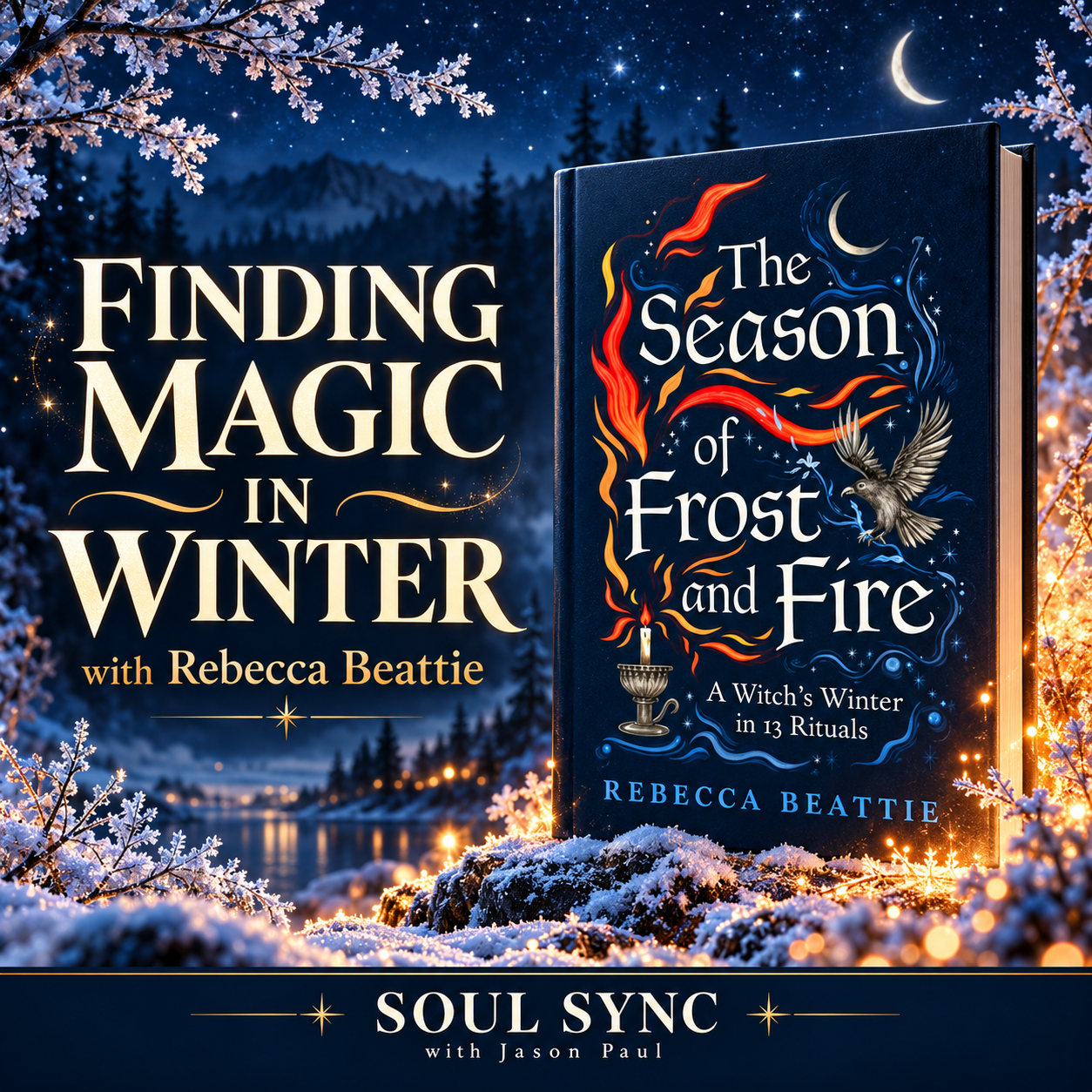
The Season of Frost and Fire: Finding Magic in Winter | Rebecca Beattie
Listen to the full episode above, then read on for what it stirred up in me.
I own two cauldrons.
I love all things witchy. You could leave me in Glastonbury for five hours and I'd still be amused. When Rebecca Beattie's new book arrived and I held it for the first time, something in me went: oh, hello. I know this.
I've long had a feeling that I was a witch in a previous life. I can't prove it and I wouldn't try. But I know what I'm like. I burn sage and sandalwood. I love putting together my own mixes, different ingredients blended for a particular intention. There's one I burn for clairvoyance, made from bits I picked up in Glastonbury. Give me a bowl, some dried things and a purpose, and I'm a happy man.
So when Rebecca came back onto Soul Sync to talk about The Season of Frost and Fire: A Witch's Winter in 13 Rituals, I wasn't a neutral interviewer. I told her on air that the book has a powerful energy just sitting in my hands, and I meant it.
It's out on 8 October, which is perfect timing. The clocks are about to go back and most of us are already bracing.
This is a reflection on that conversation and on the season we're walking into. I want to tell you what Rebecca changed my mind about, and why I'm planning to do winter differently this year.
Why this has always felt like a magical time of year
I've always looked at this time of year as a magical one. The light goes gold, then thin. The air smells of smoke. Something in me wakes up just as everything else is supposed to be shutting down.
[JASON: add a line or two of your own here. A memory, a place, something you do every year at this time.]
The more I read, the more I think that feeling is very old. Here are a few things about this season that I find wonderful.
Winter used to start now. In the Celtic calendar, Samhain on 31 October marked the end of the harvest and the beginning of winter, the dark half of the year. Halloween is what's left of it.
It was the season of the dead long before it was the season of sweets. At Samhain the veil between this world and the spirit world was believed to be at its thinnest. As a medium, what strikes me is that this is the one time of year our culture gives everybody permission to think about the people they've lost.
The shortest day is Monday 21 December. London gets 7 hours and 49 minutes of daylight, and the solstice itself falls at 8.50pm. The word comes from the Latin for the sun standing still.
The evenings start drawing out before the solstice. London's earliest sunset is around 13 December, a week before the shortest day. I love that. The turn begins before you can see it.
People built for this moment five thousand years ago. Newgrange in Ireland is older than Stonehenge and the pyramids. At sunrise around the winter solstice, light enters through an opening above the door and reaches the chamber at its heart. It's a tomb. Somebody made sure that on the darkest morning of the year, the light reached their dead.
We're closest to the sun in the depths of winter. The Earth makes its nearest approach to the sun in early January. Our winter comes from the tilt of the planet, not the distance. Nothing has moved away. We're only leaning the other way for a while.
I find that last one a comfort, and not only about the weather.
Winter isn't what we were told it is
I'll be honest about where I started. I'm a baby about winter. I belong to a walking group that barely sees me between November and April. When it's dark at four o'clock my instinct is the same as everybody's: heating on, door shut, see you in March.
There's a whole shelf of lovely books telling us that's the right instinct. Hunker down. Light a candle. Wait it out.
Rebecca's challenge to that is what I've been chewing on ever since we recorded. As a practising witch, she said, it's a very odd way to treat a season. Nature hasn't died. It hasn't even gone to sleep. There's an enormous amount going on out there. You have to train your eye and your senses to catch it, because in winter the energy runs under the surface.
Then she compared it to psychic development, and that's when it landed. That is exactly what developing your awareness is. Nothing gets added. You learn to perceive what was already there, being quiet.
I know she's right, because the days I do get out are some of the most magical of the year. The way the frost sits. The dew. A bare tree that looks dead and absolutely isn't.
Rebecca grew up on Dartmoor and lives there now, where the logic is simple and brutal: if you won't go out in the rain, you won't go out. Her spaniel doesn't accept excuses. So she's out every morning, often without seeing another soul, which suits a self-confessed horrendous introvert perfectly.
Rebecca's book follows that old calendar, from the first frost at Samhain to the thaw of early spring, with thirteen rituals along the way.
One chapter is about resting. Nearly everything else gets you outside.
The research agrees with the witch
I went looking to see whether any of this stands up. It does.
A psychologist called Kari Leibowitz moved to Tromsø in northern Norway, where for part of the winter the sun doesn't rise at all. She went expecting to study winter depression. What she found was a town that looked forward to winter.
In her study of 238 Norwegians with Joar Vittersø, the further north people lived, the more positively they thought about winter. And the people with a positive winter mindset reported greater life satisfaction and more positive emotions.
It's a small study, and it shows a link, not a cause. But it matches something every medium knows. What you expect shapes what you perceive.
The second piece is daylight. A study of more than 400,000 UK adults found that each extra hour spent outdoors in daylight went with lower odds of depression, less low mood and better sleep. That one is observational too, but it's a lot of people pointing the same way.
So how you think about winter matters, and getting out into what daylight there is matters. Rebecca has been saying both for twenty-five years without needing a research grant.
The storm in a jar
Of everything in the book, this is the one I fell for.
In her chapter on winter storms, Rebecca gives a recipe for making a storm in a jar. The idea is that you can call on the energy of a winter storm whenever you need it: that feeling of wanting to shake everything up, and then let it settle. I told her it sounded like a snow globe with a hell of a lot more power.
I'm not going to give you the recipe. It's hers, and it's in the book. I want to tell you why it got me.
First, because it's play. To test it, Rebecca had her best friend and her editor all making jars at once, experimenting until they worked. She calls herself a creative bunny who likes getting her hands mucky, and described the whole business as sparkly mud pies.
I think spiritual people forget to play. We get terribly earnest. But when I'm blending something to burn, a pinch of this and a bit of that with a clear intention behind it, I'm not being solemn. I'm a child with a potion. That's when it works best.
Second, because of what a storm actually is. I've been in one. For a long stretch my tarot cards were all Tower and Devil. My dad died. I left the company I'd spent ten years building. And the first thing I did afterwards, before I could even sit in my own office, was clear the house. Trip after trip to the tip. I couldn't work in that room until the energy had changed.
That was the shake. What I'm in now is the settling. Everything that got thrown into the air is coming down in a new arrangement, and it's a better one.
A storm in a jar is that whole truth held in your hand. You shake it and it looks like chaos. Then, if you leave it alone, it clears. Nothing in the jar has been lost. It's just somewhere new.
I can't think of a better thing to keep on a windowsill in January.
Resting on purpose
None of this means Rebecca is against rest. The ritual I was most drawn to in the whole book is her ritual for deep rest.
What I love is how physical it is. I've got my box of incense like everybody else. She has you go out and gather what is actually growing in winter: holly, bay, rosemary. And she pairs it with the Hermit card, which she greets like an old friend. Oh good, she says. Let me hermit for a while.
There's a difference between resting and going flat. Hibernating is something that happens to you. A ritual of rest is something you decide. You gather the greenery, you light something, you mark the moment. You're telling yourself: this is rest, I chose it, and it counts.
That's how I think about what I burn at home. The sage, the sandalwood, the clairvoyance blend from Glastonbury. The ingredients matter less than the moment of deciding. Energy follows thought, and a ritual is a way of putting your thought somewhere on purpose.
Rebecca was disarmingly honest that she has to relearn this all the time. She told me about marching through a beautiful wood with her sister, reciting her to-do list, until her sister pointed out that she writes books about finding calm in nature and might like to leave her phone in the car.
We teach what we need to learn, Rebecca said. We write what we need to read.
Her measure now is a chair. She bought herself a really good one for the garden, and the test is whether she's sitting in it and looking at the clouds. I asked whether it had cobwebs on it. I think we both knew I was asking about mine.
I also confessed that my crystals have stopped sparkling under the dust. Her advice was to take them outside and let the wind blow it off. Which is the whole book in one sentence, really.
Six small things to try before the solstice
Rebecca's rituals are hers, and they're in the book. These are simpler ones you can do with every day items at home. They come out of our conversation and out of what I do at home.
Walk in daylight every day this week. Twenty minutes will do. Find one thing that is alive and getting on with it.
Light a candle on 31 October for someone you miss. Say their name out loud. That is all Samhain really asks of you.
Gather something green. Holly, bay, rosemary, ivy. Put it where you'll see it every day.
Blend something with intention. You don't need my cauldrons. A bowl and whatever herbs are in the cupboard will do. Decide what it's for before you start, and that decision is the ritual.
Do the chair test. Sit outside for ten minutes with no phone and look at the sky.
Mark the solstice. On Monday 21 December, watch the sun go down and remember that the afternoons have already begun to lengthen.
Three winters deep
Here's a detail I found quietly beautiful. This book took three winters.
The first winter, Rebecca lived it. She had just moved house and was getting to know a new stretch of her home landscape: the shape of the land, what's there, who's there. She walked it and kept a diary. The second winter she was editing, so she did every ritual again to make sure it worked. This winter is the third, when the book goes out into the world. She said it has felt nurtured into being, not beaten with a stick.
She has kept the Wheel of the Year for twenty-five years, and says that each time a festival comes round you go a little deeper. That changed how I think about seasons. They aren't a circle you trudge around. They're a spiral. You come back to the same dark afternoon in January, but you aren't the person who stood there last year.
I'm certainly not. This is my first winter as a full-time medium. Last winter I was running a recruitment business and rushing from the gym to my desk.
For years I thought of the spirit world as somewhere up there that I had to reach for. What mediumship has taught me, and what Rebecca said in her own way, is that the sacred isn't above us and gone. It's all around. The work is to sit, allow, and be present enough to notice.
Winter is good at teaching that, if you let it. There's less to look at, so you look harder.
Rebecca also told me she has never known an ending that didn't lead to something better. Winter is the year's ending, and the beginning is already underneath it.
If this is your first winter without someone you love, I know that can sound too neat. I'm not saying the dark isn't dark. I'm saying something is still alive under it, and so is the bond.
The question the whole book is built on is this: what do you need, not just to get through winter, but to enjoy it? Here's where I've got to.
Mornings that begin by sitting quietly with my spirit team, before anything else gets a look-in.
Turning up to the walking group when it's raining.
A storm in a jar on the windowsill.
Both cauldrons in regular use.
What's on yours?
Rebecca's parting words were to slow down enough to hear yourself think, and to have some compassion for where you are. I'd add one more. Go outside. It isn't dead out there.
If this winter feels heavy
If you're heading into the dark months carrying a loss, a mediumship reading may help. It can't take the grief away. What it can do is remind you that the relationship hasn't ended. If it's your own life you want clarity on, a psychic reading is centred on you. You can book either reading here, online from anywhere in the world.
And if you'd like to spend the darker evenings learning to trust your own awareness, Donna King and I start two live online classes this month: Psychic Development: The Power of You on Sunday 25 October, and Mediumship Development: Moving in the Intelligence of Spirit on Monday 26 October.
Rebecca and I also talked a lot about the tarot cards people fear. I've written that up separately in The Death Card, the Tower and the Devil: What the Scary Tarot Cards Really Mean.
About Dr Rebecca Beattie
Dr Rebecca Beattie is an author, witchcraft consultant and teacher who grew up on Dartmoor. She is a Wiccan priestess with a PhD in Creative Writing, and she trained in psychic development and mediumship at the College of Psychic Studies in London. Her books include The Wheel of the Year and The Way Through the Woods.
The Season of Frost and Fire: A Witch's Winter in 13 Rituals is published by Elliott & Thompson on 8 October 2026. She's touring independent bookshops this winter.
Listen to the full conversation
There's much more in the episode: lost goddesses, winter skies, singing your head off on Dartmoor, and why neither of us can stay away from home for long. Listen above, on the Soul Sync podcast page, or search "Soul Sync with Jason Paul" wherever you get your podcasts.