Astrology, A Shortcut to the Soul: How to Read Your Birth Chart
Surely there was supposed to be an instruction manual for this.
I think most of us have had that thought at some point. Something handed over with the birth certificate: welcome to Earth, here is everything you need to know.
In my meditation room there is a lovely piece showing my sun rising on one side and my moon setting on the other. I look at it most days. Yet until very recently, if you had asked me what any of it meant, I could not have told you. I work with the spirit world every week, and the sky above my own head was still a beautiful mystery to me.
That began to change when I sat down with astrologer Debra Clement for this week’s episode of Soul Sync. Debra describes the birth chart as “a shortcut to the soul”, and by the end of our conversation, and the reading she very kindly gave me afterwards, I understood exactly what she meant.
Our conversation is rich with insight, and I would love you to listen to it in full. What it did not have room for is the practical part: what to actually look at, where to begin, and how to start reading your own chart. So that is what this post is for. Think of it as the beginner’s guide I wish I had been handed, shaped by what Debra taught me and by what I learned when she turned the lens on my own stars.
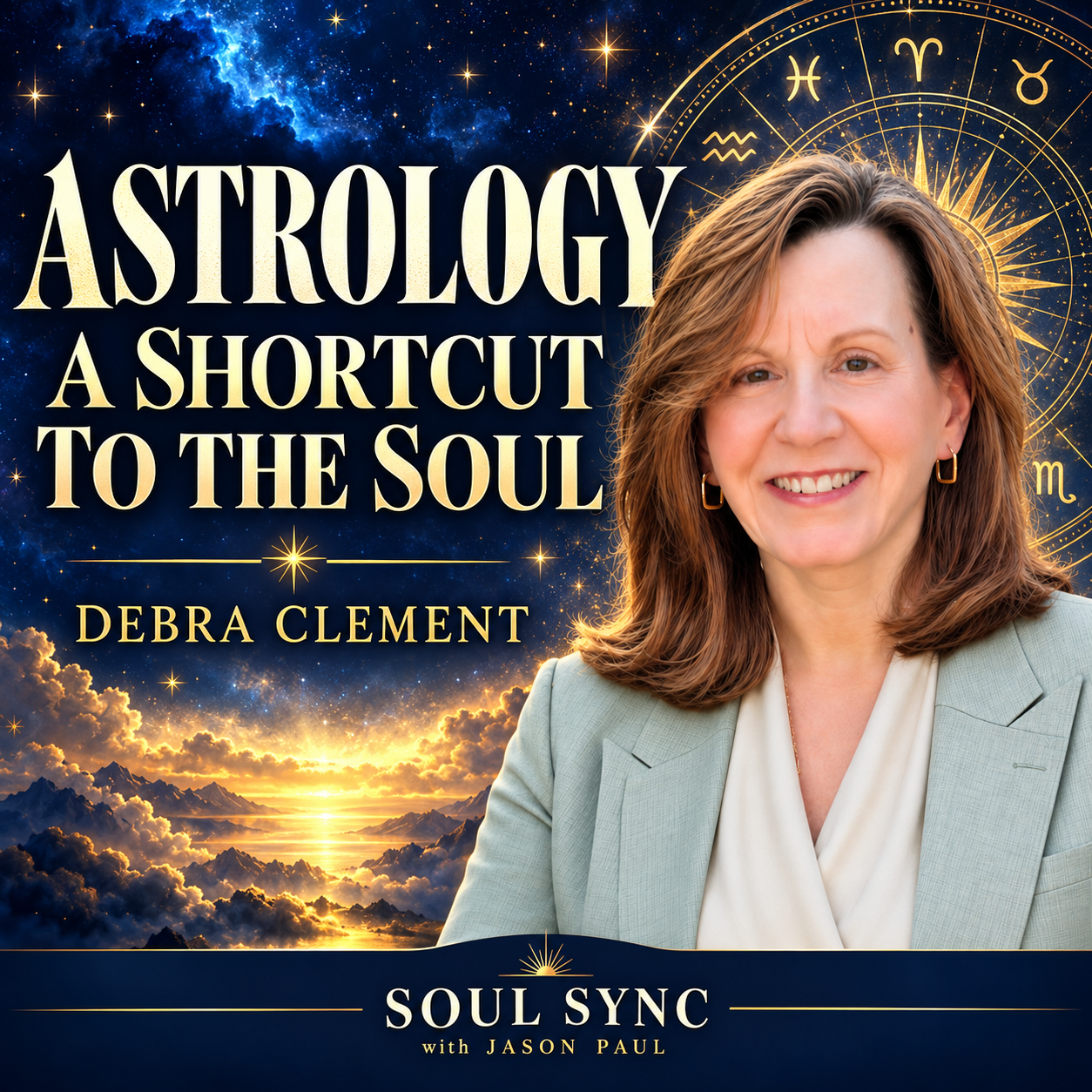
Who is Debra Clement?
Debra has been a consulting astrologer for more than 35 years. She specialises in predictive astrology, trains and certifies astrologers through her own professional programme, and hosts the Astrology Unpacked podcast, where she teaches and interprets the current planetary cycles. She has also worked as a medium, and spent many years practising law, having earned her law degree at 40.
Astrology hooked her at 16, when she read Linda Goodman’s Sun Signs, as so many of us did. Yet she did not believe the planets could actually influence her life until, in her twenties, she sat down to study her transits and found they matched the previous year of her life perfectly. For a self-described left-brained, logical person, that was the proof.
Turning it into her full-time work was never the plan. When the US property market crashed in 2008, Debra was working in real estate law and lost her job. After a year of searching, she turned the readings she had been doing part time into her career. Having walked through a few unexpected doors in my own life, I recognised a lot in that story. You can find Debra at debraclementastrology.com.
Why your newspaper horoscope rarely lands
Debra was refreshingly honest about horoscope columns. She used to read them too, and occasionally something hits. A lot of the time, though, it does not land, because it is written for the masses.
Psychology has a name for why those columns can still feel so personal. In 1948, the psychologist Bertram Forer gave his students what he said were individual personality profiles. Every student received the same text, assembled from general statements, and on average they rated it more than four out of five for accuracy. It became known as the Forer effect, or the Barnum effect.
That is precisely why a sun sign column and a birth chart are two very different things. Your sun sign is a single placement, shared with roughly one in twelve people. Your birth chart is a map of where every planet sat, in which sign and which house, at the exact moment and place you arrived. Two people born on the same day, a few hours or a few hundred miles apart, can have strikingly different charts. That specificity is where astrology becomes genuinely interesting.
Step one: get your birth chart (and find your birth time)
Debra’s first piece of advice for anyone curious is simple: you need your date, time and place of birth. The time matters more than most people realise, because it sets the structure of the whole chart, including your rising sign and which planets fall in which houses.
A few practical pointers:
Finding your time. In England and Wales, birth certificates do not usually show a time of birth (it is generally recorded only for twins and multiple births). Scottish birth certificates do include it. In many other countries it is held by the register office where your birth was recorded. A parent or relative, a baby book or hospital records may also hold the answer.
Drawing your chart. Once you have your details, a free site such as Astrodienst (astro.com) will draw your chart in seconds.
No birth time? You can still explore your sun sign and your planets by sign, and usually your moon sign too, unless the moon changed sign that day. Your rising sign and houses need the time.
Two websites, two different-looking charts? Check the house system. Many sites default to Placidus, while others use Whole Sign houses. Both are used by professional astrologers, and the planets themselves stay the same.
When your chart appears, it can feel like a lot: a circle, twelve segments, a scattering of symbols and a web of coloured lines. Debra’s word for it was “mind-boggling”, and she meant it kindly. The secret is to read it in layers.
Step two: start with your Big Three (sun, moon and rising)
Debra gave me the clearest definitions I have ever heard:
Your Sun is where and how you want to shine.
Your Moon is what you need to feel secure.
Your Rising sign, also called the Ascendant, is how you approach life and the first impression you give. Debra put it beautifully: imagine she is sitting on a sofa at a party and you walk in. The immediate impression she forms of you is your rising sign. Once she gets to know you, you may turn out to be a little different.
The real insight often lives in how these three relate to each other. Debra’s own Sun is in Capricorn, an achievement-oriented sign, and her Moon is in Libra. Part of her has always wanted to climb the ladder, while her Libra Moon says, yes, but I want to take everybody with me. Seeing that in her chart made sense of a lifelong pull between ambition and keeping the peace.
Mine was just as telling. My Sun and rising sign are both in Virgo, and my Moon is in Taurus. Virgo, Debra explained, is the sign of service, here to improve things. It has a reputation for being nitpicky, and I will hold my hands up to having high standards. As she said, if it was not for Virgo and the engineers, the bridges would not stand. My Taurus Moon explained something else entirely. One of the first things she asked me was whether I am very much into the way things taste and feel, and she said nobody could hand me plastic and pass it off as leather. They could not. I can tell instantly.
Try this: write down your Sun, Moon and rising sign, and notice how each one shows up in an ordinary week. Where do you want to shine? What helps you feel safe? How do people describe you when they first meet you?
Step three: find your chart ruler
The planet that rules your rising sign is known as your chart ruler, and it acts like a thread running through the whole chart. Find your rising sign below, then look at which sign and house its ruling planet sits in.
Aries: Mars
Taurus: Venus
Gemini: Mercury
Cancer: the Moon
Leo: the Sun
Virgo: Mercury
Libra: Venus
Scorpio: Mars (modern ruler, Pluto)
Sagittarius: Jupiter
Capricorn: Saturn
Aquarius: Saturn (modern ruler, Uranus)
Pisces: Jupiter (modern ruler, Neptune)
With Virgo rising, my chart ruler is Mercury, the planet of communication, and mine sits in Libra. Debra read it straight away: a natural communicator, with a little openness to people-pleasing. Both true. Most of my week is spent communicating, whether that is with the spirit world, with sitters or here on Soul Sync.
Step four: the planets and what they represent
Think of the planets as the “what” of your chart, the different parts of you:
Sun: identity, vitality and where you want to shine
Moon: emotions, needs, security, home and family
Mercury: thinking, learning and communication
Venus: love, beauty, pleasure and what you value
Mars: drive, courage and initiative
Jupiter: growth, wisdom and good fortune. Debra describes Jupiter as showing where things could be easy, where we can develop things easily. It expands whatever it touches.
Saturn: structure, responsibility, time and life lessons
Uranus: change, freedom, originality and the unexpected
Neptune: imagination, spirituality and intuition
Pluto: depth, power, endings and rebirth
Chiron: often called the wounded healer, showing where an old hurt can become a gift for others
The North Node: not a planet but a point in space which, as Debra explains, speaks to what our soul came here to do and to learn
You may also see a small “R” beside some planets. That means the planet was retrograde when you were born: from Earth, it appeared to be moving backwards. Many astrologers read a natal retrograde as energy that turns inward first, or develops later in life. Hold on to that one, because it comes up again in my own reading.
Step five: the 12 houses of the birth chart
If the planets are the “what” and the signs are the “how”, the houses are the “where”: the area of life in which that energy plays out. Debra walked through all twelve in the episode, and several of her descriptions surprised me. Here they are in summary, each with a question to take to your own chart.
First house: you, your body and your approach to life. This is where your rising sign begins. How do I meet the world?
Second house: the money you earn, your possessions and your personal values, meaning who and what matters most to you. What do I truly value?
Third house: communication, learning and thinking, as well as siblings. Are you logical or intuitive? How do things come to you? How do I learn and speak?
Fourth house: home, property and ancestry, including the gifts and talents passed down through generations. Debra notes that family lines of mediums and intuitives often show here. What have I inherited?
Fifth house: fun, romance, entertainment, children and creative self-expression, and probably most people’s favourite house. What brings me joy?
Sixth house: daily work and service, routine and physical health, and also, as Debra likes to mention, our furry friends. What does a good day look like?
Seventh house: marriage and committed partnerships, and also best friends, adversaries and divorce. In Debra’s words, it is everyone who is other than you. What do I look for in others?
Eighth house: Debra’s choice for the most complicated and most fascinating house of all. It covers shared money and inheritance, it is a psychic house linked with connecting to the other side, and it is also the underworld of life. What do I share, and what transforms me?
Ninth house: expansion, philosophy, belief, travel and higher knowledge of every kind. Where am I growing?
Tenth house: career and calling, your public life and reputation, at the very top of the chart. Sometimes career and calling are the same thing, and often they are two different things. What do I want to be known for?
Eleventh house: casual friends, colleagues, groups, hopes and wishes. In modern terms, Debra adds, it is also social media and audience. Who are my people?
Twelfth house: long known as the house of sorrow, and also where the intuitive live. Debra associates it with mediumship and with emotional and psychological health, the place where the mind and emotions can help heal the body. What is moving beneath the surface?
A useful tip: an empty house simply means no planet sits there. That area of life is still active in your chart, and you read it through the sign on the edge of that house (its cusp) and that sign’s ruling planet.
Step six: aspects, or how the planets get along
Debra described aspects as how well the planets get along with each other in the wheel. They are the angles between planets, and they are the coloured lines you see criss-crossing the middle of your chart. The main five are:
Conjunction (0°): two planets blended together, intensifying each other
Sextile (60°): friendly, a door of opportunity
Square (90°): creative tension that pushes you to act
Trine (120°): easy, natural flow
Opposition (180°): a pull between two sides, often lived out through relationships
Debra made a point I found really freeing. Hard aspects can be some of the most productive in a chart. Hard energy is provocative energy, and that is when things happen, including the good things. She says a big success almost always comes with a challenging transit in the background. Easy, flowing energy feels lovely, and sometimes we simply enjoy it rather than make the most of it.
Weaving all of this together is what astrologers call synthesis. Debra was honest that while anyone can learn the basics, the synthesis is complex, and most people benefit from a professional to interpret the full picture. I appreciated that. It is very much how I feel about mediumship: the foundations can be learned by anyone, and the depth comes with years of practice.
What a birth chart can reveal about psychic and mediumistic gifts
This was the part of the conversation where my medium radar really went up. Debra, who has worked as a medium herself, says the gifts show in the chart. The houses most associated with psychic sensitivity are the fourth, eighth and twelfth, and she also looks at how intuitive planets such as the Moon and Neptune connect with the rest of the chart.
She was careful to draw some distinctions that every developing medium would benefit from hearing:
A person can be very psychic without being a medium.
A person can be a gifted medium without earning a living from it.
A gift is one thing, and a career or a public profile is another. Those connections need to be in the chart as well.
Sometimes, she said, she can see a gift clearly in a chart while the person themselves holds some doubt about it, perhaps through self-consciousness, or because something has held them back. I have met so many people like that in my circles.
When she looked at my chart, the signatures were everywhere. My Sun sits in the twelfth house, which she sees as the mark of someone very intuitive. Jupiter is in my eighth house, close to my Moon, and it was retrograde when I was born. Debra has a lot of mediums among her clients, and she has seen Jupiter retrograde in the charts of well-known mediums too. For her it signals a healing gift of some kind, whether that shows up as a psychic, a medium, a Reiki practitioner or even an acupuncturist. Jupiter also rules one of the intuitive houses in my chart, and she asked whether anyone in my family was gifted. My granddad was a medium.
I want to hold this lightly, because I know how a passage like this can land. A chart is a map, and the territory is your own lived experience. I have sat in circles with people whose gifts are extraordinary and who have never looked at a birth chart in their lives. And even the most beautiful psychic signature still needs sitting, practice, patience and good teaching to unfold. My chart did not give me my mediumship. Years of development did. What the chart gave me was confirmation, and a new language for something I had already lived.
If you are curious about your own sensitivity, whatever your chart says, my free online development circle on Tuesday evenings is a lovely place to start exploring it. And if you would like to go deeper, Donna King and I teach a weekly Psychic Development Class, The Power of You, and a weekly Mediumship Development Class, both online.
Transits: how astrology works with timing
Your birth chart is a snapshot of one moment. Transits are what happens next. The planets keep moving, and as they cross the sensitive points in your chart, they coincide with different themes and events in your life. This is Debra’s specialism.
The slow-moving outer planets carry the most weight. Uranus spends around seven years in each sign and Neptune around fourteen, while Pluto, which takes roughly 248 years to travel the whole zodiac, can stay in a single sign for anything from around twelve to more than thirty years. When one of them makes contact with a planet in your chart, Debra says the cycle typically lasts around a year and a half, and it often lines up with a major life change. In her experience, these are the cycles that help get us back on track when we have wandered off our path.
Each planet brings its own flavour:
Jupiter tends to expand and bring opportunity.
Saturn tests and structures. Your Saturn return, around the ages of 29 and 58, is the best known transit of all.
Uranus brings change, freedom and the unexpected.
Neptune dissolves boundaries and inspires.
Pluto transforms. As Debra puts it, Pluto transforms what it touches, and sometimes it kills it off first before it brings something new in.
Many astrologers also talk about a cluster of transits in the late thirties and early forties, when Uranus opposes its position at your birth and Neptune squares its own. For anyone born in the 1970s or 1980s, Pluto squares its own position around then too. It is often called the midlife transit. If you have noticed a quiet but persistent pull towards a new direction around that age, you are in very good company.
How to look at your own transits: most free chart sites, including astro.com, can show the current planets against your birth chart. Start with the slow ones. Note when Saturn, Uranus, Neptune or Pluto form a conjunction, square or opposition to your Sun, Moon, rising sign or chart ruler, and read the theme rather than chasing every daily movement.
That last point matters. Debra does not check her daily planets every day, or even every week. “I don’t live and die by it,” she told me. “And I don’t think anybody should.” Her clients usually see her once a year for a forecast of the year ahead, with precise dates they can keep track of and look back on.
A date for your diary: Mars retrograde, 10 January to 1 April 2027
In my reading, Debra flagged a period that applies to everyone. From 10 January to 1 April 2027, Mars will be retrograde. Mars is the planet of initiation, so she sees it as a less favourable window for launching something new. Her advice was wonderfully practical: if you can, launch before it begins. If you need to launch during it, be prepared to put in a little more effort, treat it as a soft launch, and launch again in April. As ever, she does not live and die by it, but if you are planning a new venture for early 2027, it is worth knowing.
Hard seasons, surrender and the calendar on the wall
One of the most moving things Debra shared came from the early 1990s, when she was going through an extremely stressful personal situation. She looked at what was happening in her chart, understood when the cycle had begun and when it would end, and marked the end date on her calendar. It helped her keep her sanity, she said, because all influences pass, even the challenging ones.
I think there is something in that for anyone moving through a hard season, including grief. Seeing that a season has a shape, a beginning and an end, will not take the pain of it away, and a chart sits alongside support rather than in place of it. Yet for some people, knowing that a season will turn can be a small light to walk towards.
Her second story was about Pluto. A Pluto transit touched the part of her chart connected to income just as the 2008 crash cost Debra her job in law. She kept looking for work, and she also recognised the cycle for what it was. “I didn’t fight it as much,” she said, “but I didn’t just wave a flag of surrender either.”
When she read my chart, she found that I have been moving through one of these Pluto cycles myself: a long season of change around home and family that began around a year and a half ago. Hearing her describe her own moment of surrender, I felt as though I was having exactly the same one. I have spent a lot of my life pedalling uphill, achieving plenty and still pushing against things that were never meant to be mine. The lesson Pluto keeps offering, Debra says, is knowing when to surrender. To me, that means stepping into the rhythm of life rather than fighting it, and I have found that whenever I do, life becomes a great deal easier. The good news she gave me is that this particular cycle is finishing.
Fate, free will and the soul’s agenda
So is everything written in the stars? Debra is emphatic about free will. She believes the soul chooses the moment it incarnates, when the heavens are aligned for the major lessons it has come to learn, and that certain events in life are fated. Over decades of readings, she noticed she could see in a chart when a client had not had both parents available in early childhood, whether through separation, illness or loss. It was validated every time, and it led her to believe that the soul chooses its parents and its experiences.
“When the issue is in the natal chart,” she told me, “so is the answer.”
That is the line I keep coming back to. Your chart is not a pass to excuse a temper or a late start. It is an invitation to ask: what am I here to learn from this? An assertive streak might be there to teach you to care more about other people, or it might be there so you can stand up for someone who cannot stand up for themselves.
My own feeling is that we arrive with a hazy agenda and plenty of room for choice. We can take the direct route, or the scenic, round-the-houses route, and the spirit world will, to varying degrees, keep nudging us back towards our path. We usually know when we have drifted, because we feel it in the body, in the gut. Ever since I started following that gut feeling, life has flowed far more easily.
Test your chart the way a good sitter tests a reading
Here is the thought I have been sitting with since this conversation, and it comes straight from mediumship.
In my readings, I ask sitters to answer with just yes, no, don’t know or maybe. (I explain why in my approach to mediumship.) A no is every bit as valuable as a yes, because it lets me go back to the spirit communicator for clarity and keeps the reading on track. Some of the strongest evidence I have ever given began as a “don’t know” that only made sense weeks later.
Debra works in a remarkably similar way. During readings, she asks questions to test the patterns she is seeing, and when a prediction misses, she asks clients to tell her so she can go back and learn from it. She told me about a client, some twenty years ago, whose chart showed he would be out of work by April. He had been thinking of retiring, so he was delighted. April came and went, and a month or two later his wife rang. He had not retired. He had been fired. It was a Pluto transit, and Debra went back over the chart to understand what she had missed.
So here is my suggestion for working with your own chart: treat it as evidence to test, rather than a verdict to accept. Read a placement, then hold it up against your life. Yes, no, don’t know, maybe. Keep the yeses. Learn from the nos. Let the don’t knows sit for a while, because some of them may make perfect sense later. It honours your own experience, and it is the same humility that makes for good mediumship. As Debra says, none of us are perfect, and in this work it is important to know that.
What my astrology reading taught me
After we stopped recording, Debra very generously gave me a reading. I am keeping most of it private, but several things she saw have stayed with me, and I think the lessons reach well beyond my own chart. As I said at the end of the episode, it was honestly like reading an instruction manual to my life.
The gift was confirmed, rather than created. Debra has observed something with Jupiter retrograde: there is life before 40 and life after 40. She described me as a rosebush. Since birth I have been blooming, with job after job flowering and falling away, and one bud that never quite opened. Somewhere between 38 and 42, she said, that bud opens, and it never falls off the bush. I am 39, and over the last few years I have watched mediumship gently draw me away from everything else.
Healing through words. Chiron sits near the top of my chart, close to the Midheaven, the point of career and calling. In mythology, Chiron was a centaur and a healer who could heal everyone but himself. Debra read that as healing being part of my life path, and with Chiron in Gemini, it comes through words. Then she asked whether I write. I told her no, although I had felt called to over the years. You are reading this, so make of that what you will.
I am here to learn to receive. The South Node shows what comes naturally, and mine is in my first house. If there is a mess, Debra said, I clean it up myself, and my first thought is never who could help me with this. The other end of that axis points towards collaboration, letting other people pull their weight, and learning to receive. That one landed. It is a lesson I am leaning into, whether that is co-teaching with Donna King, co-hosting our free circle, or handing the microphone to my guests on Soul Sync.
An unconventional path is part of the design. Uranus in my third house, opposing the tenth, told Debra that my route to mediumship was anything but traditional. Magician, chef, cabin crew, police officer, legal recruiter, business owner and now medium: I would say that is fair. She also noted that the third house is connected with the hands, sleight of hand included, which made perfect sense of the young magician I once was.
Know when to surrender, and when to build. Alongside the Pluto cycle that is drawing to a close, Debra pointed to Jupiter moving through my eleventh house, the house of groups and audiences, as a strong time for building community. Looking at how many new faces have joined our free circle lately, and how Soul Sync keeps growing, I can feel it.
Debra ended our conversation with a hope I share. Astrology, she said, can help us “not just be a better person, but… be the person that I feel we came in here to be.” Whatever your stars say, I hope this guide helps you take a first step towards reading them.
Astrology questions, answered
What is a birth chart?
A birth chart, also called a natal chart or horoscope, is a map of where the Sun, Moon and planets were in the sky at the exact time and place you were born. It is divided into twelve houses, each representing an area of life.
Do I need my exact birth time?
For your rising sign and houses, yes, ideally to within a few minutes. The rising sign changes roughly every two hours, so even an approximate time helps. Without one, you can still work with your planets by sign.
What are the psychic houses in astrology?
Astrologers such as Debra Clement associate the fourth, eighth and twelfth houses with intuition and psychic sensitivity, alongside planets such as the Moon and Neptune. A psychic signature in a chart shows potential, and development is how that potential unfolds.
What is a Pluto transit?
A Pluto transit happens when Pluto, moving slowly through the sky, forms a significant angle to a planet or point in your birth chart. These cycles typically last around a year and a half and are associated with deep transformation: endings that make room for new beginnings.
Is astrology the same as mediumship?
They are different practices. Astrology interprets the positions of the planets. Psychic work reads the energy and information around a person, and mediumship is communication with people in the spirit world. Debra has practised all three, and she finds astrology the most precise for timing.
Is astrology scientifically proven?
No, and it is worth saying plainly. Controlled tests have not supported it, the best known being physicist Shawn Carlson’s double-blind study published in Nature in 1985, in which astrologers could not match birth charts to personality profiles better than chance. Astrologers have challenged how such studies are designed, and the debate continues. For me, astrology earns its place the way any spiritual practice does: through what it helps you notice, and what you choose to do with it.
Listen, learn and connect
Listen to the full conversation with Debra at the top of this page, or on the Soul Sync podcast page. New episodes go out every Monday and Thursday.
Learn more with Debra. Her closing advice was to look beyond the daily horoscope, and to start by listening to an astrology podcast. Hers is Astrology Unpacked, with mini lessons every week. You can also book an astrology reading with Debra or explore her courses at debraclementastrology.com.
Explore your own gifts. Join our free Tuesday development circle, or book a place on The Power of You (Sundays, from 25 October) or the Mediumship Development Class (Mondays, from 26 October).
Book a reading. If a conversation like this has stirred something for you, you are welcome to book a psychic mediumship reading on Zoom, wherever you are in the world.