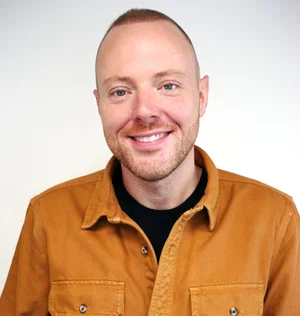
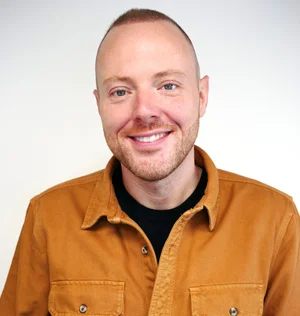
Some people spend years working out what to call the thing they've always felt. A sense of something before anyone's said a word. A read on a room the second you walk into it. A depth of feeling that everyone around you seems to have somehow learned to switch off.
That's the territory I got into on this week's episode of Soul Sync, in a conversation with psychic medium and teacher William FitzRoy. We talk about sensitivity, intuition, identity, and the slow, sometimes messy process of working out that the parts of yourself you were told to manage might actually be the parts worth trusting.
You knew you were different long before you had a word for it
William's story starts the way a lot of these stories start: as a kid who was more comfortable with what he now understands were spirit and energy than with a lot of what was going on around him. For years he didn't have language for that. He just knew he felt things other people didn't seem to, and he needed an explanation for it, so he reached for whatever was closest.
First it was the arts. He threw himself into music and theatre and assumed that was simply what "creative people" felt. Then, as he got older and came out as gay, he filed the sensitivity under that instead — decided that the depth of feeling, the awareness of energy, must just be part of being gay. Neither explanation actually fit. It took hitting what he calls rock bottom in his early twenties, feeling like he didn't belong anywhere he'd looked, before he found a description that finally matched the experience.
I could relate to that more than I expected to. I had my own version of it growing up — a childhood label, a sense of being "too sensitive," and years of quietly filing that feeling under whatever identity was closest at hand, because nobody had handed me a more accurate one. If you've ever done the same thing — decided your sensitivity was really about your job, your relationships, your diagnosis, your sexuality, anything except itself — this is worth fifty minutes of your time.
The class that finally gave it a name
The moment that changed things for William was a two-hour class on something called psychic meditation. An hour in, he says, he was sitting there with his jaw on the floor. He didn't have the vocabulary for what was being taught, but he knew instantly that it was what he'd been looking for his whole life. He describes it as a "hello to my spirit" — the first time anyone had given proper language and structure to something he'd only ever experienced as raw, unmanaged feeling.
The idea he came back to again and again is that your consciousness is a musculature. Sensitivity to energy isn't just something that happens to you — it's a skill with two sides, and most sensitive people only ever train one of them. You can be extraordinarily receptive and still have no idea how to direct or shift what you're picking up, which is exactly how sensitive people end up overwhelmed. Learn the other half — how to hold and move your own energy, not just absorb everyone else's — and the same trait that used to flatten you becomes something you can actually use.
Spirituality doesn't have to be a performance
One of the more useful reframes in this conversation is what William calls the "New New Age." Twenty years ago, he says, he was scared to admit he'd taken a class on spirit guides. Now you can buy aromatherapy at the supermarket. Spirituality has gone mainstream enough that the taboo has mostly disappeared — which means the real work now isn't about announcing that you're intuitive. It's about integrating it into an ordinary life without needing to make it a whole identity.
William has spent his career doing exactly that: reading energy constantly, using what he picks up to inform decisions, without necessarily telling anyone that's what he's doing. We talked about how much of that comes down to removing your own need for anyone else to validate it. Once you actually own something, you stop needing someone to tell you it's real.
That landed for me on a personal level too. I've spent a long time moving between a very "muggle" world of running a business and a much quieter, more intuitive one, and for years I treated those as two separate people. William's take — that they were never meant to compete, just to work together — is the kind of thing that's obvious in hindsight and genuinely useful to hear out loud.Why structure sets you free
William trained for years in theatre before he ever taught a psychic development class, and the parallel he draws is one of the best in the episode. An actor memorises every line, learns every piece of blocking, drills it until it's automatic — and then gets on stage and forgets all of it, because the structure is now doing its job quietly in the background while instinct takes over.
He builds his teaching the same way. Give someone a form to hold onto — what to do if you see something unsettling, how to hold your own energy safely, what happens next when you don't know what happens next — and paradoxically, that structure is what gives them the freedom to actually develop the art. Mediumship and psychic work, in his view, are far closer to a craft you train than a mystery you either have or don't.
The real curriculum is healing yourself first
The part of the conversation I keep coming back to is about projection: all the unresolved stuff sitting inside us gets projected outward until we actually deal with it. You can't sit with someone else's pain, panic or grief and stay regulated if you haven't done that work on your own first — which is exactly why William's training runs a full year before it gets anywhere near "the good stuff." Most of it is simply teaching people how to sit still with themselves again, in a culture that's made that harder than it's ever been.
You don't need anyone's permission to trust what you already know
If there's one thing to take from this episode, it's this: the traits you were taught to manage, hide or explain away might not be a problem to solve. They might be exactly what you were given to work with. You don't need a diagnosis, a label or someone else's approval to start trusting what you already sense. You just need to stop waiting for permission.
Connect with William FitzRoy
William FitzRoy is a spiritual mentor and teacher with over two decades of experience in embodiment and energy work. These days his teaching lives at Path of the Mystic, where he works with people one-to-one and through ongoing study groups, helping sensitive people turn what can feel like an overwhelming trait into a trained, workable skill. You can find him at williamfitzroy.com.
Listen to the full conversation
This post covers the highlights — the full episode goes much deeper into identity, energy work, and what it actually takes to build a regulated, sustainable spiritual practice. Listen to the complete conversation on the Soul Sync podcast page, or search "Soul Sync with Jason Paul" wherever you listen to podcasts.
If something in this conversation resonated — a question about your own sensitivity, or simply not knowing where to start — you're welcome to get in touch or book a tarot or mediumship session, in Bristol or over Zoom, wherever you are.
-
Jason Paul: Welcome back to the Soul Sync podcast. It's me, psychic medium Jason Paul. This is the podcast for curious souls, deep thinkers, recovering overthinkers, and anyone trying to make sense of the parts of themselves they were never taught to understand.
Today's episode is called "The Gifts We Were Never Taught to Understand" — ironically. This is a conversation I recorded a little while ago, back in January, with William FitzRoy, and listening back to it now, I find myself hearing it in a completely different way. At the time we recorded this, I was still balancing and stepping between two very different worlds — running the recruitment business I'd built over many years, whilst also trying to make more room for mediumship, my connection with the spirit world, and the parts of me that had always known there was something more beneath the surface. A lot has changed since the time of this recording, and perhaps that's why this conversation feels so relevant to me now, because it's really about what happens when we stop trying to fit into the version of ourselves that feels acceptable to everyone else, and start becoming more honest about who we are.
William and I talk about sensitivity, intuition, identity, being different, and the pressure to hide parts of yourself. We could both relate to that as gay men — it was very difficult for both of us in younger parts of our lives. We also talk about the strange journey of realising that qualities you might once have thought were a weakness can become part of your strength. That's very relevant to mediumship, because how many of you listening right now have been told you're too sensitive, that you should just let it go? That's a key thing for sensitive people to hear. Especially when we're opening ourselves to mediumship, we're already in a heightened state, and everyone listening is going to be on a different level of sensitivity. But the journey of unfolding your mediumship is really about turning up that sensitivity dial.
You don't need to call yourself a medium, a psychic, a healer or a spiritual person to connect with this episode. Maybe you've always felt things deeply, or picked up on people's moods before they even said a word. So, without further ado, this is my conversation with William FitzRoy.
Jason Paul: So, William FitzRoy — welcome.
William FitzRoy: Thank you, it's so nice to be here with you. I've been making the rounds and having conversations with people that I find interesting. To me, it's all about connection — connecting with other sensitives, other psychics and mediums out there. I think all of us, for a variety of reasons, may be feeling a little isolated right now, or a little in our own thing. So I've made it a personal mission for myself, this year and last, to reach out to other people doing this work and have conversations with them, in hopes of fostering connection. Being on a podcast felt like an interesting way to do that, because other people get to witness that and be part of the conversation.
Jason Paul: Why do you think a lot of us sensitive people are having a hard time? Why do you feel that is?
William FitzRoy: Well, maybe that's just because I'm in the United States, and having a hard time over here at the moment. I feel like the pressure of what's happening in culture and society, economically and socially, has a tendency to make people feel isolated or alone — even though it's easy to separate yourself from that, find the truth in it, and realise what's actually happening is maybe a little less intense or dangerous than it seems on the surface.
Jason Paul: Because you are a medium — that's correct, isn't it? We're both in the same world.
William FitzRoy: Yeah. I call myself something different depending on the context, but I do psychic readings, clairvoyant readings, and I work and function as a medium a lot. More than all of that — certainly over the last five to ten years — I consider myself more of an educator and a teacher, because I teach classes, and I have a passion for helping other people foster those gifts in whatever way they choose. That doesn't have to mean becoming a professional medium or psychic — it can be tools for other things entirely.
Jason Paul: How did spirit first come to touch you? What's the story behind that, William?
William FitzRoy: I've always been connected to, or in communication with, spirit, as people would say. As a kid I was very sensitive to energy, to out-of-body beings and energies. I had more imaginary friends than my parents knew what to do with, and communicating with them — which now I'd identify as out-of-body entities and beings — felt almost more real than the friends I had at school. Looking back, I think I was always a medium, I just didn't have the language for it. So I found refuge in the arts, which I think a lot of sensitive people do — I got very involved in music and theatre as a way of channelling that creative energy. And the funny thing is, I thought everyone did that. Here I was, this super sensitive child communicating with, say, Mickey Mouse or Elliott from Pete's Dragon, assuming everybody had that kind of imagination.
Jason Paul: Well, you only know your own reality, don't you — we all assume our world is the way the world is, and that's what limits us: our own perception of the world. I can understand that being your reality. But I'm guessing your parents must have been very accepting and nurturing of this ability, rather than shutting it down?
William FitzRoy: That was a complex situation, but I think they did their best navigating it with me, helping me find community and outlets to feel safe and supported. I assumed all theatre people were like me, so I threw myself into theatre all through school, and quickly realised — no, not all theatre people are sensitive, that's not the common thread. Then, moving into later adolescence, I started to identify as gay, and thought, "oh, so this sensitive, imaginative, spirit-communicating thing must just be what gay people are like." So I moved from explaining this gift through the arts, to explaining it through my sexuality.
Jason Paul: I can relate to that, because it's complex, isn't it. I grew up and can understand the sensitivity being tangled up with being gay — I got that too. There was a whole period around age eleven where I thought I liked girls, then it moved to liking boys. But I also had ADHD in the background, so I was told I was "too sensitive," and I associated that with being gay as well. It's a point people who haven't been through it might not realise — but we all live our own reality. What is normal, William? What is normal?
William FitzRoy: Aren't we all still trying to figure that out in some way. So — to take you through the rest of the journey — I decided this thing that made me different, in my relationships, my point of view, how I engage with the world, must be because I'm gay. So I got really into being gay, the gay community, the connection there. But I quickly realised, particularly through dating, that not all gay people have this kind of sensitivity and awareness of energy and spirit. That collided with leaving university, moving to the city in my early twenties and starting my own life, and I hit what some people would call rock bottom — I didn't understand who I was or how I fit into any of these constructs, and none of the communities I'd looked to for an answer had actually provided one. I was overwhelmed and overloaded, and didn't know what was happening to me. Then, through a roommate at the time, I got connected to a meditation class based on a technique called psychic meditation — using meditation as a tool to become aware of energy. It was a two-hour class, and an hour in I was sitting there with my jaw on the ground. At the break I went up to the teacher and said, "I have no idea what this is, I don't even know what you mean by psychic, I don't understand any of it — but whatever this is, this is what I've been looking for my whole life." No one had ever talked about energy, spirit, self-awareness, in the way she was presenting it. I thought, whatever this is, I'm all in.
Jason Paul: Why did it hit you so hard in that instant?
William FitzRoy: Because I think it was a hello to my spirit. There was a part of me that was so used to being receptive to energy from others, and part of what these techniques taught — and what I now teach — is that being sensitive to energy isn't just about being receptive, it's also about being able to change and direct energy. A lot of sensitives get overwhelmed by their sensitivity because no one's ever taught them the other half — it's like a bicep and a tricep. However strong you are in sensitivity, you're equally capable, on the other side, of directing and changing energy. Finally having language and context for that felt genuinely empowering — like a strong hello to something inside me.
Jason Paul: It's like, in that one moment, it changed the entire direction of your life instantly.
William FitzRoy: Yeah. I went on to study with a bunch of different teachers for about fifteen years, and about ten years ago started teaching on my own — working on re-languaging and integrating psychic, clairvoyant and mediumship tools into what I've been calling the "new new age." I feel like we're in a new new age now — what we'd think of as the new age has passed, and things need to move around a bit.
Jason Paul: What do you think the picture is over there? Because obviously in England we have spiritualist churches — it's practically a religion here. I go to courses, and there are always so many American people on them, because you don't have that as much in the States, so people come over to do the Hogwarts equivalent. How's it fitting into society in America — are people waking up to it, do you think?
William FitzRoy: Part of that comes down to the fact that European cultures — and I'd include the UK in that — have a long lineage of spiritualist tradition. America was founded very puritanically, under a different kind of dogma than the rest of Europe historically. So we have a different relationship to spirituality here — it's more commercial, more third-chakra based, than —
Jason Paul: That's certainly one way to put it, isn't it.
William FitzRoy: Yeah — it's more a thing you do than a thing you are.
Jason Paul: That's a very American way of practising it rather than being it, I can understand that. The essence of American society is the American dream — materialistic, the biggest house, the biggest car, that's how success is defined, it's the DNA of the place. But that's a society built on a scarcity mindset too, isn't it — that's how it's ordered. Whereas you go further east and you find teachings so rooted in the old ways. You mentioned before we started recording that one of the things that resonated with you, and part of why you reached out, was trying to walk with a foot in both worlds, and how challenging that is. I relate to that totally — I run a business of my own, a full-time job, and I'd love to do this kind of thing full-time, just sit and talk to lovely people like you, William. But it's very difficult, especially when you're bombarded with "muggle" matters all day — matters of the ego and so on. It can be hard for a sensitive person to live a spiritual life, a life with intent, trying to stay present and grounded. How do you navigate that in today's world? It's difficult, isn't it?
William FitzRoy: Yeah, this is something I have a particular passion about. When I started this work twenty-odd years ago, I made a decision — I don't know that I understood it at the time, but looking back now I understand why. A lot of people I was studying with went all-in on spiritual study and practice, making it their whole life. I decided very early not to do that, and to keep my corporate career alongside it. I've been freelance my whole career, a contractor, so I do intense work for a short stretch and then get a few months off in between.
Jason Paul: Oh, that sounds lovely, William — sign me up.
William FitzRoy: It was very nice. Somehow I created a rhythm where those two things don't compete, they work together. I think that's partly because there's something I'm here to teach people about that. To bring it back to my origin story — twenty, twenty-five years ago I took my first class on spirit guides, and I was so scandalised, thinking, "I can't tell anyone I'm doing this, they'll think I'm crazy."
Jason Paul: I don't dare mention what I do at work either. I've been told off by my mum, who works in the same business as me, a few times — she said, "don't bring the psychic and medium stuff in, these people you manage are twenty-two, twenty-three." I've come to the conclusion that people think I'm mad enough without mentioning I'm having a psychic download or whatever it might be.
William FitzRoy: Right. So thinking back to that time — now you go to Target, or Boots, or somewhere —
Jason Paul: Thank you for making it British, we like that — I'm a frequent traveller.
William FitzRoy: — and they sell aromatherapy at Target. All the things that were once "new-agey," the kind of "what is that, that's weird," are now so integrated into pop culture that none of it feels taboo any more. That's why I call it the new new age — it's woven into the undercurrent of everything now. The challenge for people is how to bring these abilities into your whole life without having to announce that's what you're doing. I'm reading people, reading energy, reading energy dynamics all the time — I'm just not telling anyone that's what I'm doing while I'm doing it. But that doesn't stop me using what I pick up to inform decisions, to support my clients, my colleagues, the businesses I work with. It's about removing the need for anyone else to validate it for you. When you really own something and internalise it, you don't need anyone to tell you you're right, or that it's valid. You just own it and do it. Integrating those two worlds means extracting the need for validation, and just being it and doing it, letting it serve your own goals as much as it would someone else's in a reading or session.
Jason Paul: That's a really valid point — for years I didn't know I was a psychic, I was using psychic skills in recruitment without realising that's what they were. Even in my days as a police officer I'd get hunches, gut feelings, and I had no other way to describe them, because at that point I was an atheist. Even now in my current work, I don't say I'm using it — which is probably my mum's point: don't say you're having a psychic download, no one will understand, so why tell them. But you do blend the two, and why wouldn't you, if you're using that — to be honest, that's intelligence. Why would you only use your head, when the head is all ego and runs away with you, when you could use your psychic side too? Blending the two lets you live your soul's plan more, doesn't it?
William FitzRoy: Yeah, and to really integrate it, that sensitivity can't just be something you do at the spiritualist church on Sunday, or when somebody's paying you a hundred dollars for a reading. It becomes something you have and deploy across all sorts of circumstances and settings. In my experience, that's infinitely more validating than giving a reading once a week, being told I did a good job, then packing it away until the next opportunity. Instead, it's a whole-you kind of thing.
Jason Paul: That makes sense — that's what it should be, rather than something you pack away under the stairs. It's about realising that power is within you, always there, ever-present — why would you shut it down? But you go through periods of growth with your mediumship and psychic work, don't you — I think the journey of becoming a medium is one of healing, and by healing yourself, you go on to heal other people. Oh, what a beautiful cat you've got in the background there — we're cat fans on the Soul Sync. So you've been helping people with energy work since 2008 — how do you go about supporting people through that, and how can people help themselves?
William FitzRoy: My background in the arts has been incredibly useful here. I believe very strongly that psychic and mediumship abilities, the ability to sense and shift energy, is more like an art than a science — and if you treated it as such, I think people would have much better access to those abilities within themselves. I had the good fortune of spending most of my formative years in artistic, conservatory-style education, at school and then at university, where I studied theatre directing at a really strong conservatory programme. What people don't realise about anyone who really commits to an art — ceramics, visual art, acting, whatever it is — is that it looks like it's just coming out of them, but that's not true. The ones who are really good have a strong structural foundation in a craft that supports their imagination coming through as art. The example I like to use is actors, because that's where I come from. You memorise your lines — that's rote, you just sit and learn them. You learn the blocking — on this line I move here, then this person does that — and you drill all of it. Then the really good actors — real actors, not just celebrities, which is a different thing entirely — memorise all of it, do all of it, and then get on stage and forget it. They let instinct take over, because the body has already been trained in what to say and where to move, so it feels safe, and that safety is what frees you up for inspiration and imagination. Having come through that kind of education, what I've done is ask: how do you apply that same structure to something like clairvoyance, mediumship, psychic ability? And it works really well. You teach people how to hold their own energy, almost like a yoga posture. Once you have that foundation, and your body feels safe and supported, and you have tools to fall back on — if I see something strange, what do I do with that? If I see something uncomfortable as a seer, what do I do? — those are all questions a craft and a form can answer. Give someone a form, let them learn it, and then they can move into the art of it, because they have tools to lean on in the moments they don't know what to do. That actually gives you more freedom. It's almost paradoxical, Jason — to have freedom, you first need structure.
Jason Paul: You do, because what you're really learning is a habit, a new way of being, a new way of interacting with the world. Even getting to the point of quieting your mind — I don't love the phrase "successfully meditate," but even reaching that point — can be a nightmare for some people. It was for me, it took me ages. And then you go through these journeys where, if you want to live your full potential but you're carrying limiting beliefs — say you want to make a lot of money but deep down believe you're not worth it — you're never going to get there. You have to do the self-work. I think spirituality often gets glamorised — the nice lady with the dazzling white teeth, the little sparkle, living her best life, as if you have to be "whiter than white" to progress. And I think a lot of us carry this idea that even in death we'll be judged — do we get through the gates, or sent back down somewhere murkier. There's so much judgment out there, William. So how do you approach someone who comes to you — say, a typical stressed American professional, lost in the pressure of their career, wanting to manifest, take control, live their best life. What would you say to them?
William FitzRoy: You first have to learn how to close your eyes, find stillness, and become aware of your own inner life — sit with the complexity of it, the traumas, all the unresolved conflict we carry — until you're actually on that healing journey. So many people come to this work wanting to help others, which is noble, the world needs more healers, I don't think anyone would argue with that. But you can't truly heal anyone else until you're healed enough yourself to sit with someone and stay regulated, without matching or absorbing their panic, stress or trauma. My academy runs short-term classes, ten or twenty weeks, but the foundational clairvoyant training is a full year, because it takes that long — first, just to learn to sit with yourself. We've largely forgotten how to do that as a culture, mostly thanks to the internet. As a kid I could sit and read for six hours, get through a book or two in a weekend. Now, sitting and reading for two hours, part of me can barely handle it.
Jason Paul: We're living in a world of constant distraction, the shortest attention span imaginable.
William FitzRoy: And it's getting worse.
Jason Paul: It is — which is why I think there need to be healthy boundaries with your electronic devices. That's a good first step.
William FitzRoy: That directly correlates to sitting in meditation, channelling for an hour with somebody. Your consciousness, your attention, is a musculature — you have to train the muscle to work properly. People don't always expect that. I had a student recently, two or three months in, who said, "this has been great, but when do we get to the magic?" And I told them, honestly, I don't know when that will happen for you — it happens when you're ready, and my job is to hold the space until it does. I can't make it happen for you, and you can't force it either. A lot of it is deeply personal, similar to acting, or painting.
Jason Paul: You train and train, and then one day you wake up and get that moment of inspiration, that download that just arrives.
William FitzRoy: Yes.
Jason Paul: It's all fascinating. So it sounds like a large part of what you do now is dedicated to helping people, in one way or another.
William FitzRoy: I also do a bunch of ordinary corporate work — that's kind of you to frame it otherwise, Jason. Half or three-quarters of my time is spent in meetings with corporate clients wanting me to execute some creative brief, with no real spiritual satisfaction on the surface. But the satisfaction I get is being able to be myself in those experiences, without feeling I have to become someone else to belong in that world.
Jason Paul: What's the greatest lesson the spirit world has ever taught you?
William FitzRoy: The dynamics of projection — how all that unresolved stuff inside us gets projected onto the world or onto other people until we resolve it within ourselves. We never want it to be about us, we always think it's something else doing it to us. That doesn't mean things aren't happening to us — but once you have neutrality and space around it, those things become much easier to manage. It's when we're caught up in unresolved parts of ourselves that we project them outward and try to avoid dealing with them.
Jason Paul: You see it all the time, don't you — people saying "the world is so bad to me, it's someone else's fault," "it's my boss's fault I didn't get the promotion" — that chip-on-the-shoulder way of living. I've never lived like that — I've always had a high level of drive, and known that what you put out is what you get back. William, would you like to leave us with a closing thought to end this episode of Soul Sync?
William FitzRoy: Relating it back to theatre, as ever — that's my love language. I really feel that in this new new age, this moment we're in as human beings sharing this planet, those of us who've been sensitive to energy, working with energy, being psychics or mediums, have simply been ahead of the curve. And it's time for everyone else to wake up to that. That doesn't mean everyone needs to talk to dead people, or wave their hands around moving energy — it just means recognising the ability you already have to change energy in and around you, because everyone has that ability. I get genuinely excited when I see people who wouldn't normally call themselves psychic, clairvoyant or mediumistic have a shift experience, and start to understand that this is part of our shared human lineage, something everyone gets to have in the human experience. I find that really exciting.
Jason Paul: Well, William, thank you very much for coming onto the Soul Sync — it was a delight to talk to you.
William FitzRoy: Yeah, this was so much fun. Thanks for connecting with me, and for answering my email.
Jason Paul: He really made me laugh and smile a lot there — I loved talking to William. It reminded me of going to Chicago with my mum for my birthday a couple of years ago. I absolutely loved it, but she spent the whole trip saying "my feet are hurting, we've walked too much," while I was looking at my Apple Watch celebrating twenty thousand steps — she was not enjoying that, I'll tell you.