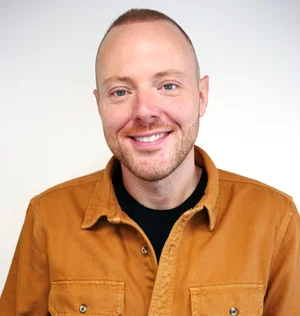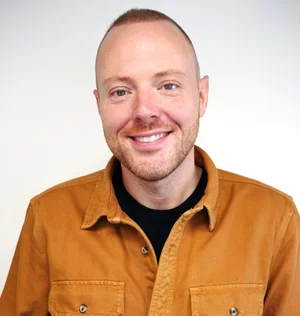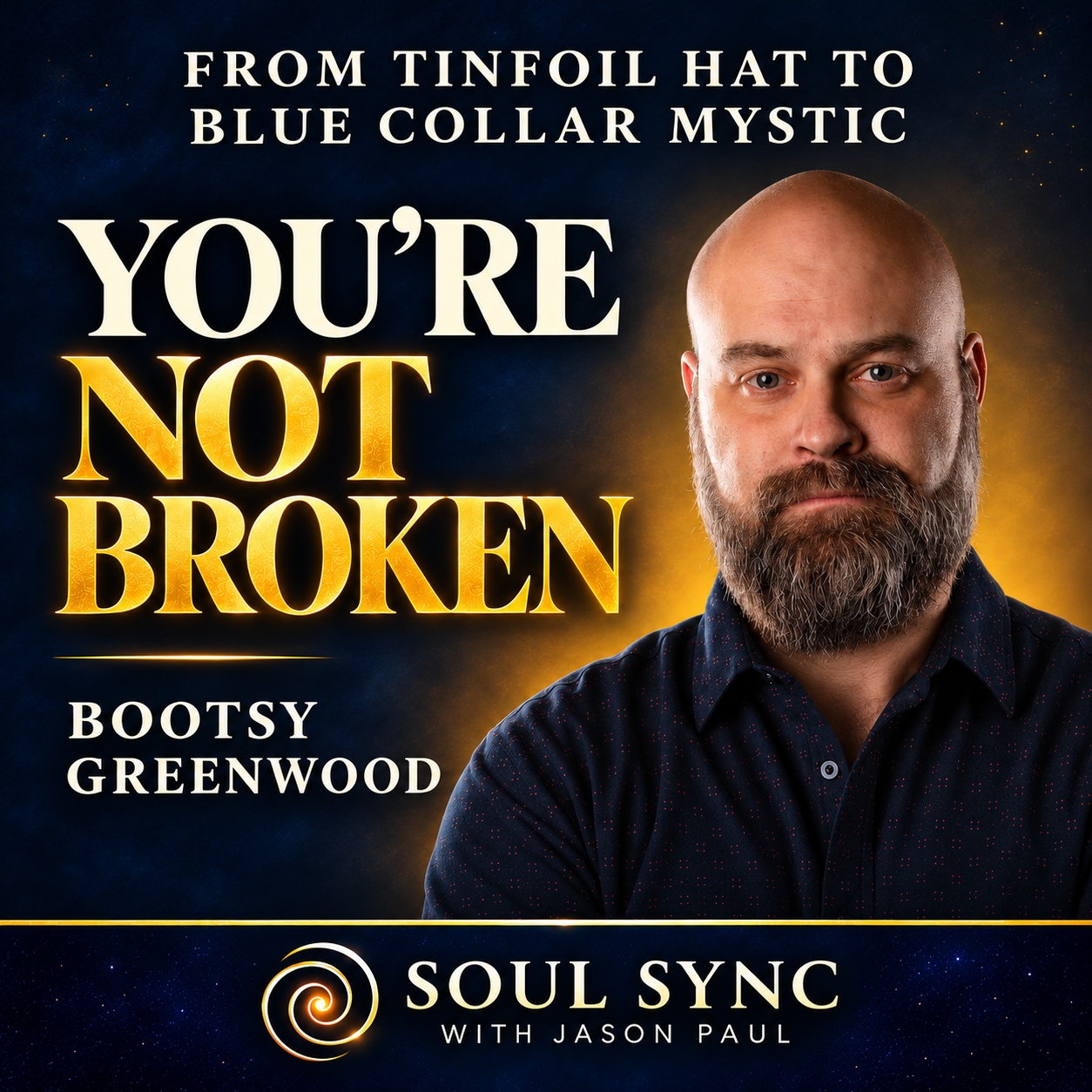
From Tinfoil Hat to Blue Collar Mystic: Why You're Not Broken, with Bootsy Greenwood
Soul Sync with Jason Paul, in conversation with coach, comedian and self-styled Blue Collar Mystic Bootsy Greenwood. Listen below, or read on for the full write-up and transcript.
When I first stepped into the world of mediumship, I nearly walked straight back out of it. Everyone seemed to be love and light, whiter than white, and nobody talked about the hard road that got them there. I'd been told for years how successful I was, yet I didn't feel happy, fulfilled, or like I understood what any of it was for. I didn't think a world like that had room for someone like me.
It was only when I started meeting mediums who talked honestly about their dark nights of the soul, the addictions, the breakdowns, the years of feeling lost, that I thought: oh. Maybe I do belong here.
That's why my conversation with Bootsy Greenwood on Soul Sync landed so deeply with me. Bootsy doesn't dress any of it up. And the message running underneath everything he shared is one I think a lot of people need to hear: struggling doesn't mean you're broken.
What is a dark night of the soul?
The phrase goes back to the 16th-century Spanish mystic St John of the Cross, whose poem and commentary describe the soul passing through darkness on its way to union with God (Wikipedia). Interestingly, he never actually used the exact words "dark night of the soul" himself (America Magazine).
Today we use it more loosely, for a crisis of faith or a long, painful period in life when the old way of seeing things stops working. The ground gives way, and nothing you used to rely on seems to hold.
The important thing St John understood, and Bootsy's story shows so clearly, is that the darkness isn't the end of the story. It's a passage.
Bootsy's story: not one dark night, but several
Back in 2012, Bootsy was living out of a van in Montana with his girlfriend, raft guiding in the summer and ski instructing in the winter. Then he went down the rabbit hole: conspiracy theories, 9/11, the Federal Reserve. By his own admission he was wearing a tinfoil hat "almost literally all the time", and he says he can't blame his girlfriend for leaving.
He moved back to Georgia, into his dad's basement, and kept stacking up information until he was isolated, depressed and, in his words, "victimised" by everything he was consuming. That was the first dark night.
He crawled out slowly through the Tao Te Ching, Eckhart Tolle and the Bhagavad Gita, then worked 50 to 60 hours a week on a tree farm. A second dark night followed, more spiritual this time. By 2016 he was a bartender going through another break-up, drinking heavily, smoking two packs a day and getting high, and still reading self-help book after self-help book.
What I love is that he laughs now about ever thinking there would only be one dark night. There wasn't. There were several, and each one took him deeper into who he really is.
Why you're not broken
The turning point came from a book called Reality Transurfing by the Russian author Vadim Zeland. Its second chapter is about something Zeland calls "pendulums" (Reality Transurfing, Chapter II).
As Bootsy explains it, a pendulum is the collective energy that forms whenever people gather around a shared way of thinking: a political party, a football team, a company culture, or a habit like smoking. Here's the bit that changed everything for him. Whether you're for the thing or violently against it, it's still feeding on your energy.
When he understood that, something switched. He had believed he was broken, a "degenerate" who would never quit smoking. Instead he saw that he had been pulled into an energy that wasn't him. He quit smoking that same year.
You don't have to buy every idea in Zeland's book to take something from that. Sometimes the most freeing thing is realising the pattern you're stuck in isn't who you are.
The mind is a great tool but a terrible leader
One line of Bootsy's has stayed with me ever since we recorded. The mind is amazing at logistics, strategy and detail, but it's a terrible leader, an absolute dictator. The heart needs to be in the driver's seat, with the mind in the passenger seat reading the map.
I know this one from the inside. In my early days running a recruitment business, I'd walk to the office doing affirmations about being the best salesperson in London. Eighteen months later I was so busy trying to control every problem that worry had replaced belief, and the wheels came off. Living from the head kept me anxious. Living from the heart, as I do now, brings flow.
He retired from being a seeker
This one might surprise you. Bootsy says he has "retired from being a seeker", because if you identify as a seeker, what does that imply? That you never find.
For years he was hoarding information, telling himself the next book, course or teacher would be the one. What changed his life wasn't more information. It was the day he decided to throw himself into the fire and actually apply what he'd learned.
Within a few years he'd become a credited film producer, started stand-up comedy, and ended up hosting events on cruise ships, interviewing Peter Gabriel and doing a guitar-pick-throwing contest with Gene Simmons on the KISS Kruise. None of it came from waiting until he felt ready.
The beliefs we hold true
I've had more than one dark night of the soul myself. I won't go into all of them here, but I can honestly say they've shaped me more than any success ever did. The discomfort I've faced is exactly where my biggest growth came from. I don't think I'd have built what I've built, in business or in mediumship, without those nights.
And what they taught me most was to question the beliefs I'd been holding as true.
Some of those beliefs were my own. Plenty were other people's, handed to me and quietly carried for years. I left school and became a pot washer, then a magician, cabin crew, a police officer, a recruiter, and eventually built a multi-million-pound company. At almost every step, someone had a view on who I was and what someone like me could do. If I'd taken those views as fact, I'd never have left the first job.
It's the same thing Bootsy talks about. Before you can know who you really are, it helps to see who you're not, and a lot of who we're not is simply what other people decided about us. As I said to him in the episode, I feel the second half of my life has been about unlearning a good part of what I picked up in the first.
Here's what I've come to understand. If you want to get somewhere in your life, it isn't only a plan or a goal. It's a vibration, a state of being. Bootsy describes it as resetting your nervous system to a new balance point, so the life you want starts to feel like the one you should be living. You don't wait to arrive before you feel it. You embody it first, and you let life catch up.
So it's worth asking yourself: which of the beliefs I'm carrying are actually mine? And which ones are keeping me in a version of my life I've already outgrown?
A balanced word, and where I stand
I always want what I share here to be grounded, so it's worth saying that you don't need to be spiritual to see this pattern. In the mid-1990s, psychologists Richard Tedeschi and Lawrence Calhoun developed the theory of post-traumatic growth: people who go through psychological struggle after adversity can often see positive change afterwards (American Psychological Association). People who experience it often report a new appreciation of life, greater personal strength, new possibilities and spiritual change (APA).
The researchers are careful, and so am I. Tedeschi is clear that trauma isn't good for people and that even those who grow still hurt (UNC Charlotte). Sceptics would also point out that ideas like pendulums and "jumping timelines" aren't science, and Bootsy himself treats them as a practical model rather than proof of anything. That's fair.
But as a medium, I'll say this plainly: I believe there is more to us than our worst chapter, and that spirit walks with us through the dark as well as the light.
Finding your zone of genius
Today Bootsy calls himself a Blue Collar Mystic: someone who takes big spiritual ideas and brings them down to earth. As a coach, the first thing he works on with clients is self-sabotage. Then he moves on to purpose.
He draws on Gay Hendricks' book The Big Leap, which describes an internal thermostat that limits how much success and happiness we allow ourselves, and a "zone of genius" where we do our best work (Readingraphics summary). For Bootsy, his purpose is simply to bring people joy, whether from a stage, a podcast or a coaching session.
His final words to me were these: the world is a mirror and reflects what you project into it. "An actor's job is not to act, it's to audition." Find what that is for your life, appreciate yourself for doing it, and keep growing through the struggle.
If you're in a hard season right now, I hope this conversation reminds you that you're not broken. You might just be in the middle of becoming.
POINTS TO SIT WITH
A dark night isn't a verdict on you. It's a passage. Bootsy had several, and each one took him closer to who he really is.
Notice what's feeding on your energy. Whether you love something or can't stand it, if it takes more than it gives, ask whether it's really you.
Let the heart drive. Your mind is brilliant at reading the map. It just shouldn't be the one steering.
You don't have to be a seeker forever. At some point, the next book matters less than taking one step with what you already know.
Start with who you're not. If "who is the real you?" feels too big, notice what you know isn't you, and let that go first. Many of those things will be beliefs other people placed on you.
Audition for your life. Do the thing that's yours to do, appreciate yourself for doing it, and keep going.
Explore your own path
If this conversation has stirred something in you, come and experiment with me. My free online mediumship development circle runs on Zoom every Tuesday, 6–8pm UK time, and everyone is welcome, wherever you are in the world. If you'd like to build trust in your own intuition, there's The Power of You, my online psychic development class, or my online mediumship development class. You can also book a reading here.
You can find out more about Bootsy, his coaching and his community on Bootsy's website, and follow him on YouTube and Instagram.
Helpful resources
If anything in this conversation, including the talk of addiction and dark times, has touched on something you're living with, please reach out. You don't have to carry it alone.
Samaritans (UK and Ireland): call 116 123, free, any time of day or night.
NHS 111 (England): call 111 and choose the mental health option for urgent help.
988 Suicide & Crisis Lifeline (US): call or text 988.
-
Jason Paul: There's a point some of us reach in our lives where everything we've been holding together just stops holding on. The glue just falls apart. Maybe it's a relationship, maybe it's money or work, or a habit that's been quietly taking over. Maybe it's just waking up one morning and realising you don't recognise your own life anymore.
Rock bottom doesn't always look dramatic from the outside. Sometimes it's very ordinary. You keep turning up and smiling, and inside you're running on empty. Now, my guest today has been there not once, but several times. Bootsy Greenwood was a bartender. He was drunk half the time and stoned the rest. He read self-help book after self-help book, hoping the next one would be the one that fixed him.
It never was. He was collecting answers and changing absolutely nothing, and he's honest that he didn't get one dark night of the soul, he got a few, and he laughs now ever thinking there'd only ever be one. What struck me about talking to Bootsy is that he doesn't dress any of it up at all. He'll tell you the mind is a great tool, but actually a terrible leader.
He'll tell you that the real change didn't come from another book, another teacher, another course. It came when he was so tired of being stuck that he threw himself into the fire anyway. Now, you might be in your life in a really difficult chapter at the moment, and I hope you hear this. Struggling honestly doesn't mean you're broken.
Sometimes it's the very thing that's shaping you, and here's the thing, Bootsy's story gets brilliantly unlikely from there. We literally go from a tinfoil hat in the back of a van and his dad's basement to becoming a credited film producer, doing stand-up comedy on cruise ships all around the world, and crossing paths with Gene Simmons and Peter Gabriel.
Today, Bootsy calls himself the Blue Collar Mystic. He takes big spiritual ideas and brings them back down to Earth where they belong, where real life happens. He explains it all through Mario and the fire flower. Trust me, it works. A quick heads-up, there's some colourful language in this one. I'm Jason Paul.
This is Soul Sync, and here's my conversation with the lovely Bootsy Greenwood.
-
Jason Paul: Bootsy, welcome to the Soul Sync. It's lovely to have you here
Bootsy Greenwood: I'm honoured to be here. Thanks for having me, Jason
Jason Paul: The first thing I want to say is I love your glasses. We were talking about them before we get going, and you're wearing your rose-tinted spectacles today. God knows I've had those on for a long period in my life. Not anymore, not today, but they're beautiful
Bootsy Greenwood: Well, I really appreciate it. It's a great reminder to keep things optimistic and, uh, keep things reframed, as well. So they also serve a couple other purposes. They're keeping my eyes protected from all the blue light everywhere
Jason Paul: There's a lot of it these days, isn't there? Um, you need to do that, otherwise you will not sleep well. So you are a blue-collar mystic, you describe yourself as, and what I loved in your, um, show notes is you take abstract and esoteric ideas and bring them back down to Earth. What is a blue-collar mystic in your mind, Bootsy?
Bootsy Greenwood: It's a great question. Honestly, it's someone who grew up around a bunch of rednecks and meth in West Georgia and thinks that everyone should have the same access to these sometimes lofty spiritual concepts and ideas that get thrown around on YouTube and in many of these cult-type occult books.
Um, so I really think everyone has a connection. I think basically everything we do is spiritual. It's just a matter of understanding how we're connected and really diving into ourself as deeply as we can to really understand who we are, what we're connected to, and how much power we actually have on an individual and collective level.
So I wanna share the information and the knowledge that I've explored through many rabbit holes and make it as approachable and as accessible as is possible.
Jason Paul: You make an interesting point there, and I wanna go back in time in your story in a moment, but I, when you was just saying there about spirituality, about how a lot of it is portrayed, I had this in my mind at the very beginning of being a medium and ex- starting to explore this world. I almost felt that I didn't belong in this world, because it was almost everyone was love and light.
Everyone was walking around whiter than white, and no one would talk about, um, the difficulties, the hard-trodden path they'd had to get there. So I almost felt that I didn't belong, in this kinda world, and it was only when I started coming across, other mediums who talked about addiction, ta- uh, people I came across who'd really had a dark night of the soul that I started to feel, oh, maybe I do belong here.
So on that note, you mentioned that you grew up in Georgia. Take us back to the, the Bootsy, or even I want to say the Owen before Bootsy even became a thing, because your story just looks crazy
-
Bootsy Greenwood: It was. You know, in 2012 I went, uh, I was actually raft guiding, uh, with my girlfriend then at the time. We were living out of a van doing the van life thing. Ski instructing in the winter, uh, raft guiding in the summertime. I was living in Montana right outside of, uh, Yellowstone National Park.
Beautiful place, and just having fun, really enjoying life. And then I started to explore more about reality and more about what was going on. I got into Alex Jones. I got into conspiracy theories and started to, you know, do a lot of research about 9/11 and all of the, the classics, right? Like the Federal Reserve, you know?
And just started looking into philosophy, the allegory of the cave, and I realised that most of my life had been built on a, a pretty false foundation. All, everything that I learned in school, all the institutions that I had gone and taken accreditations from and certificates from and all that was not complete and total bullshit, but, uh, a lot of it was not at all practical or usable.
And I was... I had a lot of contempt for the institutions because I'm like, "Man, these could really be doing a lot of good."
And I saw a big disconnect there.
And in 2012, there weren't quite as many communities as what there are now, so I had very little support. So wound up going through a, a breakup, 'cause I was completely insufferable by that point.
-
I cannot blame my then girlfriend at the time whatsoever. Like, being in those close quarters, living in a van with someone who thinks that, uh, who's wearing a tinfoil hat almost literally all the time is not a place that is, uh, a fun, uh, to be, to experience at all. Um, so we broke up. I moved back to Georgia and basically into my dad's basement literally, and started continuously doing more and more research and stacking up all this information and ruining every holiday gathering with the family, "We gotta buy a farm.
We gotta buy a f- we gotta get off the grid. We gotta get out of the matrix." And, uh, and that's basically the level that I was on there for a couple of years. And then, um, and I just got so deep into that, and so isolated, and so depressed and victimised by all of the information that I was consuming at that point, that at a certain point I was like, "All right.
I gotta do something different here."
And so that's when I started looking into more spiritual texts, the Tao Te Ching, uh, reading, like, The Power of Now by Eckhart Tolle. Um, you know, as- anything that I could find, Buddhism, Hinduism, Bhagavad Gita, anything I could find, uh, I started looking into. And that helped me to begin to crawl out of that space a little bit at a time.
Started looking into old-school self-help, more Tony Robbins, whatever I could find.
And I was piecemealing that stuff together as best I could. Got out of my dad's basement and started to do my, one of my first business venture projects as an entrepreneur, which was working on a tree farm, um, which was hard, back-breaking labour.
I loved being outside, but it was pretty, pretty rough work.
And I was working, 50, 60 hours a week outside in the heat or the cold, as it were. Rain, shine, didn't matter. And, uh, and feeling Pretty exhausted by that. Uh, and so 2014, 2015, I'm living somewhere, you know, in, in a new city. I'm starting to go out, I'm starting to experience things.
I've gotten through that first dark night of the soul, and then, uh, I'm going through another one, which is very spiritually, um, focused and more on my own awakening. And then a couple years into that, I started to... I actually discovered this other book called Reality Transurfing, and that book, for me, was the one that tied the room together, and that put me on a completely different trajectory.
In 2016, I was a bartender. I was tired of the tree farm. I quit doing that. Started just bartending and, uh, went through another breakup around that time and, uh, was drinking a lot. And when I found the Transurfing book it just, it was less spiritual and it was less self-help. There is, there are elements in that book, but it's really more like a model of reality and how it works instead of a self-help book or, like, a rah-rah type of book or, like, a spiritual book like, oh, all the live or connect to God or any of that.
It's essentially devoid of a lot of that type of vernacular, and it's beautifully written, but there's more practicality to it as far as understanding the world through more of a quantum physics lens, the observer effect.
And that made a lot of sense to me, and it was practical, and I could, like, start to take on the ideas of, like, energy and some of these more higher level concepts in a more practical form and actually see how they operated in reality, how they operated in nature, um, and see that through a little bit of a different lens.
So once that happened, I really started to implement those principles. I ran that book like a software in my mind for about now 10 years. I still go back to it. That's the main core of what I teach and what I practise. And, uh, and so that, that was really the way that I started To dig out.
Jason Paul: What's the book called again?
Bootsy Greenwood: Reality Transurfing
Jason Paul: If it, do you know what? When you're ex- explaining that, and you will notice this as we go through this episode, I very much go with what I feel as a medium, it feels to me that, um, because it was devoid of, uh, opinion it feels to me like it was a factual book and almost a, a manual.
And it feels to me that what you'd been searching for all that time prior to then, um, was facts. You wanted to know, um, how things w- really were. It feels to me that you were searching. It feels to me that your soul was wanting answers, and the answers weren't within the life that you was currently living
-
Bootsy Greenwood: That's exactly right. Like, I've retired, I've t- uh, from being a seeker at this point. Like, I think that keeps a lot of us stuck, right? Like, oh, I'm a seeker. If you identify as a seeker, what does that n- what does that imply? That you never find. So I don't feel like I'm a seeker anymore. I'm more understanding, like, hey, like these principles, these are the principles.
It's, this is natural law. This is how the world operates. And as long as I conform to these principles and live my life through these rules so to speak, then at that point, like, things should happen as, as it's outlined in the book. And in my experience, with a little bit of tweaking here and there and some encouragement, some good support, some good environments, some good instruction, coaching, et cetera, then it act- it, it actually really does.
If you've ever heard the concept of, uh, jumping timelines, like, that idea really comes from this book, um, at least in my opinion. I don't know any other book that really talks about that. So people who talk about that on YouTube, like, they're really talking about this book, 'cause he opens up with the idea that, like, infinity is real, right?
And so we all are taught that in, uh, third grade, and they're like, "Okay, cool, now long division." So there's not really like-
Jason Paul: It's almost like you would need the whole school curriculum over five years just to debunk that very subject. It's, you know... So when you talk about jumping timelines what does that mean?
Bootsy Greenwood: Yeah, that's a really good question. So I think there's a, there's a lot of people who, in my opinion, interpret that in some really far out, woo-woo way. But to me, that's not what it means at all.
When I say jumping timelines, really what I ne- mean is resetting your nervous system to a different, uh, balance point so that it feels like the reality that you should be experiencing.
So if we take this idea of infinity, which we completely gloss over, you know, which is incredibly powerful if you s- sit there and try to think about. We can't un- even understand it, but, you know, the old books talk about eternity. There's the Akashic records. There's all these different ideas that basically represent infinity.
And so within this in- infinite world that is ex- existing in the metaphysical or in the mental world or the mind of God or the all or however we wanna label that, there's literally everything already exists already in infinity. So it already exists.
So that put, took a lot of pressure off me as far as being able to change.
I didn't think I could change, but when I understood that, I was like, "Oh, wait. So the version of me that I wanna inhabit, it already exists somewhere." Like, the, the thing that I wanna create, it already exists somewhere, so I basically just need to, like, tune into it and find where it is. Like, as a medium I imagine you probably could, uh, resonate with that a little bit, where it's like
Jason Paul: it's an interesting concept because I'm at a very interesting crossroads right now where I've just stepped away from the sales business that I've been in for, oh, about 15 years in the sales, I'm now in a, um, position where I'm starting mediumship full time. That's what I'm gonna do. I've set on it.
And I know somewhere within, uh, infinity is me standing on a very big stage in a theatre somewhere. But we can understand that, but i-i-it can be very difficult. Even me, I, you know, I'm... I've ran my business for years. You would think and feel that, of course, I know this is my calling 'cause I've had every sign possible that this is what I should be doing, from the spirit world, from this world.
Even then you can get, uh, the ego chip in and say is that really gonna be possible? Are you really on the right path?" So even when you understand that to, you know, to get yourself in that, that vibration and place I'm getting very good now at just saying, "Shut up. Of course, this is meant where I'm meant to be."
But, you know, and I... But it takes time and because it's new, because it's something different, you know, I can find myself in that. You know, when you started to understand this, um, concept, which is such a big concept that it just blows the mind, um, you know, even to think that time isn't a thing and you said every, every version of Bootsy exists somewhere.
Okay if they exist somewhere, then how do you get there and how do you navigate this, and how do you apply this concept to the life that you live?
Bootsy Greenwood: It's a really good question, and, uh, it's a, you know, it's a lot to unpack, but it's a consistent practice, and It's moving through different options as they come up and as they present. It has a lot to do with nervous system regulation. The author uses one word that is Very powerful, and it's just choice.
So instead of materialisation, manifestation, you know, this kind of mumbo jumbo that we hear very often, it's really about choosing and choosing that next action that's in alignment toward that self that you really wanna inhabit and embody and bring into the world So embodiment, understanding it is one thing.
It's like, yeah, of course.
This thing's out there, and of course it is. Absolutely. But then actually physically inhabiting that is, is a process, and it's something that unfolds. Like, I've made a lot of changes. I'm still not where I guess I would wanna be, but if you were to take, Drunken, two packs a day, high all the time, 2016 version of me behind a bar to the version that I inhabit today, there is a massive difference as I continue to choose my way toward the expression that I ultimately want to be in this world.
So it's a process. It's not something that you just like, oh, let me just jump timelines like a genie, you just wiggle your nose, and then all of a sudden you're in a different, like, world altogether. Uh, it's not that at all.
It's The, the model itself is practical, understanding that we all inhabit this one shared dream in the world.
It's not like, oh, you inhabit this other timeline, and then you just, like Elijah, get like, you know, sucked up into heaven or something. It's like, no, we're responsible for the reality or our layer of reality that we're consciously creating, and so is everyone else, and they're all overlapping at all times.
So that means there's quite a bit to navigate, way more than the mind could ever calculate, even though it's an amazing piece of equipment. So it's really about tuning into the heart and understanding what is the next choice? What is that next move? It sounds like that's exactly what you're doing, and I love the vulnerability of it.
I've been going through this and continue to go through this. I just made a huge move. Last year, I sold everything that I had in June and said, "Fuck it, I'm gonna hit the road. This is what I feel like I need to be doing." Spent the whole entire year going to seminars and trainings and shooting videos in nature and in cities and in the middle of crowds and just doing batshit crazy things, and ultimately, those were leading me further and further toward this version that I'm becoming and developing and now I've landed in Austin, Texas.
I expect to be here for quite some time. Really like it here. Um, but, I had no idea what I was doing
Jason Paul: Feels like you don't even in this plan that you've just... I say plan, it feels to me that there isn't necessarily a plan. It feels to me that you're just going with what you feel and trusting and knowing that what you're doing is right and it's where you should be
Bootsy Greenwood: Yeah I think it's both. You know, I think that's really...
the Kybalion is another really profound book that has influenced me a lot. I think a lot of people think I'm saying Kabbalah when I say that. I'm not. I'm saying Kybalion, K-Y-B-A-L-I-O-N. And one of the things that it says is it's got the seven natural law principles in there, and one of the ideas is that every truth is a half-truth.
So having a plan is a, is not a bad thing. I do have a plan, but I'm also flexible in how that plan comes together and what the, the moving parts and ingredients are gonna be as we, you know, move into whatever that is. And I would say that the plan is less this thing on paper that is a box that you check, and more of an experience and a feeling of what it is that I want to, um, to experience in the world.
Like, what is the feeling underneath it? So that to me is a great way to go. If you're like, "Hey, I wanna do this thing." Like, What does that mean? Like, how does that feel in your body? And if you can tune into that, then that means that you're broadcasting that emotion out into the world, into the mirror.
As above, so below, or the world is a mirror and reflects the image that is projected into it. So you're actually putting that into the world and moving toward that emotion. So it may organise in a different form, or, like, the, the material aspect might be a little bit different than maybe what your mind conceptually comes up with.
I think the image is very powerful in the mind. But once we loosen the grip on how it needs to come together, that gives us some flexibility within the plan, and it gives us something that we really truly want to, like, experience in ourselves, and that could come about in some pretty unique and unexpected ways
Jason Paul: It feels to me that what you're describing now is you know where the destination is you want to get to, you know where it is that you want to be, but what you're doing is loosening your grip on the control that we have in our lives where we say, "Oh, this is what it needs to be." And we're in this fight or flight, high-stress situation of trying to control every single aspect of our lives in order to get there.
Because I actually remember back in my early days of when I just started my legal recruitment agency, and it was just me in an office alone, I would sit there, uh, manifesting, uh, i- imagining in my mind, walking in the morning with affirmations, "You are the best salesperson in London. You will make the most deals."
All these things. Then what happened was 18 months down the road, I started to get very stressed about, um, all the problems, all the things that were going on. And then what happened was you start to replace that vibration of gratitude and belief with worry, trying to control. And for me, the wheels literally did come off.
But as soon as my company went up, it came down as volatile as a Bitcoin immediately afterwards. And I feel that w- we try to control our lives in all aspects, but it feels to me what you're describing is having fluidity in, um, not being so hard on yourself at every little component of what it is to get you there, but having an openness of mind of, um, trusting in what will need to come will come.
And that, that creates flow and it creates rhythm, doesn't it? Rather than what we all try and do is control every aspect of our life, which ultimately puts us in our head, not with the way that we feel. So then we start making decisions, uh, where we're just in our head all the time, which then just creates feelings of anxiety, doesn't it?
-
Bootsy Greenwood: It absolutely does. Look, the mind is an amazing piece of equipment.
Love the mind. Incredible. So good at logistics, strategy, how things are gonna come together, details, tedious tasks, but it's a terrible leader. It's an absolute dictator. So we need to lead with our heart, and that needs to be the, in the driver's seat, and then the passenger is the mind reading the map and helping the heart go down that path.
So people say, "Oh, follow your heart," but they don't really give you an operating manual for that. It's just this platitude, right? That we, "Oh, follow your heart." That, that could get you into a lot of trouble without a little bit of help from the mind. But if you understand how to meter and temper and balance those two elements out, which we are, we're heart and mind, or soul and brain, however you wanna look at that, the yin and yang, um, and that's what we're, uh, that's what we're composed of.
So getting those two elements to come into alignment is a big part of the book because at that point you're not, like, trying to just manifest stuff from the universe like it's an Amazon package. You're, like, bringing things into your reality that actually fulfil and fit your soul, your expression, who you are, and they're unique to you, right?
Like, if everyone wanted a Tesla, you know, it's like everyone's trying to get the same thing. That's it's boring. That might not be who you are, right? Like, You might not, uh, y you might like a, a cool obscure '80s T-shirt, like a Pac-Man type of thing. Somebody else might want a polo, you know?
It just fits their soul better, and that's really what the, uh, the idea Is to once you find your true goal, your life becomes a celebration. It's not once you fulfil or once you accomplish the true goal it's just finding it because the heart sings and the mind rubs its hands with glee because it has a cool project to work on.
It's on its mission.
-
Jason Paul: Do you know what? One thing that jumped out at me about your story, and I could really understand this, is when I was in, um, the depths of despair with addiction to cocaine, to cannabis, uh, uh, and all these things you get stuck on this record of repeat, and I'd had many dark nights of the soul, and I completely understand why I fell into these, um, traps of addiction.
For me, it was about self-worth. It was, um, people telling me all the time that I'm successful but not feeling it, not feeling happy, not feeling fulfilled, not feeling that I understood what life was all about. And I felt that I was just on this, uh, conveyor belt, and I thought, "What is the point of life?"
But for you to have gone from that place of searching to go through, um, you know, also having your own battles with, um, addiction, what is it that in that text that made you, after all the things that you'd tried, you, it flicked a switch and it changed your perspective? What... Because even in the concept of what you're describing, to know that the Bootsy who could be all these things existed, you were far from feeling anywhere like that.
What was it that flicked in your s- head so suddenly that enabled you to, to change the way that you'd viewed everything in your life that had been before?
Bootsy Greenwood: Yeah, really good question, and I can answer it in one concept. It's the second chapter of the Reality Transurfing book called Pendulums. And many of us who are in spirituality, we may have heard the idea or concept of egregores or thought forms or, you know, how energy kind of collects or clusters. But the way that this author explained it, it just completely blew my mind, and it h- made me realise that, like, to your self-worth point, there wasn't anything wrong with me.
I wasn't broken, which previously I had thought. I thought there was something wrong with me. I'd never be able to quit smoking. I was just a degenerate fuck-up, and all this.
Like that's the script that was in my head, that I was completely broken and a total victim and that I would never quit smoking.
I quit smoking that very same year as soon as I found out about this concept, and I wanna tell you what makes it different than just like, oh, it's energy forms. Uh, what he says is that when people come together, they start to think in the same way. So there's like this thought stream that's created, and this thought stream is what he calls a, a pendulum.
So energy collects and like attracts like. So people who are of the same ilk or, like, they have the same political beliefs. So a great example of this idea is a political party or a sports team or, uh, a company culture or any- anywhere that people gather and basically conform. So what happens is once we become an adherent to this particular energy, then all of a sudden we take on the characteristics and attributes, and we start to lose our identity over to it, right?
Like, if you can become so obsessed with a football team that you're not even you anymore, right? Like, so you start to become just a husk of who you actually are on the inside because you're basically being pimped. You're repping this, this energy structure. Now, here's the game changer, though, that makes it a pendulum and not, like a thought form or, you know, a, a thought...
uh, an energy current or whatever. And that is that whether you're for the thing or you violently oppose it, you're actually still working on its behalf. So you don't have to be, uh, like, pro this. You could be against it and it's still getting all of your energy. It doesn't care. There's no such thing as bad press because energetically it's just eating and feeding on all your energy that you're giving over to it.
So that, like, comment on the internet, that politician you hate, that sports team that just really gets up your craw or whatever, like, that is actually farming out your attention, and it's stealing your energy out from under you. So the same is true with smoking cigarettes or addiction or any of that kind of stuff.
So as soon as I realised that, I was like, "Fuck, like, this isn't actually who I am." Like, I'm not... I identified, I'm a cigarette smoker. It's like, no, I'm actually not a cigarette smoker. Like, the real me is some w- spirit with, uh, you know, a personality. I believe the heart has its own essence when it comes in.
There is a personality that we each have. And so digging into that and understanding that, but it's not... I'm not broken There's nothing wrong with me. I got sucked into this energy that has basically seduced me. And when I quit smoking cigarettes, as an example, it... I realised how much energy I got back and how much bandwidth in my brain that I got back because those loops of, "Oh, I gotta smoke a cigarette.
I gotta go outside right now. Five minutes
Jason Paul: Oh God, you weigh so much. If I think back to when I, um, was, uh, and I do still enjoy the occasional cigarette. It's something I, you know, need to knock on the head, but I do keep, uh... The problem is you've got to want to quit, and I do now want to quit. I've probably only now got to that stage.
But you it's not easy. It's not easy, these things. But even what you're saying in just that light, that, that moment that you discovered that, being able to just recognise, that in itself is just massive because we don't realise this because if we are in a certain environment and we are a certain way of being, for us to be different involves change.
And are we gonna change within an environment that's familiar, that's known, that's comfortable, that's all these things? That in itself takes, um, a lot of recognition. And even when you was describing, okay, I've understood in this concept of who I want to be, but it sounds like before you can even get to that stage, you need to understand who the true you really is
-
Bootsy Greenwood: Yeah, and I think you unders- need to understand before you know, can really understand who the true you really Is who the true you really isn't. And that's a great place to start because then you start to cut away the things that are really not helping you. And to your point on like, hey, dude, if you can have an occasional cigarette, there's nothing wrong with that.
If we understand what our, uh, relationships are to these pendulums, and then we manage those to where it's like if I'm getting as much energy at least as I'm giving to the thing then that's a good deal, right? Like, that's a, at least it's a wash.
The problem becomes is when it's getting more energy from me than I am getting from it, and then I start to lose energy as a result of it.
And the ultimate thing that we really wanna do is to become our own pendulum because pendulums aren't bad in essence. It's just how nature's structured, right? Like, you can look at an ant colony or a school of fish or a flock of birds. They're all moving in a direction. They're all tapped into whatever that collective mind is, that group think, and they're moving through it.
And human beings, we're no different. We're herd animals a- as a a- as, as we've developed over many m- millions of years or however the fuck long we've been here, I don't know. But we have these, uh, propensities to wanna belong, to be in a group, and very often those get exploited. And if we're not conscious of them and we can't cut the ones away that are not beneficial to us, then we're basically just getting pulled down all these different roads, and then our energy's just being harnessed
Jason Paul: Very interesting because I hadn't necessarily thought about it in that way, but it can be very difficult, and this is one of the things in mediumship we talk about a lot, about being your true self. Who is the real Jason, the real... What is my soul really craving? And I now feel that I live, uh, my life in a way that is in alignment with who I wanna be.
But that can be a really difficult question to ask someone. Who do you wanna be? If you're in a situation where you're going through, um, a dark night of the soul or you've got addiction, um, to ask you who the true you is, that, that's a difficult, um, comprehension to swallow. But by asking what you're not allows you to very quickly, doesn't it, realise that I know I don't want that.
I know that's not me. It allows you to cut those things, to help you to start the process of identifying who you really are, because we get lost. And I think many times in my life where, you know, I've known that I'm this kind of sensitive, a bit theatrical, a bit flamboyant, but different parts of myself had been suppressed.
And if you'd have said to me 10 years ago, um, of the very exposing question of, Jason, who is the real you, I'd have found that very, um, exposing and it would have probably heightened my, um, anxiety and nervous system even more in that question because I wasn't ready to maybe publicly acknowledge who that was because for me, you know, I was suppressing parts of being gay, parts of being, um, sensitive and all these different parts of me.
So I wouldn't of... But if you'd have asked me who I know I'm not I would've been able to much easily answer that question. So it's very interesting, isn't it? So once you decided that you'd become aware of this, um, universal truth of what you could become, how did you start to put the pieces in place to implement that from where your life was to where you wanted to be?
Because to understand this amazing, um, universal truth, but to then start living in alignment with it that's another big step, isn't it?
Bootsy Greenwood: Oh, it is. And there was a lot of trial and error, right? Like, I had to fuck around and find out a lot.
Jason Paul: Yeah.
Bootsy Greenwood: You know? And there was, uh th and fortunately for me, there were things that came into, uh, my awareness, that came into my world that I didn't know about previously, people that were profound mentors to me, you know, groups that I became a part of or even started and initiated myself that helped with this development.
It's something that I think needs to be curated very consciously as, like, how what do you want your world to really be like? How do you want it to feed you? How do you want it to support you?
What are the inputs that you are willing to have in your world? Because once you start to go down this world, it is a world of awareness and staying as aware as possible.
So quitting, you know, smoking a bunch of weed, you know, like, uh, quitting drinking, s- uh, cigarettes, all the other vices and addictions that I was carrying with me helped a tremendous amount to open up that space and really understand who I was. And I'll say too, it's a continuing unfoldment.
It's not something that's just like, "Oh, we're done in one day," right?
Like, it's an infinite game, not a finite one, and it's something where we're constantly learning new things, constantly experiencing new things, new, uh, parts of ourselves, and I think that's part of the beauty of it. Like, it's, it becomes a lifestyle more than it more than, like, some work that you've gotta get done and get, "Let's get the, to the end of the week and f- and fix this and figure it all out."
It's like, "No, this is actually kinda cool, like I'm exploring this," a- and who knows what path it takes you down. There have been people like Steve Pavlina, who are amazing self-help leaders, who got into BDSM, you know? And it,
Jason Paul: Ha
Bootsy Greenwood: ...Maybe- that's the trail that you wind up going down, right? Like, uh last year, what here in Austin when I was visiting, uh, yeah, actually earlier this year, a, a girlfriend of mine was like, "Hey, we're gonna...
Uh, uh, we wanna g- go do this Shibari thing." And I was like, "What's that?" She's like it's where you got tied up by ropes and, uh..."
You know?
And so I go into that, and I'm like, "All right. We're gonna try it out. I know." You know? It's, but it's constantly putting yourself in a position to explore, and that's the fun part.
It's like, as you're discovering who you are and what it is that you really like, there may be things that you think you'll love. I thought I would've loved scuba diving. Hated it. Just felt so claustrophobic, nosebleeds, did not like it at all. Uh, scared to death of sharks, And, but I wound up loving other things like, um, like raft guiding or, uh, hiking or, you know, other activities that I loved.
And so there's definitely trial and error that goes into it, and that is a big part of it. You have to allow yourself to try new things, and the pattern interrupts are huge opportunities for growth and for you to experience more of yourself and see what it is that you like. Going to a... Most people won't even go to a park that's an hour or two away, even though they've wanted to go there for Oh
-
Jason Paul: Oh, we talk ourselves out of things, don't we? We, um, I, which is why I feel Mel Robbins' five-second rule is a great rule to live your life by, and I use that now. If I say I'm gonna go out on my bike, it's like five, four, three, two, one, do it.
Because you won't, you'll talk yourself out of it. Oh, it looks like it's gonna rain, or even are my tyres pumped up enough?
We talk ourselves out of things, and we talk ourselves out of, ooh, is that a good decision? Am I being too out there? Should I really do that? But by having that, that openness, um, you start opening yourself up to opportunity. Because you even went on to the, and it sounds bizarre this, uh, to doing stand-up comedy, which is the ultimate putting yourself out there.
Um, how did that come about? And how... Because I just I actually think I've got potential as a stand-up comic somewhere along the line, 'cause I feel very drawn to it. But that is not for the faint-hearted, is it?
Bootsy Greenwood: It's really not, and that was something that I just tried. A- at the time, I think the first time I did comedy was, yeah, was, I remember exactly what, it was 8/18/2018. So that was
Jason Paul: in all those numbers there, there? Uh the medium in me says that's a sign from the universe, Bootsy, if ever there was
Bootsy Greenwood: For sure. And that was part of the development, and it was something that I tried.
It's not something that to me is, like, front and centre now. I really think that I'm in the pocket and doing what I'm meant to be doing in, more in my coaching practice, but it's still something that I get to do and enjoy, and it's really been developmental as far as a set of skills, public speaking, uh, social pressure, handling, um, you know, shame, humiliation, rejection, those types of things.
Stand-up is a great avenue if you just wanna, you know, punish
Jason Paul: Yeah. You say that you did it to some extent, but I think you're being slightly modest there because you've been touring on cruise ships doing all sorts with the comedy, so it's taken you quite literally round the world
Bootsy Greenwood: No, it really has, and I'm very fortunate for that.
And some of those opportunities were Sh- th- in a way I shouldn't have had those opportunities. They came through a little bit of what I illustrated earlier, just being open to the process.
You know, the traditional trajectory of a stand-up comedian is that you do brutal open mics for 10 years, develop your five minutes, and hopefully get on a late night show, and then all of a sudden everything pops for you.
But what actually happened for me was I felt inspired to send my friend a weird, stupid video one time when I was on set, and he sent me one right back saying, "Hey, man. I've been working with this, uh, company that does cruises and they need hosts for events. And, uh, if you wanna do that and spend the summer in, or the winter, in the Caribbean, you know, let me know.
I think you'd be great for it." And so I sent him a message back and I was like, "Yeah, I'd love to." Got on the call, Sent my resume and all that, all, did all the formality type of stuff.
But then I wound up working for this company called Sixthman who did Impractical Jokers cruise. You know, I got to work with amazing comedians and really see who, um, uh how they operated, right?
Like before it was this very small community of like open micers who were very competitive and really at a place of, uh, frustration and disappointment. But then getting exposed to people who had been successful and were in an abundance mentality was hugely, um, impactful for me. And then I got to do like the guitar pick throwing contest with Gene Simmons on the KISS Kruise.
I got to interview Peter Gabriel. I got to really put myself in a position to grow and learn and experience what it was really like to be a comedian only a couple of years into the practice, just because I followed my intuition and I did the next action, which opened up an opportunity that I, wasn't even on my radar.
-
Jason Paul: You, as you were ta- talking through that, it, you are making me laugh because you have re, uh, invented yourself many times. And I have as well because I started off life as a magician, then I became cabin crew, then I was a police officer, then I was a recruitment consultant, and I was a che- Honestly, I've had so many jobs it's like the film Catch Me If You Can.
And but there's something in that ability to keep, um, changing, to keep, um, reinventing. And a lot of your life now is about coaching people to help them transform, which is beautiful in itself 'cause it's almost like it's you've been there, you've done that, and now you're dedicating your life to helping people to come out of the patterns that, you know, you was once in.
And that must feel very full circle in a sense
Bootsy Greenwood: It is very full circle And yeah, it's something that I have done like you and I love to hear your different iterations. That's so cool. Uh, yeah and I've done it many times. A musician, raft guide, tree farmer, you know, uh prank coordinator, uh, did a lot of production work
Jason Paul: That sounds like half the population's id i- uh ideal job. Um, What's the salary on that one? Where do I apply, Bootsy?
Bootsy Greenwood: Honestly, it was a lot of fun, and I learned a lot of creative problem-solving skills from that.
The logistics alone would be enough to drive someone mad because one thing changes and then you have to change everything. So understanding those the nervous system and the regulation and many of the concepts in the book really helped me through that because It was very challenging at times and very high-stress.
Being in the film industry can be that way.
Um, so yeah I honestly, it is full circle.
That's really well said, and that's why I say, like, I still love comedy, still pursue it. I still get to do it. I'm very lucky and fortunate that I do that. It's mo- it's less of like this is my penultimate, you know, career, and it's more like, hey, this is something that I get to do and enjoy, and I get to make fun skits and sketches with my friends and do improv and fun and be funny on stage when I'm teaching.
And so I feel like it's really been an expansive thing for me. But to your point, yeah, what I really feel like I'm meant to do and am doing is helping people through their own reinventions
Jason Paul: I feel there's so many similarities between us. It's even the same as my mediumship. I often look and think why did I go through all of that, um, horribleness at different points in my life?" And it's like because it, this was the destination. This is where you were meant to be at this point in your life.
And without that, um, you wouldn't be here because you wouldn't have the softness, you wouldn't have the understanding, you wouldn't have the h- humility, the empathy, all these other things. So when you're helping people now, and they're identifying that they want to bring about a change in their life, whatever that might be, and there's an aspect of them wanting to redefine their identity, obviously this, this book worked for you.
That, that was the, the, the penny drop moment. But, you know, everyone is different. We all have a different kind of, uh... You know, for me, I've read some books and gone, "Oh my goodness, that absolutely, um, you know, has made the penny drop for me." But how do you navigate this with people? Because, um, you know, we've all got different histories, we've all got different experiences, and we've all got different beliefs that form, um, you know, how we view ourselves and what we do in terms of our actions.
Bootsy Greenwood: Yeah it's person to person. It's different. You know, this book doesn't land for everybody. Some people don't resonate with it, and that's totally fine. I have friends and clients who are like, "Hey, just help me understand what's going on and walk me through it.
I don't wanna read this 900-page brick, Uh, rather just give me the sauce, uh, shortcut me." And back to being like a blue collar mystic, that's my role is to be like, "Here's what's going on.
Here's how we can use the principles and ideas from this book and actually apply them." 'Cause I wound up putting myself in a situation where I was essentially just hoarding information and just like reading all these books and I thought, "Oh, the next thing.
Oh, the next thing. Oh, the next thing. Oh, once I understand this, once I take this course, once I read this book, and la." And that's back to the idea of really, um, you know, consuming information versus actually having the transformation really applying this stuff. And I find that a lot of people who are seekers or identify as seekers, like that's the loop they find themselves in.
But it's really not until we throw our hat over the fence and we're like, "All right, I'm just gonna do it. I'm just gonna go." Like what is it? There's a saying that I love so much.
It's ready, fire, aim, right? Instead of aim, fire. 'Cause like you're saying, we talk ourselves out of things, right? all resistance comes from the mind.
All hesitation comes from the mind. The heart is like, "I want this thing." And the mind's like, "Yeah, but what about this? And what would this person think? And what if this happens? And what if there's not enough money? And what if this? And what if that?" And if I listen to my mind, I'd still be in my dad's basement.
You know what I'm saying?
I'd still be Mm-hmm contemplating the Federal Reserve and 9/11 and having new theories about it all the time.
You know what? It actually wasn't the government.
It was this other, you know, Secret Service agent," or whatever.
Jason Paul: Drowning in paper, Bootsy with all these case files. 40 files you've got of all these different investigations you're heading up
Bootsy Greenwood: Red twine strings all across the, the map board with different, uh, redacted documents from the CIA. Yeah, like, that's no way to live.
So so what I No. So what I try and do is just take what's practical. And there are lots of other things that I've found to be useful that I personally implement and share, you know, uh, as well.
But this book particularly, I just owe a lot to it because it was really that one that took so many ideas and put them together. And there's no one book that h- explains everything, but as far as it goes, I think this one gets as close as you could ask for. There may be a couple other ones like Thomas Campbell's My Big TOE, which is, for me, a little bit drier, and it's not as much fun to read as Reality Transurfing, but it has the frameworks.
It un- It's, it shows you how the, the theories work, and it shows you about probability and how to choose.
-
Bootsy Greenwood: So there are a lot of different books that you could explore and apply. This one was just the one for me. And, uh, one of my mentors has a great analogy that I think about all the time. She talks about how if someone is looking for a transformation, then think about Mario in the, the old video game, you know, so Mario eats this flower and then all of a sudden can fling fireballs. Now, most people will focus on the flower and sell people the flower.
They'll be like, "All right, the flower is beautiful. It has a green stem. It's got these leaves. It's got white petals, and it's got a red centre, and it's an amazing flower.
And if you eat it, it's delicious, and you can shoot fireballs."
But if you instead focus on, "Hey, I can make you fling fireballs literally at these crazy ducks that are out to get you, and they just die in your wake, and you just will become a freak.
Like you can just run over shit, and it's amazing.
You're gonna love the, this version of
Jason Paul: Sign me up. Sign me up. I want some fireballs
Bootsy Greenwood: Exactly, dude. It's a fireball fest, you know? And then it's like, okay, here's how we're gonna do it. They don't care how. They don't care that it's a flower that you've gotta eat, which sounds a little psychedelic. No. No it
Jason Paul: it's not strange for this show. certainly not strange
Bootsy Greenwood: if they, if you could actually get them the result, then that's really what matters. And back to the idea of like, hey look, we make a plan and we do our best with it, and then we iterate along that plan, there's gonna be moments where it's like, okay, this didn't go according and we need to readjust here, you know?
Everything's constantly iterative and it really is an infinite game, so it's not something where, The work's finally done. I can stop working on myself, right? It's like we're gonna adapt, we're gonna change, and that's the beauty of it, is to continue that exploration and find out where it leads, and that's the f- that's the fun part.
If the, if we knew the end of the mystery already before we got there, then it would be kinda boring, you know?
Jason Paul: It would be bloody boring. It boring. It's like me, I often think with my mediumship and my, um, seeker, uh, to know more, the more I know, the more I don't know. And I feel that if you've got a mindset of feeling that you've arrived somewhere, um, y- you know, you're playing a bit of a dangerous game there.
The universe has a way of tripping you up, and it's a dangerous mentality to fall into because, um, y- that's where you get caught out with things like relapses, falling into old patterns and whatever. And it... And you made an interesting point earlier as well when you said about unlearning. You know, I do think schools have a b- a, you know, a much bigger role to play in really equipping young people with the skills and the knowledge they need in order to, um, live their life.
But I've often said that I feel that the second half of my life is unlearning, you know, a good proportion of what I learned in the first half. And that's, what you're trying to take people through. It's trying to challenge their beliefs and how they view, um, what's possible. Because in this show, and even in my work as a medium, I have seen people and, uh, do the most incredible things from sticking, you know, pennies on a wall with nothing but your mind, right up to someone being able to bend steel and transform, uh, take a, uh, GPS device and make it, um, what's the word I want to use?
Teleport a, a 100 kilometres away. Anything is possible, but the only limitations is that of our mind and it's, and it, and the mind is the, yes, it's to be embraced and yes, it's beautiful, but it can be so unhelpful and it's such a journey of trying to, um, form these, on a scientific way, these new neural pathways to break out of the, the patterns, the beliefs that we have and whatever.
And I guess they, in a way, that must be what you are facilitating
Bootsy Greenwood: It, it really is, and it's different for everybody's gonna have their own unique experience.
That's one of the things that really stood out to me in the book. If we think about infinity and we think about, like, an infinite grid, then everyone's perspective is somewhere u- unique on that grid, right?
Like, no one's having the same experience, though we do have a lot of similar, um, things that we go through, challenges, internal frustrations, overcoming blocks, et cetera. But, like, your goal is different gonna, is gonna be different than my goal, is gonna be different than the next person's goal. And so whatever it is that we're pursuing, there's gonna be a unique pathway for each person based on what it is that they're looking to do.
So it's, th- that's kind of the fun parts, too. It's like there's no, like, there's no, like, static, like, outline type of in-the-box sort of curriculum that really can address this because every single experience is unique of its own.
It's a dream. It's a singular dream of God
Jason Paul: When you're d- looking at a client or when you're looking at taking on someone coaching, how is it you're d- breaking this down to really understand what it is you need to work on that person with? I know it's individual, but is there like common things that you'll look at? Is it what's holding me back?
What's not making me live that, um, et cetera?
-
Bootsy Greenwood: Yeah, there are definitely common, um, common points, common sticking points. The first thing that I dive into is self-sabotage, number one. You gotta understand that mechanism. And as it turns out, that's something that's wired into us. It's really baked in because of how we've developed and evolved over however long we've been here.
We're part of a tribe, and so for us to level up, it puts us in... Like, the nervous system is like, "Uh, threat, danger." Like, we could be kicked out of the herd. We could be asked to leave, and then we've gotta be on our own. We're exiled. Now we've gotta fight a bear with our bare hands. We don't have people around us who, Can help us.
So we sometimes get really nervous. And back to the idea of being a pendulum. When you become a pendulum, that means that there's gonna be people who are for you, and there's gonna be people who are against you, and they're gonna be on both sides. So you're gonna have haters, so you have to learn to be okay with that.
And ultimately, we are in a world where we're far more safe than we were before, but that's really the first thing that I like to tackle with all of my clients. It's like we need to understand this mechanism so we can identify it when it pops up, and we can work our way through it. Because that pressure and that fight or flight survival, uh, comes up, and then the mind takes over.
That's what happens. So it suppresses the heart in that s- fight or flight.
And so if we can start to u- understand that mechanism and deal with it in real time, then we start to actually encourage the pain of growth. And we s- if we can, like, learn to, like, like that, and then put that into our system as, like, "Hey, this is good for us.
We want this type of, uh, uncertainty, this type of discomfort in the system. It's good for me," then we reframe it, and we can grow much more quickly as a result of that. So that's the first thing that I like to work on with people. And then from there, I'm a big fan of purpose. Like- I believe everyone has a purpose.
I believe we all have our own expression at a soul level, and that there is a purpose. And I distinguish that between a role. Like, you have a role in society, but that's not necessarily your purpose. So I'll give an example. Like m- I believe my purpose is, it's a very generalised statement, is to bring people joy.
That's what I believe I'm here to do. That's my m- my reason, my mission on this earth, my reason for being. Now, I can do that from a stage, I can do that on a podcast, I can do that in a coaching container. There's many ways that I can apply that purpose. So the role's distinct from the reason itself or the purpose itself.
And like, your true goal is something, I think, that is just resonant to you. And I've had clients who are like, "Beautify the earth," or, you know, to help people relieve stress or whatever it makes sense for them in their system, something that keeps them motivated and moving. And then at that point we start to distinguish, like, what do you not need to be doing, right?
And what is your true genius? So the true genius is, like, w- the thing that really energises you in the system and keeps you moving in that direction, like your zone of genius is what it's called in the... There's a book called The Big Leap I would strongly recommend anyone to read.
Jason Paul: Oh, you are so good for book recommendations, aren't you? You're like a walking library, Bootsy.
Bootsy Greenwood: You know? Um, but that was unique because he talks about, we have four different zones: a zone of incompetence, the zone of competence, the zone of excellence, and then our zone of genius. So he worked with, like, Bonnie Raitt and other, Musicians and people over time to help them make the leap between the zone of excellence, which in Bonnie Raitt's case, she was, like, a blues club musician.
And then when he started working with her, then she took the leap to become a, a real pop star and creating her own style of music instead of just playing, like, blues stuff in a club for people who are like, "We like the blues."
So that was her making a big leap into her zone of genius and really being creative.
So that's an example of what it's like when you find your zone of genius. Like, for you it's mediumship, right? And so that would be, like, the big domino for you. And usually there's a handful, there's like three or four things, right? It's not just it's an example, right? There's like three or four things that, like, that those are the things that are, like, really moving the needle for you.
And then for that, we take everything that's not moving the needle, and then we try and, uh, get as much of that off your plate as is humanly possible. So that all gets, like, delegated out as much as is humanly possible, and then that way you can focus on what's really driving things forward.
-
Jason Paul: Purpose and passion are so important. If you're not doing something where, um, you're being driven by purpose, it starts to grate on you, and I think so many p- of us can relate to being in that job where we're not really enjoying it. We're doing it to pay the bills, but it's not really serving a purpose.
And I think sometimes people get away with doing stuff like that because what they do is they use that to fund whatever their purpose or their passion is. But if you're not doing that in any way, I think it... You start to get, uh, depleted on energy, and it's... Uh, I've, I run my ener- my life very much by energy now.
I look at my energy as my commodity even in the way I plan my days. Um, and I've had that mentality for a long old time now. But it's fascinating to hear what you do, and I love the way that you take, um, this and make it so clear and down to earth because, um, you know, s- this... A lot of this spirituality s- um, content out there, it's c- sugar-coated.
It tastes lovely. It's like a nice dessert, isn't it? But the journey of growing, the journey of getting to where you wanna be, growth isn't comfortable, and this is, um, you know, one thing that I have spent years and years coaching lawyers with, um, who want to take the next leap or whatever, and even people in my own company, is, um, you know, to grow you need to come out of a comfort zone.
And most of the time the comfort zone isn't actually comfortable. It's just a perceived sense of safety within that zone, isn't it?
Bootsy Greenwood: Exactly. Yeah, and it's your nervous system saying, "Okay, we're okay here, and we wanna survive." So it's not coming from anywhere that's thriving or abundant. It's coming from scarcity and just being okay, and that's not a place where growth happens. You know? It's it's in putting ourselves out there, exposing ourselves to new experiences and pressure.
That's what alchemy is, right? Like, we're changing, we're transforming by putting ourselves in a position To have to grow, to have to take on that nes- next risk or necessary challenge that is in our way. Like they say in the Stoics, right? Like, the obstacle is the way
Jason Paul: Beautiful. Honestly, you have fulfilled your life purpose because you have uplifted me and the listeners today, uh, with your beautiful way of being, and it's so lovely to see you living your, um, life in alignment with what you wanna be doing. So in Soul Sync tradition, leave us on a beautiful final thought today then, Bootsy
Bootsy Greenwood: Wow. That's no pressure at all, huh?
Jason Paul: No pressure at all. No pressure
Bootsy Greenwood: Yeah, I would say i- if I had to put it in one word, I would say the world is a mirror and it reflects what you project into it. So instead of trying to get this stuff out here to cooperate with you and exasperating yourself, think about it from the internal. What is it that you can do today and appreciate yourself for that's gonna help you move that further and further along?
An actor's job is not to act, it's to audition. So find what that is for your life, work on it, appreciate yourself for it, and continue to grow through the struggle and the pain
Jason Paul: Bootsy Greenwood, thank you, my darling. It's been lovely to have you onto The Soul Sync
Bootsy Greenwood: It's been my pleasure. Thank you so much, Jason. I've really enjoyed the conversation, and it is such a pleasure to connect with you